How to Stake Chainlink (LINK) in 2026: Native Pool, stLINK and Exchanges
 October 22, 2026
9 min read

Disclosure: This guide is information, not financial advice. Rates and pool data are as of October 16-17, 2026 and change often. CryptoDEGX has no affiliate relationship with any platform mentioned. See our full disclaimer.
The short version: you can’t stake LINK in Chainlink’s official community pool right now, because it’s full. The practical route in late 2026 is liquid staking through stake.link, which currently pays more than the official pool anyway.
Exchanges are a weak third option. Coinbase and Kraken don’t offer LINK staking at all, and the exchanges that do offer LINK “earn” products paid between 0% and 1% when we checked.
Below is each route, step by step, with the real numbers.
Already in the native pool: stay put if you’re happy with 4.32% and a 28-day exit.
Want zero effort and no wallet: an exchange earn product, but expect around 1% at best.
Want LINK in a brokerage or IRA: a Chainlink ETF, which pays no staking reward yet.
The 4 Ways to Earn on LINK, Compared
| Route | Rate (mid-Oct 2026) | Can you start today? | Getting out | Who holds the LINK |
|---|---|---|---|---|
| Native Chainlink staking | 4.32% | No, pool full | 28-day cooldown + 7-day window | You |
| stake.link (stLINK) | ~4.78% net ✓ | Yes (queue or swap) ✓ | Usually 1 to 7 days, or instant swap | You hold stLINK |
| Exchange earn products | 0 to 1% | Yes | Usually instant | The exchange |
| Spot Chainlink ETFs | 0% (minus 0.34-0.35% fee) | Yes | Market hours | The fund |
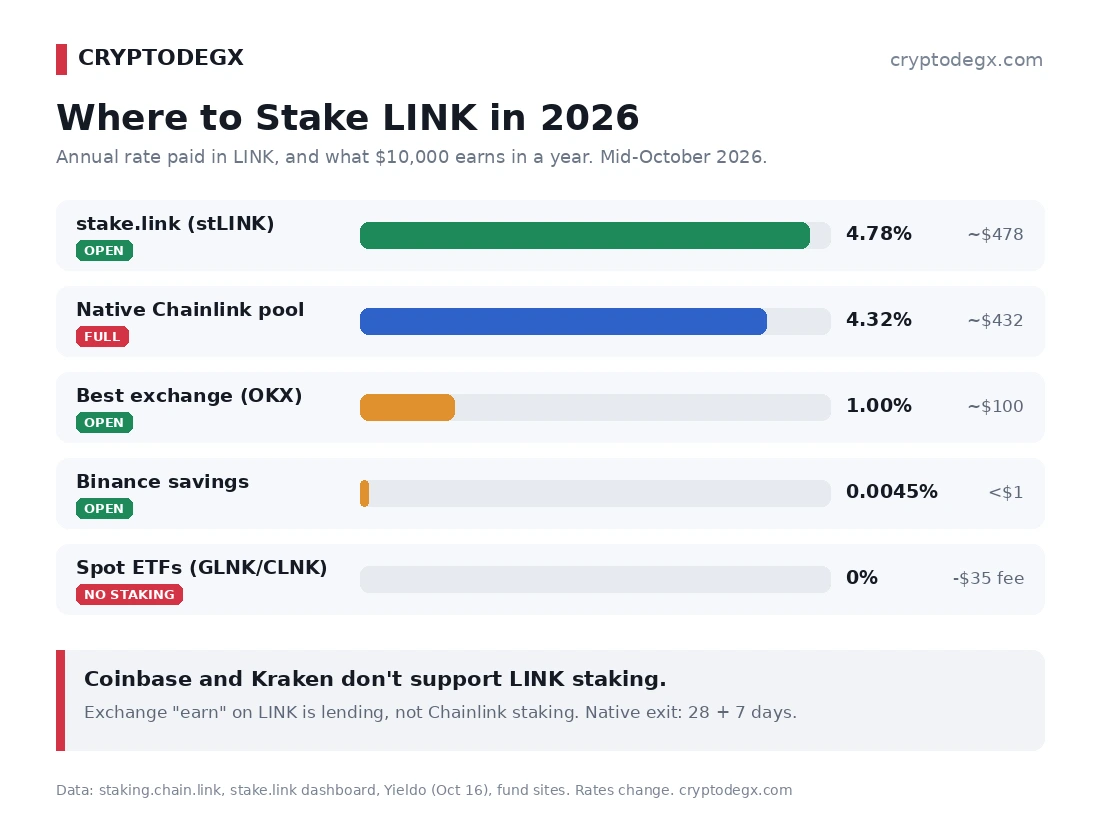
On $10,000 of LINK held for a year at today’s rates, that’s roughly $432 in the native pool, about $478 through stake.link, around $100 at the best exchange product we found, and minus $35 in an ETF.
Rewards are paid in LINK, so the dollar value moves with the LINK price.
Route 1: Native Chainlink Staking (Pool Currently Full)
This is Chainlink’s own staking program, version 0.2, at staking.chain.link. Community stakers can put in between 1 and 15,000 LINK per wallet, and the current variable reward rate is 4.32%, paid in LINK.
The problem is capacity. The community pool is capped at 40,875,000 LINK, and when we checked the contract on October 17 it was sitting right at that cap.
There’s no waiting list. A spot only opens when an existing staker withdraws, and whoever transacts first gets it.
How to stake if a spot opens
- Hold LINK on Ethereum in a self-custodial wallet such as MetaMask (a hardware wallet connected to it is safer), plus some ETH for gas.
- Go to staking.chain.link by typing the address yourself, not by clicking a search ad.
- Connect your wallet and check the pool shows free capacity.
- Enter an amount up to 15,000 LINK and confirm the transaction.
- Rewards start accruing right away.
Rules that catch people out
- The 90-day ramp-up. Rewards are locked at first and become fully claimable over 90 days. Adding more LINK to the same wallet resets that clock for your locked rewards, which is why Chainlink suggests staking extra LINK from a new address.
- Leaving takes 35 days. Unstaking starts a 28-day cooldown, then a 7-day window to withdraw. Miss the window and you start over. You keep earning during the cooldown.
- Early exits can cost rewards. Unstaking before the ramp-up finishes may forfeit part of your locked rewards.
- No slashing for community stakers. Only node operators can be slashed under current rules.
All of these come from Chainlink’s staking FAQ. If you’re already in the pool, there’s little reason to leave, since getting back in is hard.
Route 2: Liquid Staking With stake.link (stLINK)
stake.link is a liquid staking protocol run by 15 Chainlink node operators. It describes itself as the only third-party delegated staking solution in Chainlink’s staking program, built with Chainlink Labs. You deposit LINK and receive stLINK, a token representing your staked LINK plus rewards.
It pays more than the native pool because it stakes across both the community pool and the higher-paying node operator pool. Its LINK pool held 7,208,184 LINK and showed a 4.78% reward rate when we checked its dashboard. stake.link says displayed rates are already net of its fees.
Three ways to get stLINK
- Deposit into the Priority Pool. Deposit any amount of LINK on stake.link. If there’s capacity, you get stLINK at 1:1 immediately. If not, your LINK waits in a queue and is auto-staked as space opens, in batches of about 15,000 LINK.
- Swap on Curve. Trade LINK for stLINK in the stLINK/LINK Curve pool and start earning right away. On October 17, CoinGecko priced stLINK at $12.24 against $12.25 for LINK, a discount of about 0.1%. Our DEX safety rules apply here.
- Migrate from native staking. If you’re already in the community pool, stake.link’s migrate flow converts your unbonded LINK into stLINK after the cooldown.
After you stake
- Rewards arrive automatically. stLINK rebases about every seven days. Your balance grows, and no transaction shows up.
- Use wstLINK for DeFi. Lending markets can’t handle balances that change on their own, so you wrap stLINK into wstLINK, available on Ethereum, Arbitrum, Base and Polygon.
- Getting out. Withdrawals are filled from queued deposits first, so they’re often instant, and stake.link says they usually complete within 1 to 7 days. Or sell stLINK on Curve at the market rate.
What it costs
stake.link takes a share of rewards, not your deposit: 16% from the community pool and 26% from the node operator pool, with no deposit or withdrawal fees. The 4.78% figure is after those cuts. Your only other cost is Ethereum gas.
The trade-off is risk. You add smart-contract risk on top of Chainlink’s, and stLINK can trade below LINK in a sell-off.
If you borrow against wstLINK, a market de-peg can liquidate you even though the redemption value hasn’t changed. Keep any loan well below the limit.
Route 3: Exchanges (Read This Before You Click “Earn”)
“Stake LINK on an exchange” sounds simple, but the options are thinner than most guides suggest. Coinbase’s own LINK page says Chainlink staking isn’t supported, and Kraken lists LINK staking as unavailable.
Where exchanges do offer LINK, it’s usually a flexible savings product. That lends your LINK out instead of staking it in Chainlink. Rates tracked by Yieldo on October 16, 2026:
| Exchange product | Annual rate on LINK |
|---|---|
| OKX Flexible savings | 1% |
| Bybit Flexible savings | 0.7% |
| Bitget Flexible savings | 0.3% |
| Gate.io Flexible savings | 0.12% |
| Binance Flexible savings | 0.0045% |
Even the best of these pays about a fifth of what stake.link does, and the exchange holds your LINK the whole time. Some sites advertise “up to 7%” on LINK. Check whether that’s a short promotional tier capped at a small amount before you move anything.
The one real advantage is effort. If you’ll never touch a wallet, 1% beats 0%. Just weigh it against custody risk, the pattern our exchange red flags guide tracks.
Route 4: Chainlink ETFs (No Staking Yet)
If you want LINK in a brokerage account or IRA, Grayscale’s GLNK and Bitwise’s CLNK hold real LINK. Neither stakes as of October 2026. GLNK can only start once a tax-related “Staking Condition” is met, and CLNK says it may add staking later.
So you pay a 0.34-0.35% fee and earn nothing extra. We compare both in GLNK vs CLNK.
Outside the US, the 21Shares Chainlink ETP does pass through staking yield, but it charges 2.50% a year, which eats most of it.
Is Staking LINK Worth It?
For a long-term holder, yes. 4 to 5% a year in LINK beats leaving it idle.
Be clear about what it is, though. Staking rewards come from Chainlink’s non-circulating token supply, not from network fees. Meanwhile, LINK’s circulating supply grows about 8% a year from scheduled releases, as we break down in our Chainlink max supply guide.
So staking offsets about half of your dilution. It doesn’t beat it. Our staking math guide and staking calculator help you run your own numbers.
Taxes
In the US, the IRS treats staking rewards as income when you gain control over them, under Revenue Ruling 2023-14. How that applies to rebasing tokens like stLINK isn’t spelled out, so keep records of your balance changes and ask a tax professional.
No legitimate site needs your seed phrase, and no one gives away free LINK for connecting a wallet. If unknown tokens show up in your wallet, don’t touch them.
FAQ
Can you still stake Chainlink in 2026?
Yes, but not directly in the official community pool, which is full at 40.875 million LINK. The main working route is liquid staking through stake.link, which queues or swaps your LINK into stLINK. Exchange earn products and ETFs pay less or nothing.
What is the LINK staking APY?
The native v0.2 community pool pays a variable 4.32% in LINK. stake.link showed about 4.78% net of fees in mid-October 2026, because it also stakes in the higher-paying node operator pool. Exchange savings products on LINK paid 0 to 1%.
Is stake.link safe?
It’s run by 15 Chainlink node operators and is the only third-party delegated staking solution in Chainlink’s program. You still take on smart-contract risk and the chance that stLINK trades below LINK in a sell-off. Don’t stake money you can’t afford to have locked or discounted.
Can I stake LINK on Coinbase, Kraken or Hyperliquid?
No. Coinbase says Chainlink staking isn’t supported, Kraken lists LINK staking as unavailable, and Hyperliquid offers LINK trading only. OKX and Bybit offer LINK savings products at around 0.7 to 1%.
How long does it take to unstake LINK?
Native staking needs a 28-day cooldown, then a 7-day window to withdraw. With stake.link, withdrawals usually complete within 1 to 7 days, or instantly if you sell stLINK on Curve.
What is the minimum to stake LINK?
The native pool takes 1 to 15,000 LINK per wallet when space is available. stake.link has no minimum, though Ethereum gas makes very small amounts uneconomical.
What’s the difference between stLINK and wstLINK?
Both represent the same staked LINK. stLINK’s balance grows about every seven days as rewards arrive. wstLINK keeps a fixed balance while each token becomes worth more LINK, which is what DeFi lending markets need.
Do Chainlink ETFs pay staking rewards?
Not as of October 2026. Grayscale’s GLNK and Bitwise’s CLNK hold LINK but don’t stake it, so ETF holders get price exposure only, minus a 0.34-0.35% annual fee.