Does Chainlink Have a Max Supply? LINK Supply and Unlocks Explained
 October 20, 2026
6 min read
Disclosure: This article is information and opinion, not financial advice. Market data and DefiLlama metrics are as of October 17, 2026. See our full disclaimer.
Short answer: Chainlink is a great protocol with a token that hasn’t kept up. Whether LINK is a good investment depends on one thing: whether enterprise fees grow fast enough to outrun the supply unlocks.
By adoption, nothing in Web3 infrastructure comes close. Chainlink secures over $35.7 billion in DeFi value and runs cross-chain messaging across 80+ blockchains.
And yet LINK trades around $12.25. That’s roughly 77% below its 2021 peak of $52.70, and down 29% over the past year.
Below is the math I use to track that gap, plus the numbers that would change my mind.
Why Bulls Are Buying
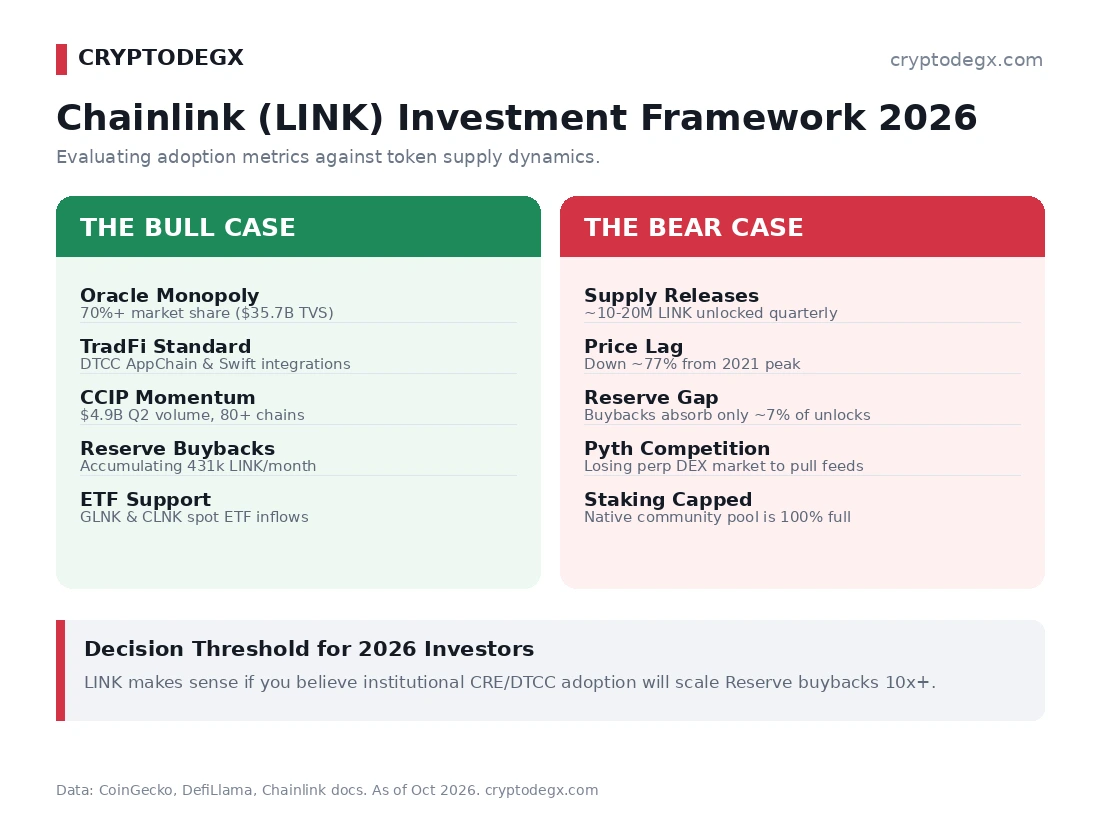
It owns DeFi lending. According to DefiLlama’s oracle rankings, Chainlink secures $35.75 billion across 538 protocols, over 70% of the oracle market. Aave ($17.9B TVL) and Sky (formerly Maker) rely almost entirely on Chainlink price feeds.
TradFi is building on it. DTCC’s Collateral AppChain, expected in Q4 2026, uses the Chainlink Runtime Environment (CRE) to coordinate data and settlement. Swift has also tested Chainlink for tokenized asset transfers.
Swift’s network connects 11,500+ institutions, which is why those pilots matter, though only a fraction of that network is involved today.
CCIP is winning bridge migrations. Chainlink CCIP volume grew 353% year over year to $4.90 billion in Q2 2026. KelpDAO ($1.5B rsETH), Mantle ($2.5B MNT) and Kraken (kBTC) moved to CCIP after competing bridges were exploited.
ETF money is arriving. Grayscale’s GLNK and Bitwise’s CLNK spot ETFs have pulled in over $179 million in net inflows since launching on NYSE Arca. Together they hold about 17.06 million LINK, as covered in our Chainlink ETF guide.
Why the Price Keeps Lagging
Unlocks never stop. As our Chainlink max supply breakdown shows, about 233 million LINK (23.3% of total supply) still sits in non-circulating wallets. Roughly 10 to 20 million LINK gets released each quarter, and big tranches often end up on Binance.
Buybacks are tiny next to that. The Chainlink Reserve buys about 431,900 LINK a month (roughly 100,000 a week, or 1.3 million a quarter) through Payment Abstraction. That offsets somewhere between 6% and 13% of quarterly unlocks, depending on the size of the release.
You can check the weekly purchases yourself on the Chainlink Reserve dashboard. It’s the first number I look at every week.
Pyth is taking the fast markets. Chainlink dominates lending. Perpetual DEXs and Solana apps are a different story, where Pyth’s low-latency pull feeds have won a big share.
Native staking is full. The 40.875 million LINK community staking pool is at capacity, paying a 4.32% variable rate. Retail holders who want yield mostly have to go through liquid staking like stake.link, which adds smart contract risk.
Valuing LINK: The Four Numbers I Watch
P/E doesn’t work for a token like this. These ratios do a better job:
| Metric | Value (Oct 2026) | What it tells you |
|---|---|---|
| Market cap / TVS | 0.26x ($9.45B / $35.75B) | LINK is priced at about 26% of the value its oracles secure |
| Annual supply dilution | ~8.5% | New LINK released from non-circulating wallets |
| Reserve buyback yield | ~0.68% ($65M / $9.45B) | Yearly Reserve purchases relative to market cap |
| Net token inflation | ~7.8% | Dilution minus buybacks |
My takeaway: net supply grows about 7.8% a year. For that to flip negative, revenue flowing through Payment Abstraction needs to grow 10x to 15x.
Until then, the token has to absorb new supply just to stay flat.
What Would LINK Be Worth? Three Scenarios
The “$150 to $500 by 2027” predictions you’ll find in search results aren’t analysis. At $150, LINK’s circulating market cap would be about $115.7 billion, nearly double Solana’s today.
A more grounded way to think about it is to tie price to the value Chainlink secures. The table assumes about 833 million LINK circulating by late 2027 (current supply plus one more year of dilution).
| Scenario | Value secured (TVS) | Market cap / TVS | Implied LINK price |
|---|---|---|---|
| Bear: DeFi shrinks, ETF flows stall | $30B | 0.15x | ~$5.40 |
| Base: steady growth, buybacks inch up | $45B | 0.26x | ~$14 |
| Bull: DTCC goes live, Reserve buying triples | $70B | 0.50x | ~$42 |
The Catalysts I’m Tracking Into 2027
- DTCC Collateral AppChain going live (Q4 2026). The question is whether real 24/7 collateral settlement creates measurable fee conversion into LINK.
- Weekly Reserve purchases. They’re running around 100,000 LINK a week. A sustained move to 300,000+ would be the clearest sign the fee model works.
- SEC approval for ETF staking. If Grayscale or Bitwise can stake the ~17M LINK they hold, that yield flows straight to shareholders.
- CCIP volume above $5B a quarter, sustained over several quarters.
Who LINK Fits, and Who Should Skip It
LINK makes sense if:
- You want long-term exposure to DeFi and tokenization infrastructure
- You can hold for 3 to 5 years through unlock headlines
- You keep it a small position (many investors cap single altcoins at 2% to 5%)
Skip it if:
- You want a quick 10x
- ~8% yearly dilution bothers you
- You prefer tokens with burn mechanics, like ETH
- You can’t sit through a 50%+ drawdown (LINK has done it twice since 2021)
Before buying, read our guides on how to research a crypto project and how much to invest in crypto.
FAQ
Is Chainlink a good investment in 2026?
It can be a reasonable long-term infrastructure holding if you believe DeFi and tokenization keep growing. It secures over $35B in value, but you’re buying into roughly 8% annual dilution until buybacks scale up.
Why is Chainlink’s price down despite high adoption?
Mainly supply. Quarterly releases of 10 to 20 million LINK from non-circulating wallets outweigh Reserve buybacks, and Pyth competes hard in perps.
Can Chainlink reach $100?
At $100, LINK’s circulating market cap would be about $77 billion (and $100 billion fully diluted). That’s possible in a strong bull market, but it would need enterprise fees and buybacks to scale massively.
How does LINK capture value?
Through Payment Abstraction. On-chain dApp fees and off-chain enterprise revenue get converted into LINK, bought on the open market and locked in the Chainlink Reserve.
Is LINK a better investment than ETH?
They’re different bets. ETH has fee burns and broad usage as a settlement layer. LINK is a narrower infrastructure play with higher dilution, so it carries more risk, and more upside if the fee model takes off.
Should I stake LINK?
The native community pool is full, so most people would use liquid staking like stake.link. You earn yield, but you add smart contract risk on top of price risk. Our LINK staking guide covers the options.
Is Chainlink a good long-term hold?
For a 3 to 5 year horizon, the adoption case is strong. The risk is that token holders don’t capture enough of that adoption if enterprise partners keep paying in fiat.
What’s the biggest risk of holding LINK?
Dilution from the ~233 million LINK still locked, competition in high-speed trading data, and enterprise deals that never translate into meaningful buybacks.