Random Tokens Appeared in Your Wallet? Don’t Touch Them. Here’s Why
 August 31, 2026
6 min read
August 31, 2026
6 min read
Disclosure: This article is information and opinion, not financial advice. See our full disclaimer.
You opened your wallet and there’s a token you never bought. Maybe several. Maybe one showing a value of $800, or $17,000, with a weird name, possibly containing a website address.
Two facts before your pulse settles: your wallet has not been hacked, and the tokens sitting there can’t hurt you. Anyone can send anything to any address; that’s how public blockchains work. The danger isn’t the token arriving. It’s what the token is trying to get you to do next.
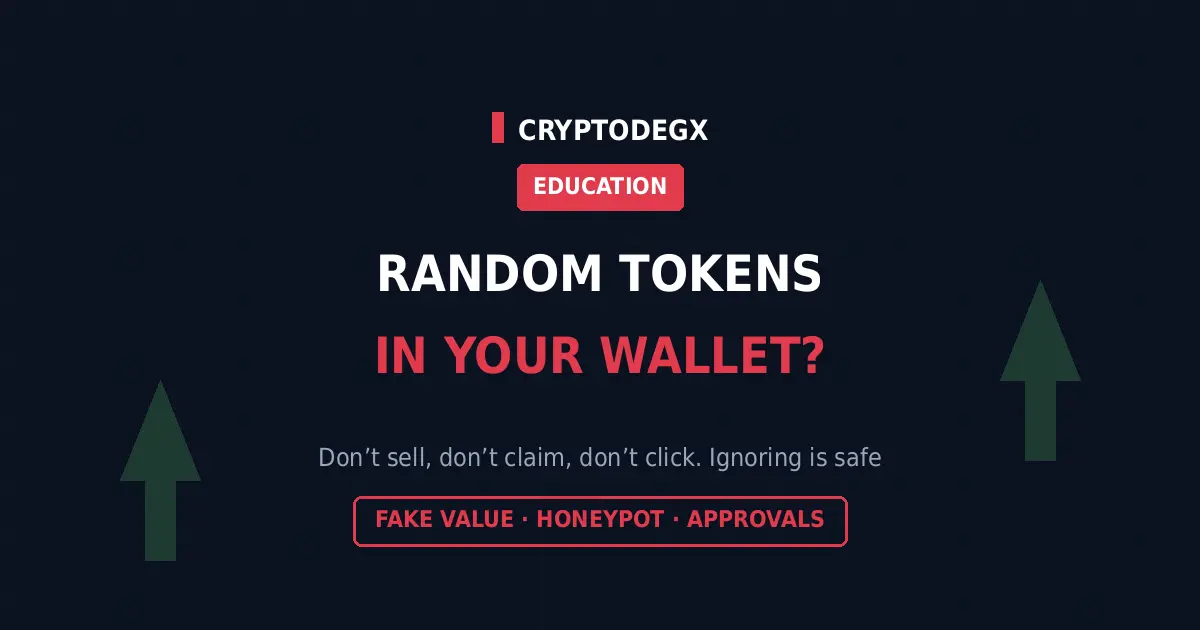
Don’t try to sell it. Don’t swap it. Don’t visit any website written in its name. Don’t sign anything related to it. In your wallet, use Hide token (most wallets have it in the token’s menu) and move on with your life.
The token is bait. The trap only springs if you interact.
What’s actually going on
These are mass-airdropped scam tokens, sprayed to hundreds of thousands of addresses at nearly zero cost. The scammer’s problem: your real coins are protected by your keys, and they can’t touch them. So they deliver something to you, engineered to make you walk into their contract voluntarily.
The fake value is the hook. The scammer creates a token, pairs a few of them against real money in a tiny liquidity pool, and the pool math prints whatever price they choose. Your wallet dutifully multiplies that fake price by your balance and displays “$17,000.” Nobody will ever pay that; the price exists only to make ignoring the token feel expensive.
The three traps, so you recognize each
The claim-site trap. The token’s name is a URL (“Reward at claim-xyz.com”). The site asks you to connect your wallet and sign a transaction to “claim” or “swap” the tokens. That signature isn’t a claim; it’s an approval granting their contract access to your real tokens, which get drained minutes later. Variants skip straight to asking for your seed phrase, which is always, everywhere, theft in progress.
The honeypot. The token shows value and even trades on real DEXs, but its contract is coded so only the scammer can sell. Victims who try to cash out get routed to interfaces that harvest approvals during the attempt. The DEX safety rules exist for exactly this species.
The lookalike dust. Tiny transfers from addresses crafted to resemble yours or your regular contacts, planting decoys in your transaction history for you to copy later. This one isn’t even trying to be sold; it’s address poisoning, and the defense is never copying addresses from history.
What to actually do, in order
Hide the token in your wallet’s interface so it stops tempting you (this only affects display; the token technically stays at your address forever, harmlessly). Don’t burn or “send it away,” which costs gas and touches the contract for no benefit. If your wallet supports spam filtering (most major ones added it during this wave), turn it on. Then treat the event as free confirmation that your address is on spam lists, which every active address eventually is, and which changes nothing about your security.
If you already interacted
You visited the site but signed nothing. You’re fine. Connecting a wallet to view a site reveals your address (already public) and grants nothing. Close it, hide the token, done.
You signed an approval or “claim” transaction. Act now: open a token-approval checker (your wallet’s built-in permissions page, or revoke.cash), find approvals granted to unfamiliar contracts, and revoke them, paying the small gas fee. If anything was already drained, revoking still shuts the door on the rest. Speed matters more than understanding here; revoke first, research after.
You entered your seed phrase somewhere. The wallet is permanently compromised, and revoking won’t help. Create a brand-new wallet with a new seed, and move everything of value to it immediately, most valuable assets first, using the careful-transfer routine at speed. Then retire the old address forever. A hardware wallet for the new setup turns this incident into your last one.
You tried to sell it and the sale failed. Classic honeypot behavior. If you only got a failed transaction, you lost gas and nothing else; check your approvals anyway if the attempt happened on the token’s own website rather than a known DEX.
Common questions
Why did random tokens appear in my wallet?
Scammers mass-airdrop tokens to huge lists of active addresses because sending is permissionless and nearly free. The tokens are bait for approval-harvesting sites, honeypot sale traps, or address-poisoning schemes, and their arrival says nothing about your wallet’s security, only that your address exists on-chain.
Does a random token mean my wallet is hacked?
No. Anyone can send tokens to any address, exactly like anyone can mail you a letter. Hacking requires your seed phrase or a signed approval, neither of which an incoming token provides. Unrequested tokens plus zero interaction equals zero risk.
Should I sell the unknown token if it shows real value?
No. The displayed value comes from a manipulated micro-pool the scammer controls, and the sale path is the trap: honeypot contracts block selling while their “help” interfaces harvest approvals to your real assets. There is no free $17,000; there is a fee-free way to lose your actual balance.
How do I remove spam tokens from my wallet?
Use the Hide token option in your wallet (MetaMask, Trust, Phantom and others all have it) and enable the built-in spam filter if offered. Hiding is display-only and completely safe; actually transferring the token away costs gas, touches the scam contract, and achieves nothing hiding doesn’t.
What is a token approval and why does it matter?
An approval is a signed permission letting a contract move specific tokens from your wallet, normally used by legitimate DEXs to execute your trades. Scam sites disguise unlimited approvals as “claims” or “verifications,” which is why the rule is signing approvals only on platforms you deliberately chose, and auditing them occasionally.
Can I get real airdrops, and how do I tell the difference?
Real airdrops exist but arrive quietly: they never require entering a seed phrase, never demand an approval of your other tokens to “unlock,” and their projects announce distribution through official channels you can verify independently. Anything urging urgent claims through a link embedded in the token itself fails the test by existing.
What is dusting, and should I worry about the tiny amounts?
Dusting sends trace amounts to many addresses either to track activity patterns or to plant lookalike entries in your history for copy-paste theft. It can’t take anything; the defense is sourcing addresses only from recipients directly, never from your transaction history.
I revoked the approvals. Is my wallet safe to keep using?
If you only signed approvals and revoked them, yes, with your remaining assets intact. If your seed phrase was ever entered anywhere, no: the address stays compromised regardless of revocations, and migrating to a fresh wallet is the only real fix.