Chainlink Reserve Explained: How Chainlink Makes Money and Buys Back LINK
 October 19, 2026
5 min read

Disclosure: This article is information and opinion, not financial advice. Reserve statistics and Etherscan balances are as of October 17, 2026. See our full disclaimer.
For years, the big question about Chainlink was simple: if thousands of protocols and banks use its oracles, how does any of that money reach LINK holders?
The Chainlink Reserve is the answer Chainlink launched in August 2025. It takes fee revenue, buys LINK on the open market every week, and holds it.
It now holds about 6.29 million LINK. That sounds like a lot until you set it next to the unlock schedule, which is where most coverage stops and where this article starts getting useful.
How Chainlink Gets Paid: Payment Abstraction
Protocols used to pay node operators directly in LINK. That worked for crypto-native teams. It didn’t work for banks and asset managers, who don’t want to buy a volatile token on an exchange just to pay for a data feed.
Payment Abstraction fixes that by letting clients pay however they want, then doing the LINK conversion behind the scenes:
- Clients pay in what they already hold. Enterprises and dApps can pay in fiat, stablecoins like USDC, or native gas tokens like ETH.
- Fees get converted on-chain. Payment Abstraction routes those non-LINK payments through DEX liquidity pools and buys LINK on the open market.
- The LINK goes to the Reserve. Purchased tokens land in the Reserve contract on Ethereum.
Value recaptured from DeFi liquidations through Smart Value Recapture (SVR) feeds the same flow. At launch, Chainlink Labs said it doesn’t expect any withdrawals from the Reserve for multiple years.
Tracking the Reserve Yourself
Everything happens on Ethereum, so you can check it any time on the official Chainlink Reserve dashboard or straight on Etherscan.
Here’s what the contract showed when we checked it on October 17, 2026:
| Total LINK held | ~6.29 million LINK (~$78 million) |
| Contract address | 0x9a709B7B69EA42D5eeb1ceBC48674C69E1569eC6 |
| Last 30 days | +431,900 LINK (~$5.4 million) |
| Purchase cadence | Weekly, usually on Thursdays |
| Average weekly purchase | ~100,000 LINK |
| Expected withdrawals | None for multiple years |
Recent purchases: 89,200 LINK on October 15, 82,480 on October 8, and 74,703 on October 1. Weekly amounts move around, so the 30-day figure is the better number to track.
Since launch in August 2025, the Reserve has gone from zero to 6.29 million LINK, an average of roughly 450,000 a month.
Is It Enough to Offset Unlocks?
Not yet, and not close.
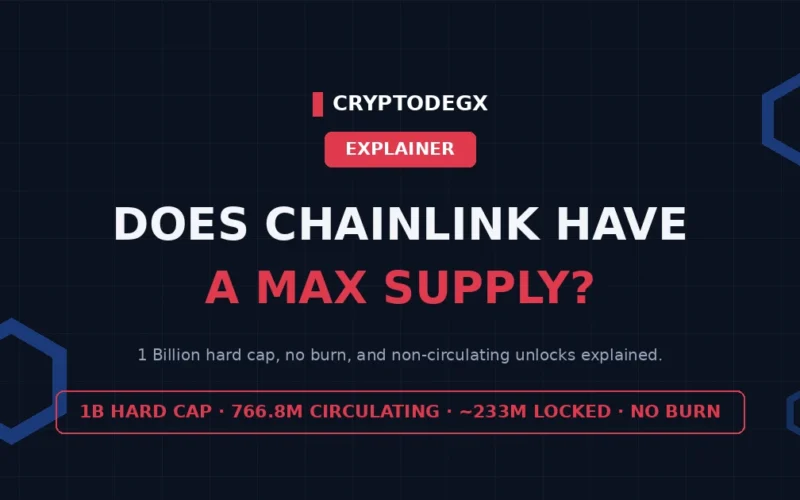
As covered in our Chainlink max supply breakdown, 10 to 20 million LINK enters circulation each quarter from non-circulating wallets. The last two releases were about 19 million in April 2026 and 18.37 million in June 2026.

That doesn’t make the Reserve pointless. It’s the first mechanism that ties LINK demand to actual revenue, and the supply side ends around 2030 when the non-circulating wallets run dry. After that, every Reserve purchase is pure net demand.
The Blind Spot: Off-Chain Enterprise Revenue
On-chain fees are fully visible. Enterprise deals aren’t.
When DTCC or Swift work with Chainlink through the Chainlink Runtime Environment (CRE), contract values and conversion schedules stay private. The only public signal is what arrives in the Reserve each Thursday.
That makes the weekly purchase the single best proxy for whether enterprise adoption is turning into token demand. DTCC’s Collateral AppChain is expected to go live in Q4 2026. If weekly buys move from ~100,000 LINK toward 300,000+ in the months after, that’s the signal. If they stay flat, the enterprise story hasn’t reached the token yet.
The Reserve vs Spot LINK ETFs
The other big holder taking LINK off the market is the pair of US spot ETFs, Grayscale GLNK and Bitwise CLNK.
| Holder | LINK held | Value | Where the demand comes from |
|---|---|---|---|
| Chainlink Reserve | ~6.29M | ~$78M | Network fee revenue |
| Spot LINK ETFs (GLNK + CLNK) | ~17.06M | ~$211M | Investor inflows |
| Combined | ~23.3M | ~$289M | About 3% of circulating supply |
The difference matters. ETF holdings can leave when investors sell. Reserve buying is driven by usage, so it only shrinks if usage does. More on the funds in our Chainlink ETF guide, and on the full bull and bear picture in our Chainlink review.
FAQ
What is the Chainlink Reserve?
An on-chain treasury that converts Chainlink’s fee revenue into LINK through Payment Abstraction, buying on the open market and holding the tokens long-term.
How does Chainlink make money?
From dApps paying for price feeds, VRF randomness, Functions and CCIP cross-chain messaging, plus private enterprise contracts with financial institutions.
What is Payment Abstraction?
A system that lets clients pay in fiat, stablecoins or gas tokens like ETH. Chainlink converts those payments into LINK on DEXs and sends it to the Reserve.
Where can I track the Chainlink Reserve?
On metrics.chain.link/reserve, or by looking up the contract address 0x9a709B7B69EA42D5eeb1ceBC48674C69E1569eC6 on Etherscan.
How much LINK does the Reserve hold?
About 6.29 million LINK (~$78 million) as of October 17, 2026, growing by roughly 431,900 LINK a month.
Does the Reserve burn LINK?
No. It holds the tokens instead of destroying them, so total supply stays at 1 billion LINK.
Can Chainlink withdraw LINK from the Reserve?
Technically yes, since Chainlink controls the contract. Chainlink Labs has said it expects no withdrawals for multiple years, but that’s a commitment, not a code-level lock.
Will the Reserve push LINK’s price up?
Not on its own at the current pace. It buys about 1.3 million LINK a quarter while 10 to 20 million gets unlocked. Its impact grows if enterprise revenue scales or once unlocks end around 2030.