Crypto Staking Calculator – Rewards & Compounding
 August 3, 2026
4 min read
August 3, 2026
4 min read
Crypto Staking Calculator
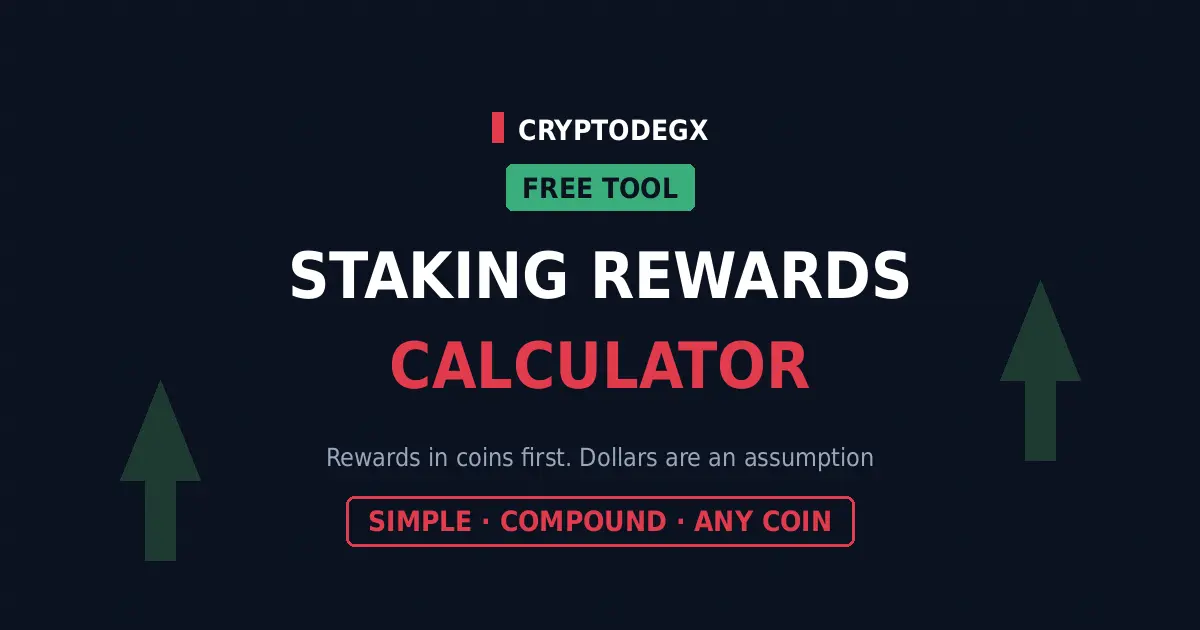
Project staking rewards honestly: in coins first, dollars only if you bring a price assumption.
Assumes a constant APY, which real networks don’t guarantee: staking rates compress as more supply gets staked, and platform fees reduce net yield. Rewards are typically taxable as income when received in many countries. Educational tool, not financial advice.
What this calculator shows, and what it refuses to show
Most staking calculators have a dirty trick built in: they assume a price. Usually a rising one. You enter 10 ETH, and they show you a dollar figure that quietly bundles “staking rewards” with “and the price triples,” so the tool feels like a money printer.
This one works the honest way around. Rewards are calculated in coins, because that’s what staking actually pays you. The dollar fields stay empty until you type a price yourself, and when you do, the tool assumes that price stays flat and tells you exactly what that assumption means.
The math underneath is simple. Simple interest if you withdraw rewards as they come. Monthly compounding if you restake them, which is where the quiet edge lives: at 3% over a decade, restaking earns you meaningfully more than withdrawing, for zero extra risk. Compounding is boring, and boring is the theme of every good habit on this site.
How to pick a realistic APY
The number you enter is the whole result, so choose it honestly. Ethereum’s base rate runs around 2.5 to 3% in mid-2026, compressed from over 4% in 2023 as staked supply passed 30% of all ETH. Solo stakers with MEV capture more, exchange stakers net less after fees. Other networks pay more, and per the pattern we keep documenting, higher staking yields usually come bundled with higher inflation or thinner liquidity. There’s no free lunch hiding in an APY table.
The full mechanics, including where the yield comes from and the risks the banners skip, are in our staking guide. The short rule: use the net rate your actual method pays, not the gross rate on a marketing page.
The two honest caveats
First, no network guarantees its APY. Rates float with participation, so a 10-year projection at today’s rate is a sketch, not a schedule. Second, the denominator problem from the staking guide applies in full: the coins are certain-ish, their dollar value is not, and no calculator changes that. If the asset drops 40%, your 3% yield kept score in a currency that shrank.
Used honestly, though, this answers the question that actually matters for a long-term holder: how much more of the asset will I own for doing nothing but not selling? Pair it with the DCA calculator for the accumulation side, and you’ve got the two halves of the boring strategy that survives every winter. When you’re ready to assess your investments, it’s crucial to calculate crypto profit and loss effectively. This will provide clarity on your performance over time, helping you make informed decisions. Understanding these figures can also highlight the benefits of holding onto your assets during market fluctuations.
FAQ
How are staking rewards calculated?
Base rewards equal your staked amount times the network’s current rate, paid in the staked asset. This calculator uses simple interest if you withdraw rewards, or monthly compounding if you restake them. Real networks pay continuously and rates float with total participation, so treat any projection as an estimate.
Does restaking rewards really make a difference?
Over short periods, barely. Over years, yes: compounding at 3% turns 10 coins into about 10.9 over three years versus 10.9 flat… the gap looks tiny annually and widens with time. Over a decade the compounded balance pulls several percent ahead of simple interest, for no additional risk beyond what staking already carries.
Why doesn’t this calculator predict my profit in dollars?
Because that would require predicting the asset’s price, and no honest tool can. Staking rewards are denominated in the asset. The dollar outcome depends almost entirely on price movement, which dwarfs a 3% yield in either direction. You can enter a price to see values at that flat assumption, clearly labeled as an assumption.
Are staking rewards taxed?
In many countries, yes: rewards are commonly treated as income at their value when received, with capital gains applying later when you sell. Rules vary a lot by jurisdiction, so check your local treatment and track reward dates from the start. Future-you will be grateful.