Chainlink Review 2026: How It Works, LINK Tokenomics, Staking & CCIP
 October 24, 2026
15 min read
Disclosure: This review is information and opinion, not financial advice. Market figures are as of October 17, 2026 and move fast. See our full disclaimer.
Chainlink is the rare crypto project where the business and the token give you two different answers. The network is everywhere: it secures most of DeFi’s price data, moves tokens across 80+ blockchains, and sits inside DTCC and Swift projects. LINK, the token, trades at $12.33, about 77% below its 2021 high.
So this review keeps the two apart. We cover how Chainlink works, what LINK is actually for, the staking pool most people can’t get into, CCIP, and the supply math that most Chainlink reviews skip.
Scheduled releases still add roughly 19 million LINK per quarter, while the Chainlink Reserve buys back about 1.3 million per quarter, and the native staking pool is full. LINK makes sense if you believe enterprise and DeFi fees will flow into the token at a much larger scale. It’s a weaker fit if you want a token that already captures its network’s value today.
| Type | Oracle and cross-chain infrastructure network |
| Token | LINK (ERC-677 on Ethereum) |
| Price (Oct 17, 2026) | $12.33 (live LINK price) |
| Market cap | ~$9.45B, rank #16 |
| Circulating / max supply | 766.8M / 1B LINK |
| All-time high | $52.70 (May 2021) |
| Staking | v0.2, 4.32% variable rate, community pool full |
| Cross-chain | CCIP, 80+ supported chains |
| US spot ETFs | Grayscale GLNK, Bitwise CLNK |
How we did this Chainlink review: we read Chainlink’s documentation and its Q2 2026 quarterly report, checked the staking contract and the Reserve dashboard directly, and pulled market data from CoinGecko on October 17, 2026. Where a number comes from Chainlink itself, we say so.
How Chainlink works (and why “oracle” undersells it)
So how does Chainlink work? Start with the problem. Blockchains can’t see the outside world.
A lending app on Ethereum has no idea what ETH costs unless something writes that price on-chain. For most of DeFi, that something is Chainlink.
The basic design is simple. Independent node operators each pull data from several sources, the network combines their answers into one value, and that value is published on-chain for smart contracts to read. No single operator decides the price.
You can watch this happen. On the ETH/USD feed that Chainlink staking secures, 31 of 31 node operators had responded when we checked the staking dashboard this week.
The ten listed first, including Blockdaemon, Fiews and DexTrac, were all within 16 cents of each other: $2,425.31 to $2,425.47. That tight spread is the product.
Price feeds are only one part of it now. The current stack includes:
- Data Feeds and Data Streams: standard prices for lending, plus low-latency data for perpetual exchanges.
- Proof of Reserve: on-chain checks that a token is backed by what it claims (our proof of reserves explainer covers what this can and can’t prove).
- CCIP: cross-chain messages and token transfers, covered in its own section below.
- VRF, Automation and Functions: randomness, scheduled contract actions and calls to outside APIs.
- CRE (Chainlink Runtime Environment): the orchestration layer banks use to tie all of the above into one workflow. This is what DTCC and Swift are building on.
Bitwise CIO Matt Hougan put it bluntly in a January 2026 memo, calling Chainlink “one of the least understood, most important, and possibly most undervalued crypto assets.” Worth knowing: Bitwise runs a Chainlink ETF, so read that as an informed view from someone with a stake in it.
Adoption in 2026: the numbers
Chainlink reports $110 billion in Total Value Secured as of its Q2 2026 review, split between roughly $60 billion in cross-chain tokens on CCIP and $50 billion in DeFi markets using its data. That’s Chainlink’s own figure.
The independent count is smaller but tells the same story. DefiLlama tracked $39.4 billion secured across 526 protocols on August 26, 2026, against $7.5 billion for Chronicle, the next-largest oracle.
The gap between the two numbers is mostly cross-chain value, which DefiLlama doesn’t count. On either measure, Chainlink is about five times its nearest rival.
The institutional side moved more this year than in any year before it:
- DTCC: its Collateral AppChain will use CRE and Chainlink’s data standard, with go-live expected in Q4 2026, per DTCC’s May announcement.
- Swift: on September 28, 2026, Chainlink said CRE will connect banks to Swift’s blockchain ledger for tokenized deposits. Swift links more than 11,500 institutions in 200+ markets.
- Project Pangea: 50+ banks representing over $10 trillion in assets, working on same-day FX settlement through Chainlink.
- Fidelity International: launched its first tokenized fund, FILQ, with Chainlink publishing its net asset value on-chain.
- Prediction markets: 10 apps adopted Chainlink for resolving outcomes in Q2, a sector we compared in Polymarket vs Kalshi.
Chainlink co-founder Sergey Nazarov called collateral management “the killer app that traditional finance has been waiting for from our industry.” Maybe. But be clear on the status: DTCC’s AppChain isn’t live yet, and several of these are pilots. A partnership is not the same thing as revenue flowing to LINK holders.
LINK tokenomics: the part most reviews skip
The basics first. LINK has a hard cap of 1 billion tokens, with no burn and no new minting. About 766.8 million are circulating.
The other ~233 million sit in what Chainlink calls non-circulating supply wallets, and they come out on a schedule.
That schedule is the important bit. Every quarter or so, 10-20 million LINK leaves those wallets.
In April 2026 it was about 19 million, with 14.37 million sent to Binance. In June, 18.37 million (about $144 million at the time) went to Binance again. Some of each release funds node operators and staking rewards, but much of it reaches the market.
LINK has three jobs that create demand:
- Paying for services, either directly or through Payment Abstraction, which converts fees paid in other tokens or fiat into LINK.
- Staking as collateral that backs oracle performance.
- The Chainlink Reserve, launched in August 2025, which holds LINK bought with on-chain and enterprise revenue. Chainlink says it doesn’t expect any withdrawals from the Reserve for multiple years.
The Reserve is real and growing. Its public dashboard shows a purchase almost every Thursday, such as 82,480 LINK on October 8. After an 89,200 LINK purchase on October 15, it held about 6.29 million LINK, worth roughly $78 million.
At the current pace, circulating supply grows around 9-10% a year, more than double the 4.32% staking rate, and the remaining ~233 million LINK runs out in about three years. Reserve buying would need to grow more than tenfold to fully offset the releases.
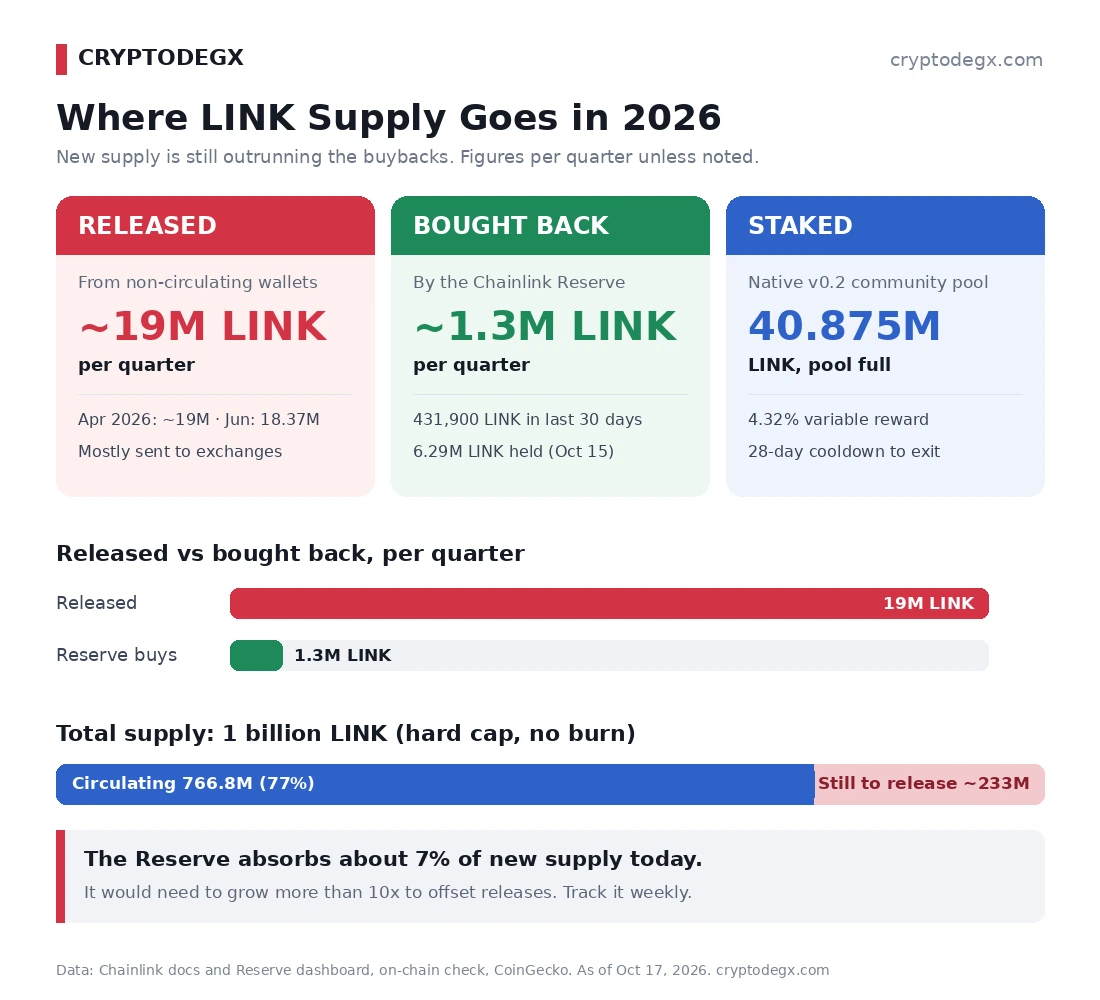
None of this means LINK is broken. It means the token’s story in 2026 depends on whether fee revenue scales faster than supply. You can track that yourself every week on the Reserve page.
Chainlink staking in 2026: 4.32%, if you can get in
Native Chainlink staking runs on version 0.2, launched in late 2023. The protocol is capped at 45 million LINK: 40.875 million for community stakers and the rest for node operators. Here are the rules, from Chainlink’s staking documentation:
| Rule | Community stakers |
|---|---|
| Current reward rate | 4.32% a year, variable, paid in LINK |
| Minimum / maximum | 1 LINK / 15,000 LINK per address |
| Unstaking | 28-day cooldown, then a 7-day claim window |
| Rewards during cooldown | Still accrue until you withdraw |
| Early exit | May lose part of accrued rewards |
| Slashing | None for community stakers (node operators only) |
The catch: the community pool is full. We checked the LINK contract on October 17, and the v0.2 community pool held 40,875,544 LINK against a 40,875,000 cap.
New stakers can only get in when someone else leaves. The staking site itself shows 40,875,000 of 40,875,000 filled.
Slashing is narrow and specific. If the ETH/USD feed goes more than three hours without a valid update, a staker can raise an alert.
Each node operator on that feed loses 700 LINK, and the alerter earns 7,000 LINK. Community stakers carry no slashing risk under current rules.
If the native pool is closed to you, there are two other routes (our LINK staking guide walks through each step):
- Liquid staking through stake.link, run by a group of Chainlink node operators. You get stLINK, which you can trade or use in DeFi, but you add smart-contract risk and protocol fees.
- Exchange earn products on OKX, Bybit and others. Easiest, but they pay little (0-1% on LINK in mid-October 2026), and the exchange holds your LINK. Coinbase and Kraken don’t offer LINK staking at all.
One honest point on yield. That 4.32% comes from token emissions, not from fees, and Chainlink expects emissions to trend toward zero as user fees grow.
With supply growing ~9-10% a year, staking covers less than half of the dilution. Our staking math guide and staking calculator help you run your own numbers.
Nobody legitimate will ask you to connect a wallet to “claim” LINK. Check the address bar, and never sign a transaction you don’t understand.
CCIP: the bigger story in 2026
CCIP (Cross-Chain Interoperability Protocol) moves tokens and messages between blockchains. Token issuers keep control of their token contracts through the Cross-Chain Token standard, and a separate risk-management layer can halt suspicious activity. CCIP 2.0 is now live.
The growth is real. CCIP processed $4.90 billion in Q2 2026, up 353% from a year earlier, and over $7 billion in cross-chain token value moved onto it during that quarter alone. A big reason is bridge hacks: KelpDAO moved $1.5 billion in rsETH to CCIP after its previous bridge provider was exploited.
Other names that switched in Q2 include Kraken for its kBTC and Mantle for $2.5 billion+ in MNT, while Lido published why it chose CCIP as the official cross-chain route for wstETH. Tempo, the payments chain incubated by Stripe and Paradigm, used CCIP to bring Coinbase’s cbBTC onto its network.
On October 8, 2026, Chainlink launched CCIP Vault Adapters. A standard ERC-4626 vault on one chain can now take one-click deposits from users on more than 80 chains, without asking them to bridge first. Aave, Lombard, Veda and Venus are among the named early users.
How CCIP 2.0 verification actually works
CCIP 2.0 went live on September 28, 2026, and the change is less about speed than about who gets to say yes before value moves. The old model leaned on one group: Chainlink’s Committee Verifier, 16 independent, security-reviewed node operators who have to reach consensus on every transfer.
The new piece is the Cross-Chain Verifier, or CCV. An institution can now run its own verifier, or hire one, that must also sign a transaction before it executes. Both the Chainlink committee and any added CCV have to agree, so an extra verifier can tighten security but cannot clear a transfer on its own. Infosys and Nethermind are among the firms named building CCVs for clients.
Why this exists is the interesting part. In April 2026, an attacker pushed a forged message through KelpDAO’s bridge, which ran on a competitor and relied on a single verifier, and walked away with about 116,500 rsETH, roughly $292 million. KelpDAO moved its rsETH to CCIP and later sued the bridge provider. CCIP 2.0’s additive model is a direct answer to that failure: no single sign-off, and institutions can bolt on their own compliance checks, like requiring extra approval on any transfer above a set size.
One correction worth making to older descriptions of CCIP: the automated offchain Risk Management Network is no longer active in current deployments. An onchain Risk Management contract remains for emergency controls, and rate limits cap how much value can leave a route in a set period.
The market’s reaction to all this adoption was telling. LINK fell about 5% on the Vault Adapters launch day, to around $12.62. Adoption headlines and token price are only loosely connected, which brings us back to value capture.
Chainlink vs Pyth and the other oracles
| Oracle | Model | Where it’s strongest |
|---|---|---|
| Chainlink | Independent node networks, broad product stack | Lending markets, cross-chain, banks ✓ |
| Pyth | First-party data from trading firms, pulled on demand | Perpetuals, Solana, fast-moving prices |
| Chronicle | Oracle that grew out of MakerDAO (now Sky) | Sky ecosystem collateral |
| RedStone | Modular feeds, quick to add new assets | Long-tail and liquid-staking collateral |
Competition is real, especially in perpetuals, where Pyth’s publisher model (Jane Street and Cboe are among its data sources) fits well. But in lending, Chainlink is still the default: research firm Castle Labs found in October 2025 that every major money market it reviewed used Chainlink price feeds. And no rival has anything like CRE or the bank integrations yet.
CCIP vs LayerZero, Wormhole and Axelar
CCIP competes in a second market that has nothing to do with price data: moving tokens and messages between chains. The four main players took different bets, and after 2026’s big bridge failure, the differences in how each verifies a message stopped being academic.
| Protocol | Verification model | Best known for |
|---|---|---|
| Chainlink CCIP | 16-node Committee Verifier + optional stacked CCVs | Banks, tokenized assets, compliance ✓ |
| LayerZero | App chooses its own verifier set (can be a single one) | Raw volume, widest chain coverage |
| Wormhole | Fixed Guardian network, 13-of-19 signatures | Tokenized funds |
| Axelar | Proof-of-stake validator chain, slashing | Cosmos-to-EVM routes |
The honest read: LayerZero still leads on sheer volume and the number of chains it reaches, Wormhole owns the tokenized-fund niche, and Axelar is the default for Cosmos. CCIP’s edge is not speed or cost, where it tends to be the pricier option, but its security model and its banking pipeline. The trade-off is real. CCIP’s multi-layer verification adds latency and cost in exchange for redundancy, and for institutions moving large sums, that is exactly the trade they want.
The flows in 2026 followed that logic. After the single-verifier exploit, large holders moved toward designs with more redundancy, which is how CCIP picked up names like KelpDAO, Kraken and Mantle in a single quarter. Whether that flight-to-safety holds when memories fade is the open question.
The risks
Value capture. This is the main risk. The Motley Fool’s Leo Sun put it well in June: “LINK could still fail even if Chainlink’s network expands,” because big partners may prefer to pay in stablecoins or fiat.
Payment Abstraction converts some of that into LINK, but enterprise revenue isn’t publicly audited, so outsiders can’t see how much.
Supply. About 233 million LINK is still to come, and releases have regularly ended up on Binance. Until Reserve purchases grow, that’s steady selling pressure.
Control. Chainlink Labs and its partners drive development, protocol upgrades and the non-circulating wallets. That’s efficient, but it’s less decentralized than the word “network” suggests.
Price history. LINK is down about 77% from its $52.70 peak and roughly 29% over the past year, even as usage grew. Size any position for that kind of drawdown; our guide on how much to invest in crypto starts from the loss you can afford.
Who LINK is for, who it isn’t
Consider LINK if
- You want exposure to tokenization and DeFi infrastructure, not a single chain
- You believe bank and DeFi fees will flow into the Reserve at scale
- You can hold through 70%+ drawdowns
- You’re fine with liquid staking if the native pool stays full
Skip it if
- You want a token that already captures its network’s revenue
- Scheduled supply releases bother you
- You need guaranteed staking access today
- You’re buying on partnership headlines alone
- Your time horizon is under a year
How to buy and hold LINK
LINK trades on nearly every major exchange. In the US, you can also buy it in a brokerage account through Grayscale’s GLNK or Bitwise’s CLNK spot ETFs (we compare them in GLNK vs CLNK), which had pulled in about $180 million in combined net inflows by mid-October. Our staking ETFs explainer covers how these funds work.
If you buy on an exchange and plan to hold, move it to a wallet you control. Our guides on withdrawing to a wallet and setting up a hardware wallet walk through it. And before buying any token, run it through our project research checklist.
What to actually watch from here
The whole Chainlink question comes down to one thing: does usage turn into LINK demand faster than new supply arrives? You do not need a price prediction to track that. You need four numbers, and all four are public.
| Watch this | Where | What it tells you |
|---|---|---|
| Weekly Reserve purchases | Reserve dashboard | Whether fee-funded buying is growing toward the ~19M quarterly releases |
| Quarterly token releases | Chainlink’s non-circulating wallets | How fast previously locked LINK is hitting the market |
| DTCC Collateral AppChain | DTCC / Chainlink announcements | Whether the flagship bank project actually goes live in Q4 2026 |
| CCIP fees, not just volume | Chainlink quarterly reports | Whether cross-chain usage is being monetized, not just measured |
The trap to avoid is treating integration headlines as token demand. A bank completing a pilot, a protocol adding a data feed, a partnership press release: none of these put money into LINK by themselves. The money only reaches the token through fees, Payment Abstraction, staking, or the Reserve. Track those flows, ignore the logos, and you’ll understand LINK better than most of the people posting about it.
Our take
Chainlink has won the infrastructure argument for now. DeFi runs on it, CCIP is pulling in assets after other bridges failed, and the biggest names in traditional finance are building on CRE. LINK hasn’t won its own argument yet.
Two numbers will settle it. Watch the weekly Reserve purchases against the quarterly releases, and watch whether DTCC’s Collateral AppChain actually goes live in Q4 2026.
If both move the right way, the current price will look cheap in hindsight. If not, LINK stays a great network with an average token.
FAQ
Is Chainlink a good investment in 2026?
It depends on what you’re betting on. Chainlink leads its market with $110 billion in reported value secured and deals with DTCC and Swift, but LINK supply still grows about 9-10% a year from scheduled releases. It suits long-term holders who believe fee revenue will grow into the token, not short-term traders.
How does Chainlink make money?
Chainlink earns fees from protocols using its data, cross-chain and compute services, plus off-chain contracts with enterprises. Through Payment Abstraction, part of that revenue is converted into LINK and stored in the Chainlink Reserve, which held about 6.29 million LINK in mid-October 2026.
Does Chainlink have a max supply or a burn?
LINK has a fixed maximum supply of 1 billion tokens and no burn mechanism. About 766.8 million are circulating; the rest is released from non-circulating wallets, usually 10-20 million LINK every quarter.
Can you still stake LINK?
The native v0.2 community pool is full at 40.875 million LINK, so new stakers can only enter when space opens up. Liquid staking through stake.link (stLINK) is the main alternative, at about 4.8% net of fees in mid-October 2026. Exchange savings products pay far less, and Coinbase and Kraken don’t support LINK staking.
What is the Chainlink staking APY?
The current v0.2 community rate is 4.32% a year, paid in LINK. It’s variable and funded by token emissions, and unstaking requires a 28-day cooldown followed by a 7-day claim window.
What is Chainlink CCIP?
CCIP is Chainlink’s Cross-Chain Interoperability Protocol for moving tokens and messages between blockchains. It supports 80+ chains, processed $4.90 billion in Q2 2026, and is used by Lido, Kraken, Mantle and Aave, among others. The current version, CCIP 2.0, adds optional institution-run verifiers on top of Chainlink’s 16-operator committee.
Chainlink vs Pyth: which is better?
They’re built for different jobs. Chainlink dominates lending markets, cross-chain transfers and bank integrations; Pyth is strong in perpetuals and fast price updates using data from trading firms. On secured value, Chainlink is several times larger.
Is there a Chainlink ETF?
Yes. In the US, Grayscale’s GLNK and Bitwise’s CLNK hold spot LINK, with combined net inflows of about $180 million by mid-October 2026. They let you hold LINK in a regular brokerage account.