Keystone 3 Pro Review (2026): The Best Air-Gapped Wallet Under $150?
 October 23, 2026
8 min read
Disclosure: This review is information and opinion, not financial or investment advice. Device specifications and pricing are as of October 2026 and change. See our full disclaimer.
Ever since Ledger drew fierce backlash for its optional seed-recovery service in 2023, the hardware wallet market has shifted toward two non-negotiables: open-source code and air-gapped isolation.
The Keystone 3 Pro ($149) is built squarely around both. Made by Keystone, the company formerly known as Cobo Vault, it drops Bluetooth, Wi-Fi, and USB data entirely in favor of a 4-inch color touchscreen, a rear camera, a fingerprint sensor, and three separate Secure Element chips. You sign every transaction by scanning animated QR codes between the device and your phone or laptop.
Here is the honest read on the Keystone 3 Pro across Bitcoin (PSBT and Taproot), Ethereum (MetaMask and Rabby), and Solana (Backpack and Phantom), including the physical trade-offs worth knowing before you buy.
Key specifications at a glance
| Retail price | $149 USD (bundles available) |
| Display | 4.0-inch color touchscreen (480 x 800) |
| Security chips | Three EAL5+, PCI-grade Secure Elements (Microchip ATECC608B, Maxim DS28S60, Maxim MAX32520) |
| Connectivity | Fully air-gapped: QR code + microSD. No Bluetooth, Wi-Fi, or NFC. USB-C charging only |
| Authentication | Fingerprint sensor + PIN, optional passphrase |
| Backup | Standard BIP-39 seed, plus passphrase (hidden wallet) and Shamir backup support |
| Code transparency | Open-source firmware and hardware schematics on GitHub (MCU and SE firmware proprietary) |
| Battery | 1,000 mAh Li-ion, rechargeable via USB-C |
| Weight & size | ~103 g, 103.9 x 62.5 x 12.9 mm |
| Anti-tamper | PCI-level self-destruct circuit wipes keys on physical intrusion |
What is air-gapped signing, and how does QR work?
An air-gapped wallet never connects directly to the internet, a computer, or a phone. No Bluetooth radio, no Wi-Fi chip, no NFC. Even the USB-C port on the Keystone 3 Pro is wired for power only; data lines never carry your private keys.
Instead, the device communicates through animated QR codes:
- Initiate: you build a transaction in your software wallet (say Rabby or Backpack) on your phone or laptop.
- Scan request: the software wallet shows a QR code with the unsigned transaction.
- Verify and sign: you scan it with the Keystone’s rear camera, review the details on the 4-inch screen, and approve with a fingerprint.
- Broadcast: the Keystone signs offline and shows an animated QR code; your phone scans it back and broadcasts the signed transaction.
Because no data line ever connects your computer to your keys, malware or a malicious browser extension on your laptop cannot reach your funds. The trade-off is a scan step on both ends of every transaction, which is the friction you accept for the isolation.
Three Secure Elements and a self-destruct circuit
Most hardware wallets (the Trezor Safe 5, the Ledger Nano S Plus) use a single Secure Element. Keystone built the 3 Pro around three independent ones from different vendors: the Microchip ATECC608B, the Maxim DS28S60, and the Maxim MAX32520, all EAL5+ and PCI-grade.
The logic is redundancy: splitting key generation, storage, and authentication across three chips means no single compromised component exposes your seed. It is a genuinely unusual design at this price, and one of the clearest reasons to pick the 3 Pro over a single-chip rival.
Passphrases, hidden wallets, and Shamir backup
Beyond the standard seed, the Keystone 3 Pro supports two features that serious holders actually use. Passphrase (hidden wallet) support lets you add a secret word on top of your seed to create a separate, deniable wallet, useful if you are ever forced to unlock the device under duress, since the attacker only sees the decoy. And Shamir backup splits your recovery into multiple shares, so no single piece of paper can restore the wallet alone.
If you have seen claims that the 3 Pro stores “three full seed phrases,” treat that loosely: the real features are the standard seed plus passphrase-derived hidden wallets and Shamir sharing, which cover the same practical goals (separation and duress protection) more accurately than a simple “three seeds” headline.
Software and companion app compatibility
Keystone does not ship a heavy proprietary desktop suite like Ledger Live or Trezor Suite. It acts as an open hardware standard that pairs into leading Web3 wallets by QR. Pairing took under a minute across the major ones in practice:
| Ecosystem | Recommended companion wallet | QR connection |
|---|---|---|
| Ethereum & EVM (Base, Arbitrum, Polygon) | Rabby / MetaMask | Excellent ✓ |
| Solana | Backpack / Phantom / Solflare | Excellent ✓ |
| Bitcoin (Taproot, PSBT, Native SegWit) | Sparrow / BlueWallet | Excellent (full PSBT) ✓ |
| Cosmos & IBC | Keplr | Good |
| Multisig | Sparrow / Electrum | Supported |
The upside of the big screen shows here: reviewing a complex smart-contract approval (a Uniswap swap, an NFT listing, a DeFi lending interaction) is far clearer on a 4-inch display than on the sub-2-inch screens of most rivals, which cuts the risk of blind-signing something you did not mean to.
Keystone 3 Pro vs the alternatives
How it stacks up against other air-gapped and premium wallets in 2026:
| Feature | Keystone 3 Pro | SafePal S1 | Trezor Safe 5 |
|---|---|---|---|
| Price | $149 | ~$50 | ~$169 |
| Screen | 4.0″ color touchscreen ✓ | 1.3″ small screen | 1.54″ color touchscreen |
| Air-gapped QR | Yes (QR + microSD) ✓ | Yes (QR) | No (USB-C) |
| Secure elements | Three (EAL5+) ✓ | One | One (EAL6+) |
| Biometrics | Fingerprint ✓ | None | None |
| Firmware | Open source (app layer) | Partly closed | Fully open source ✓ |
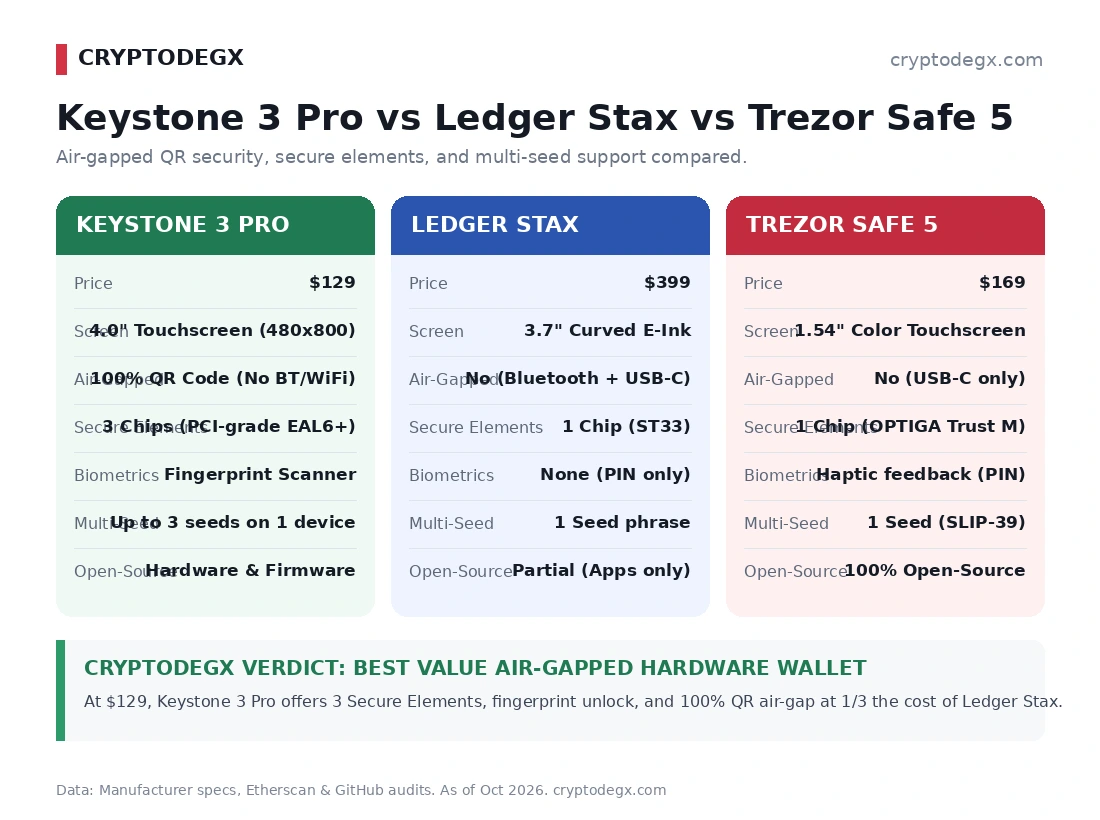
The honest framing: SafePal undercuts it hugely on price but with a cramped screen and a single chip; the Trezor Safe 5 matches it on polish and fully open firmware but is not air-gapped and has a far smaller screen. The Keystone’s niche is the air-gap-plus-big-screen combination, which nothing else at $149 delivers.
The honest catches
What works well
- True air gap: no Bluetooth, Wi-Fi, or USB data path to the keys
- Fingerprint unlock skips repeated PIN entry
- 4-inch screen makes contract approvals genuinely readable
- Three Secure Elements, a rarity at this price
- Passphrase hidden wallets and Shamir backup built in
The weaknesses
- Palm-sized, not a slim keychain device
- No polished first-party desktop suite; relies on Rabby, Sparrow, etc.
- QR scanning adds a step to every transaction
- Sealed battery needs occasional charging even in storage
- Camera scanning wants decent lighting
Who it’s for, who should skip it
Before moving funds to any hardware wallet, run through our guides on setting one up safely, withdrawing crypto from exchanges, and avoiding seed phrase restoration errors.
FAQ
How much does the Keystone 3 Pro cost?
The Keystone 3 Pro is priced at $149 on the official product page as of October 2026, with discounted bundle packs available. Earlier promotions listed it closer to $129, so the exact figure can shift with sales, but $149 is the standard 2026 price.
Is the Keystone 3 Pro fully air-gapped?
Yes. It has no Bluetooth, Wi-Fi, or NFC, and the USB-C port is used only for charging and offline firmware updates. All transaction data moves in and out through camera-scanned QR codes or a microSD card, so private keys never touch a network connection.
How many Secure Elements does it have?
Three independent EAL5+, PCI-grade Secure Element chips (Microchip ATECC608B, Maxim DS28S60, and Maxim MAX32520), which split key generation, storage, and authentication for redundancy. Most wallets at this price use a single chip, so the triple-element design is a genuine differentiator.
Can the Keystone 3 Pro be hacked through USB-C?
No. The USB-C port is wired for power and offline firmware updates only; the data lines that would carry private keys are not connected for transmission. Combined with the air gap, there is no wired path for malware to reach your keys.
Does it support multiple wallets or hidden wallets?
Yes, through passphrase support, which derives a separate hidden wallet from your seed plus a secret word, useful as a duress or decoy wallet. It also supports Shamir backup for splitting your recovery into multiple shares. This covers separation and duress protection more precisely than the sometimes-repeated “stores three seeds” claim.
Does the Keystone 3 Pro support Bitcoin PSBT and Taproot?
Yes. It natively supports Partially Signed Bitcoin Transactions (PSBT), Taproot, Native SegWit, and multisig setups when paired with wallets like Sparrow or Electrum, which makes it a strong Bitcoin option as well as a multi-chain one.
What happens if I lose the device?
Your funds stay safe on the blockchain. As long as you backed up your BIP-39 recovery seed (and any passphrase or Shamir shares), you restore the wallet on a new Keystone 3 Pro or any compatible BIP-39 hardware or software wallet.
Is the Keystone 3 Pro open source?
The application firmware and hardware schematics are published on GitHub for independent review, though the microcontroller library and secure-element firmware remain proprietary. It is more open than a fully closed device and slightly less than a wallet like Trezor that open-sources its entire stack.