Chainlink vs Pyth: Which Oracle Wins in 2026?
 October 21, 2026
5 min read
Disclosure: This article is information and opinion, not financial advice. Market figures and DefiLlama TVS data are as of October 17, 2026. See our full disclaimer.
Chainlink and Pyth get compared constantly, but they mostly win different jobs. Chainlink secures the big lending markets. Pyth feeds the fast trading apps.
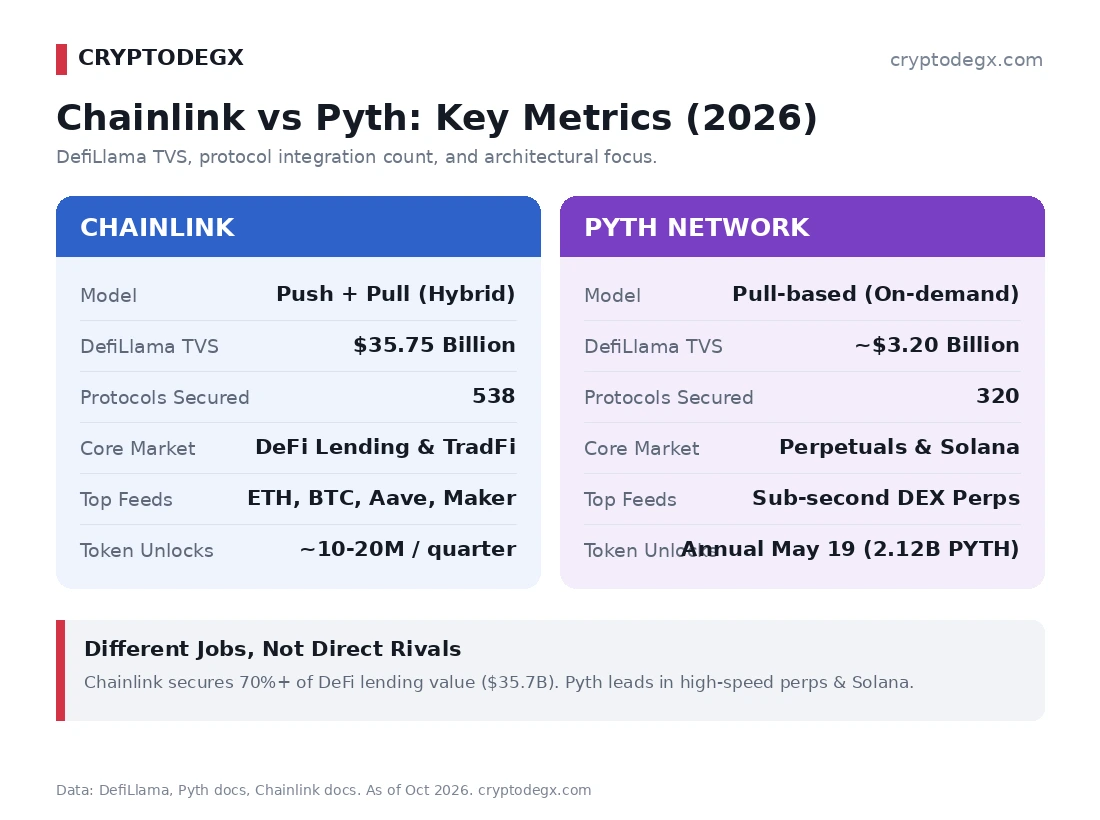
The numbers show it. Chainlink secures $35.75 billion across 538 protocols on DefiLlama. Pyth secures $3.20 billion, but across 320 protocols, most of them perp DEXs and trading apps on Solana and other fast chains.
So the useful question is which one fits your use case, and whether either token is worth holding.
Push vs Pull: The Core Difference
It comes down to how prices get onto the blockchain.
Chainlink pushes. Independent node operators write a new price on-chain whenever it moves past a set threshold (say 0.5%) or a heartbeat timer runs out. The price is always sitting in contract storage, ready to read, which is what lending protocols like Aave need.
The trade-off is gas. Every update costs money, which caps how often prices refresh on expensive chains. The details are in Chainlink’s Data Feeds documentation.
Pyth pulls. More than 120 first-party institutions, including Cboe, Jane Street and Jump Trading, stream prices off-chain to Pythnet. When someone trades, the app grabs the latest signed price and bundles it into that same transaction.
The user pays the gas, and the price is recorded at the exact moment it’s used. That’s why it’s cheap to run thousands of feeds.
Market Share: What DefiLlama Shows (October 2026)
We pulled Total Value Secured (TVS) from DefiLlama’s oracle rankings on October 17, 2026:
| Oracle | Protocols | Chains (DefiLlama) | TVS | Share |
|---|---|---|---|---|
| Chainlink | 538 ✓ | 40+ | $35.75B ✓ | ~70.5% ✓ |
| Internal oracles | 51 | N/A | $7.84B | ~15.4% |
| Chronicle | 13 | 6 | $4.87B | ~9.6% |
| RedStone | 91 | 27 | $3.87B | ~7.6% |
| Pyth Network | 320 | 50+ ✓ | $3.20B | ~6.3% |
If you add up the shares, you’ll get more than 100%. That’s not a mistake. Many protocols use more than one oracle, and DefiLlama counts their TVL under each one.
The split is clear anyway. Chainlink’s 70%+ comes from huge lending markets like Aave ($17.9B TVL), where billions sit as collateral. Pyth’s 320 protocols are mostly trading apps, with high volume but much smaller balances parked in contracts.
That also means TVS undersells Pyth. It measures money at rest, and Pyth’s business is money in motion.
Where Each Oracle Wins
Chainlink is stronger for
- Lending and money markets: years of securing tens of billions in collateral
- Institutions: the Chainlink Runtime Environment (CRE) is used in DTCC and Swift projects
- Cross-chain: Chainlink CCIP runs across 80+ chains, with a separate Risk Management Network
- Decentralization: independent node operators aggregating many data sources
Pyth is stronger for
- Perps and derivatives: sub-second prices for fast liquidations
- Solana and fast L2s: native, low-latency integration
- First-party data: prices straight from market makers and exchanges
- Long-tail feeds: pull design makes thousands of equity and FX feeds affordable
- Cost: no gas spent on updates nobody uses
Security Track Record
Chainlink’s oracle network itself has never been exploited, across years of securing tens of billions. That record isn’t perfect at the edges, though. In May 2022, LUNA’s crash pushed below a minimum price bound in Chainlink’s feed, and a few lending protocols relying on it took losses.
The lesson applies to both oracles: most oracle failures happen at the integration layer.
Pyth’s network has been reliable, but pull oracles put more responsibility on the app. If a dApp skips Pyth’s confidence intervals or staleness checks, attackers can trade against outdated prices during sharp moves. With Pyth, a careless integration is the main risk.
Tokenomics: LINK vs PYTH
Using an oracle and owning its token are two different decisions. Here’s how the two tokens compare:
| LINK | PYTH | |
|---|---|---|
| Market cap | ~$9.45B | ~$580M |
| Max supply | 1 billion | 10 billion |
| Circulating | ~766.8M (~77%) | ~7.9B (~79%) |
| Release schedule | 10-20M quarterly until ~2030 | 2.125B on May 19, 2027 (final unlock) |
| Value capture | Reserve buybacks from fees, 4.32% staking | Governance and staking |
LINK relies on the Chainlink Reserve and Payment Abstraction to turn fee revenue into buybacks, and native LINK staking pays 4.32%. Our Chainlink review and Chainlink ETF guide cover the investment side in depth.
PYTH launched with just 1.5 billion of its 10 billion tokens circulating, and 85% on vesting schedules that unlock every May 19.
The Other Contenders: Chronicle and RedStone
Chronicle started as MakerDAO’s in-house oracle. It secures $4.87 billion, mostly for Sky (formerly Maker) and the DAI/USDS ecosystem.
RedStone is a modular oracle that’s grown fast in liquid restaking tokens and yield-bearing assets. It secures $3.87 billion across 91 protocols, including SparkLend and Lista DAO.
FAQ
What’s the main difference between Chainlink and Pyth?
Chainlink mainly pushes price updates on-chain when prices move. Pyth publishes prices off-chain, and apps pull the latest one into the transaction that uses it.
Which oracle has more market share?
Chainlink, by far. DefiLlama shows $35.75 billion secured across 538 protocols, over 70% of the market. Pyth secures $3.20 billion across 320 protocols.
Why do perp DEXs prefer Pyth?
Perps need sub-second prices to liquidate positions and block latency arbitrage. Pyth delivers that far more cheaply than pushing updates on-chain every few seconds.
Is Pyth a competitor to Chainlink CCIP?
No. Pyth focuses on price feeds. CCIP is Chainlink’s cross-chain messaging protocol for moving tokens and data across 80+ blockchains.
Does Pyth have token unlocks?
Yes. PYTH unlocks every May 19, and the final 2.125 billion tokens unlock on May 19, 2027. After that, the vesting schedule is complete.
Can Chainlink do pull oracles?
Yes. Chainlink Data Streams is a low-latency pull product built for derivatives and perp DEXs, backed by Chainlink’s node network.
Which oracle should a developer choose?
Chainlink for lending, money markets and institutional RWA apps where security comes first. Pyth for perps, high-frequency trading and low-latency apps on Solana or fast L2s. Many protocols use both.
Is LINK or PYTH the better token to hold?
They carry different risks. LINK is larger, with revenue-based buybacks but quarterly dilution until about 2030. PYTH is much smaller and riskier, with one big final unlock in May 2027 and no supply overhang after that.