What Are Tokenized Stocks? How to Own Apple or Tesla On-Chain
 October 19, 2026
8 min read

Disclosure: This article is information and opinion, not financial advice. Tokenized stocks carry risks a brokerage doesn’t, detailed below. Figures are as of October 2026. See our full disclaimer.
You can now buy a token called AAPLx that tracks Apple’s share price, hold it in your own crypto wallet, and trade it at 3 a.m. on a Sunday. No brokerage account, no market hours, fractional down to a dollar. That’s a tokenized stock, and in 2026 the category went from a $2 million curiosity to a sector worth billions.
Sounds like owning Apple with superpowers. It mostly isn’t, and the gap between what it feels like and what you actually get is the whole thing to understand before buying one.
How they actually work
The mechanic is simpler than the jargon. A regulated issuer (Backed Finance behind xStocks, Dinari, Robinhood, and others) buys real shares through licensed brokers and parks them with a custodian. For each share held, it mints a token on a blockchain. You buy the token, its price tracks the underlying share via price feeds, and you can hold it in a self-custody wallet or trade it on an exchange.
The tickers follow a pattern once you spot it: an “x” suffix usually marks the xStocks version, so AAPLx is Apple, TSLAx is Tesla, SPYx is the S&P 500 fund, NVDAx is Nvidia. The token is an ordinary crypto token (an SPL token on Solana, an ERC-20 on Ethereum-style chains) that happens to represent equity exposure.
What you own, and what you don’t
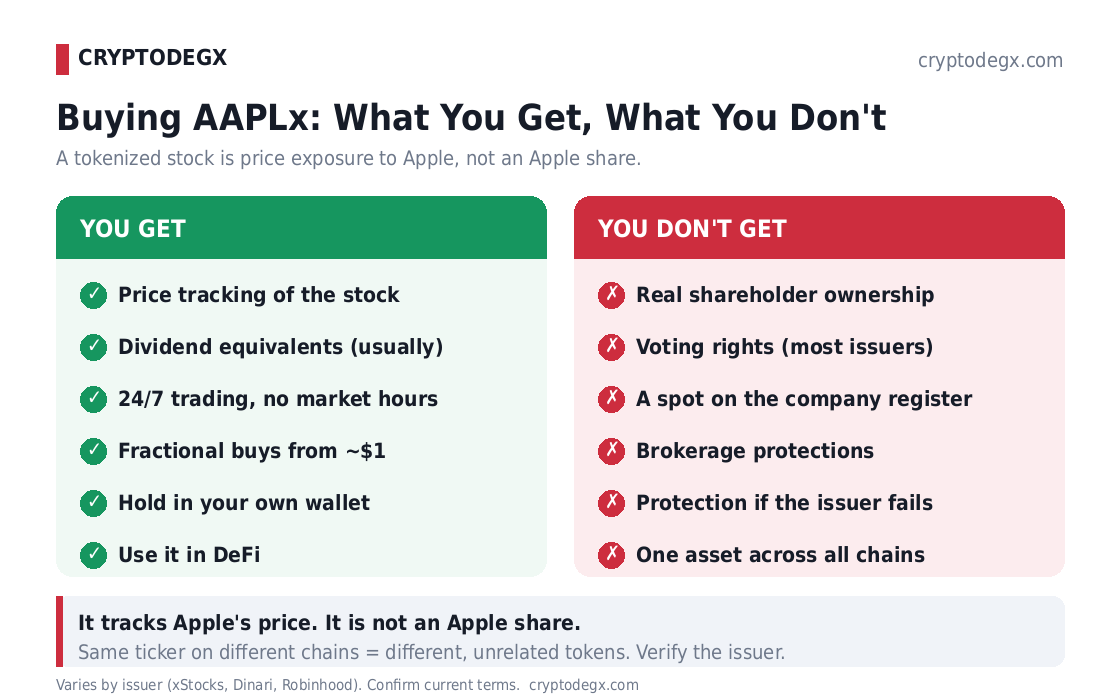
This is the section the exchange marketing glides past, so let’s be blunt. Buying AAPLx does not make you an Apple shareholder. You don’t appear on Apple’s register, you generally can’t vote at the shareholder meeting, and your legal relationship is with the token issuer, not Apple.
What you typically do get: the price tracking (the token rises and falls with the stock) and some form of dividend pass-through. What you typically don’t: voting rights, direct ownership, and the regulatory protections of a normal brokerage account. One issuer, Dinari, is the exception that proves the rule, offering dShares with dividends, voting, and corporate actions to eligible US investors, closer to real ownership than the rest.
The fragmentation trap nobody warns about
Here’s a genuinely dangerous detail the beginner guides skip. The same ticker is many unrelated tokens. An Apple xStock on Solana, a Dinari Apple dShare on Base, and a Robinhood Apple token on Robinhood Chain are three completely different assets, from three different issuers, with three different legal wrappers.
They’re not interchangeable. You can’t buy Apple on one and sell it on another, and a token with Apple’s ticker at an address the issuer doesn’t officially list might be a scam token entirely, the same risk our fake-token guide covers. Always verify you’re holding the real issuer’s contract on the chain you think you’re on, and never assume two “AAPL” tokens are the same thing.
Where you can actually buy them (and the US problem)
Availability is split by geography, and the US is the awkward case. The main venues as of late 2026:
| Platform | Product | Who |
|---|---|---|
| Kraken / Bybit (xStocks) | Backed-issued, Solana-based | Non-US |
| Robinhood EU | MiFID II derivative tokens | EU/EEA only |
| Dinari (dShares) | Closest to real ownership | Eligible US investors |
| Gate, MEXC, Crypto.com | Various xStock / own products | Mostly non-US |
Most tokenized-stock products are built for non-US users, because US securities law is strict about who can offer equity exposure. The US door opened only narrowly in 2026 (Dinari being the notable compliant route), so if you’re in the US, your legal options are limited and worth verifying carefully before funding anything.
Why bother, versus a normal brokerage?
The honest pros, because there are real ones. Tokenized stocks trade 24/7 instead of market hours, settle in seconds, allow fractional buys from about a dollar, work from a self-custody wallet alongside your crypto, and plug into DeFi (you can use them as collateral or trade them against crypto). For someone outside the US with no easy access to US equities, or someone who wants stock exposure inside their crypto workflow, that’s genuinely useful.
The honest cons: you give up real ownership and voting, you take on new risks (the issuer’s solvency, the custody chain, smart-contract bugs, thin liquidity on some tokens, and the fragmentation above), and you lose brokerage protections. A normal brokerage account is simpler, safer, and better for most people most of the time. Tokenized stocks earn their place only when the 24/7, on-chain, globally-accessible features actually matter to you.
FAQ
What are tokenized stocks?
Blockchain tokens that track the price of real company shares like Apple or Tesla, typically backed 1:1 by actual shares held with a regulated custodian. They trade 24/7 on-chain, can be held in self-custody wallets, and allow fractional ownership from around a dollar, but for most issuers they give price exposure and dividend equivalents rather than true shareholder ownership.
Do I actually own the stock if I buy a tokenized version?
Usually no. You own a token issued by a company like Backed or Robinhood that tracks the share price and is backed by a real share in custody, but you’re not on the company’s shareholder register and typically have no voting rights. Your legal claim is against the token issuer, not Apple or Tesla. The exception is Dinari’s dShares, which offer closer-to-real ownership with voting and corporate actions for eligible US investors.
Can I buy tokenized stocks in the US?
Only in limited ways. Most tokenized-stock products (Kraken and Bybit’s xStocks, Robinhood’s EU tokens) are built for non-US users because of US securities law. A narrow compliant route opened in 2026, with Dinari offering dShares to eligible US investors, but US access remains restricted, so verify eligibility and the specific product’s legal status before funding.
Do tokenized stocks pay dividends?
Most do, but the mechanism varies. Many xStocks auto-reinvest dividends by growing your token balance through a rebasing multiplier, so no cash arrives; Robinhood’s EU Classic tokens pass dividends through as cash; some platforms credit them separately. A 30% US withholding tax can apply for foreign holders. Check your specific platform, since “pays dividends” means different things across issuers.
Is AAPLx the same as AAPL stock?
No. AAPLx is a tokenized representation that tracks Apple’s price, issued by a third party and backed by a custodied share, while AAPL is the actual stock held through a brokerage. They move together in price, but AAPLx carries issuer, custody, and smart-contract risk and usually no voting rights, so it’s price exposure to Apple rather than a real Apple share.
Why is the same stock available as different tokens?
Because multiple issuers each mint their own tokenized version on different blockchains, an Apple token from xStocks on Solana, from Dinari on Base, and from Robinhood on Robinhood Chain are three unrelated assets with separate legal wrappers. They aren’t interchangeable, and a token with a stock’s ticker from an unlisted contract may be a scam, so always confirm the official issuer and chain.
Are tokenized stocks safe?
They carry more risk than a normal brokerage holding. On top of the stock’s own price risk, you take on issuer solvency, the custody chain holding the backing shares, smart-contract bugs, possible thin liquidity and depegs, and self-custody responsibility, without brokerage protections. They’re legitimate products from regulated issuers, but “Apple on-chain” is a different, higher-risk profile than Apple in a brokerage account.
What’s the point of tokenized stocks over a brokerage?
They offer 24/7 trading, second-level settlement, fractional buys, self-custody alongside your crypto, and DeFi compatibility, which matter most to non-US users lacking easy access to US equities or people who want stock exposure inside a crypto workflow. For someone with a normal brokerage and no need for those features, a traditional account is simpler and safer.