Phantom Cash Card Review (2026): The Honest Take on Solana’s Spending Card
 October 11, 2026
8 min read
October 11, 2026
8 min read
Disclosure: This review is information and opinion, not financial advice. Figures are as of late 2026 and change. Phantom Cash is US-only (with state exclusions). See our full disclaimer.
If MetaMask built its money account around yield, Phantom built its around spending. The Phantom Cash Card is a free, self-custodial Visa that spends CASH, Phantom’s dollar-pegged stablecoin on Solana, straight from a wallet you control. It’s clean, it’s fast, and it’s the natural rival to the MetaMask Money Account we reviewed recently.
But the two made opposite bets, and that difference decides which one fits you. Here’s the honest read, including the fees the “zero-fee” headline quietly leaves out.
What it is
Phantom Cash is a money account inside the Phantom wallet. You hold CASH, a USD-pegged stablecoin on Solana issued by Bridge (a Stripe company), in a self-custodial account, and a free virtual Visa card spends it. When you tap, Bridge draws CASH from your balance and converts it to dollars, and the merchant gets paid like any Visa transaction. You keep control of the funds until that moment of settlement.
The standout feature is breadth: you can fund the card from a wide set of Solana stablecoins (USDC, USDT, USDG, PYUSD), which auto-swap into CASH, and Phantom’s deep Solana integration means the range of what you can spend is genuinely unmatched among crypto cards.
| Type | Self-custodial Visa debit (virtual) |
| Balance token | CASH (USD-pegged, Solana, issued by Bridge) |
| Chain | Solana (sub-penny fees) |
| Cashback | None (rewards planned later) |
| Built-in yield | None (yield via separate Kamino step) |
| Card fee | $0 issuance, $0 monthly |
| US purchase fee | 0% |
| Availability | US only (state exclusions apply) |
| Daily limit | ~$2,000 default |
The MetaMask Money comparison that defines it
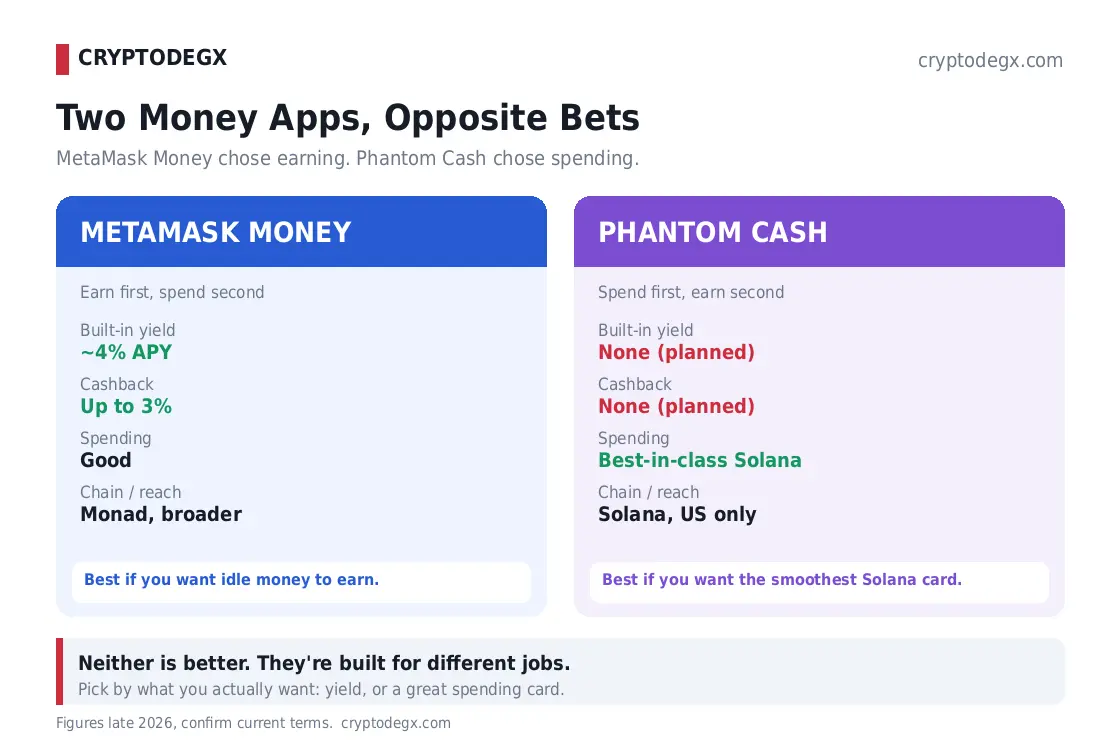
These two products are the clearest head-to-head in the money-app category, and they chose opposite priorities. MetaMask Money leads with earning: deposit stablecoins, earn ~4%, spend second. Phantom Cash leads with spending: a smooth card and the best Solana token support, earning second (and, right now, barely at all).
If you want your idle balance working for you automatically, MetaMask Money wins on paper, since yield is built in. If you want the smoothest Solana-native spending card and already live in Phantom, this is the better daily driver. Neither is “better” in the abstract; they’re built for different jobs, and picking by the wrong priority is the main way people end up disappointed with either.
The fees the “zero-fee” headline skips
Phantom markets Cash hard on being free, and the core card genuinely is: no issuance fee, no monthly fee, 0% on US purchases. But “free” has edges worth knowing before you fund it.
| Action | Real fee |
|---|---|
| Card issuance / monthly | $0 ✓ |
| US purchases | 0% ✓ |
| Swap stablecoins into CASH | Free |
| Swap CASH back to a stablecoin | ~0.85% |
| Add cash by credit card | ~3.5% |
| International (FX) purchase | ~1% (shown before confirming) |
None of these are outrageous, and Phantom does show the FX amount before you confirm. But the 3.5% credit-card top-up is steep, and the 0.85% to swap out of CASH means exiting isn’t quite frictionless. Fund with on-chain stablecoins (free) rather than a credit card, and keep money in CASH you’ll actually spend rather than cycling it in and out, and you avoid nearly all of it.
Self-custody and security
The custody model is a real strength. Your CASH stays in a self-custodial Solana account you control, so Phantom can’t freeze or spend it, which removes the counterparty risk behind most exchange failures, the pattern our red flags guide tracks. CASH is 1:1 dollar-backed with reserves managed by Bridge, a reputable Stripe-owned issuer.
The real risks are the usual ones for this product type: you depend on CASH’s peg and Bridge as issuer, on Solana’s uptime, and on the card’s third-party settlement rails. And self-custody means self-responsibility, since losing access to your Phantom wallet means losing access to the funds, with no bank to call. It’s safe in the ways that matter for your principal, with the normal self-custody trade-off attached.
How it stacks up against the field
| Feature | Phantom Cash | MetaMask Money | Bleap |
|---|---|---|---|
| Built-in yield | None (planned) | ~4% ✓ | None |
| Cashback | None (planned) | Up to 3% | USDC, tiered ✓ |
| Custody | Self-custody | Self-custody | Self-custody |
| Chain | Solana | Monad | Multi-chain |
| Availability | US only | Broader | EEA |
| Best at | Solana spending | Earning yield | Stable cashback |
The read: Phantom Cash is the pure spending play of the group. If you’re a US Solana user who wants the cleanest card and doesn’t care about rewards yet, it’s a strong pick. If you want your money to earn while it sits, MetaMask Money or a cashback card like Bleap does more for you today. Phantom’s bet is that spending volume and ecosystem lock-in matter more than rewards, and that the rewards will come. Maybe. Judge it on what it does now.
Who it’s for, who it isn’t
Get it if
- You’re a US Phantom / Solana user
- You want the smoothest Solana-native card
- You value self-custody over rewards
- You’ll fund with on-chain stablecoins (free)
- You want a free, no-subscription card
Skip it if
- You’re outside the US
- You want yield or cashback now, not “later”
- You’d fund via credit card (3.5% fee)
- You need a physical card or ATM access
- You want multi-chain spending beyond Solana
FAQ
Is the Phantom Cash Card worth it?
For US Phantom and Solana users who want a clean, free, self-custodial spending card, yes, it’s one of the smoothest options with unmatched Solana token support. It’s not worth it if you want yield or cashback now (both are only planned), if you’re outside the US, or if you’d fund it with a credit card and eat the 3.5% top-up fee.
Does Phantom Cash pay yield or cashback?
Not built in, as of late 2026. The card currently offers no cashback on spending and no automatic yield on your CASH balance, though Phantom says both are planned. The only way to earn on CASH now is manually moving it into a separate DeFi vault like Kamino, which carries its own smart-contract and variable-rate risk and is not part of the card.
What is CASH, Phantom’s stablecoin?
A US dollar-pegged stablecoin on Solana, issued by Bridge (a Stripe company) and backed 1:1 by dollar reserves. It’s the balance you hold and spend inside Phantom Cash, converted to fiat at the point of sale when you use the card. It is a stablecoin, not an FDIC-insured bank deposit.
Is Phantom Cash really free? What are the hidden fees?
The card itself is free (no issuance, monthly, or US purchase fees), but some actions cost: swapping CASH back to another stablecoin runs about 0.85%, adding money by credit card about 3.5%, and international purchases around 1%. Funding with on-chain stablecoins is free, so most fees are avoidable if you fund and spend rather than cycle money in and out.
Phantom Cash vs MetaMask Money Account?
They made opposite bets: MetaMask Money leads with built-in ~4% yield and spending second; Phantom Cash leads with the best Solana-native spending and has no yield or cashback yet. Choose MetaMask Money if you want your balance to earn automatically, and Phantom Cash if you want the smoothest Solana spending card and already use Phantom.
Is Phantom Cash available outside the US?
Full Phantom Cash card functionality is US-only, with some state exclusions, though global Phantom wallet users can access certain on-chain features. If you’re outside the US and want a self-custodial card, options like Gnosis Pay (EEA/UK) or Bleap (EEA) are the relevant alternatives.
Is Phantom Cash safe?
Its self-custodial design keeps your CASH under your control, so Phantom can’t freeze or lose it, and CASH is 1:1 backed by a reputable issuer. The real risks are the CASH peg and issuer, Solana’s uptime, the card’s settlement rails, and the self-responsibility of holding your own wallet. Safe for your principal in the ways that matter, with no deposit insurance.