How Do Prediction Markets Work? Odds, Payouts & Fees Explained
 October 17, 2026
7 min read
Disclosure: This article is information and opinion, not financial or betting advice. Prediction markets carry a real risk of losing your entire stake. See our full disclaimer.
A prediction market lets you buy a tiny contract that pays out $1 if something happens, and $0 if it doesn’t. That’s the whole idea. “Will the Fed cut rates in March?” becomes a thing you can buy shares of, and the price of those shares, right now, is the crowd’s best guess at the odds.
Once that clicks, everything else follows. Let’s walk through it with real numbers, then cover the parts that trip people up.
You buy 100 Yes shares for $60. If it rains, each share pays $1, so you collect $100 (a $40 profit). If it stays dry, your shares are worth $0 and you lose the $60.
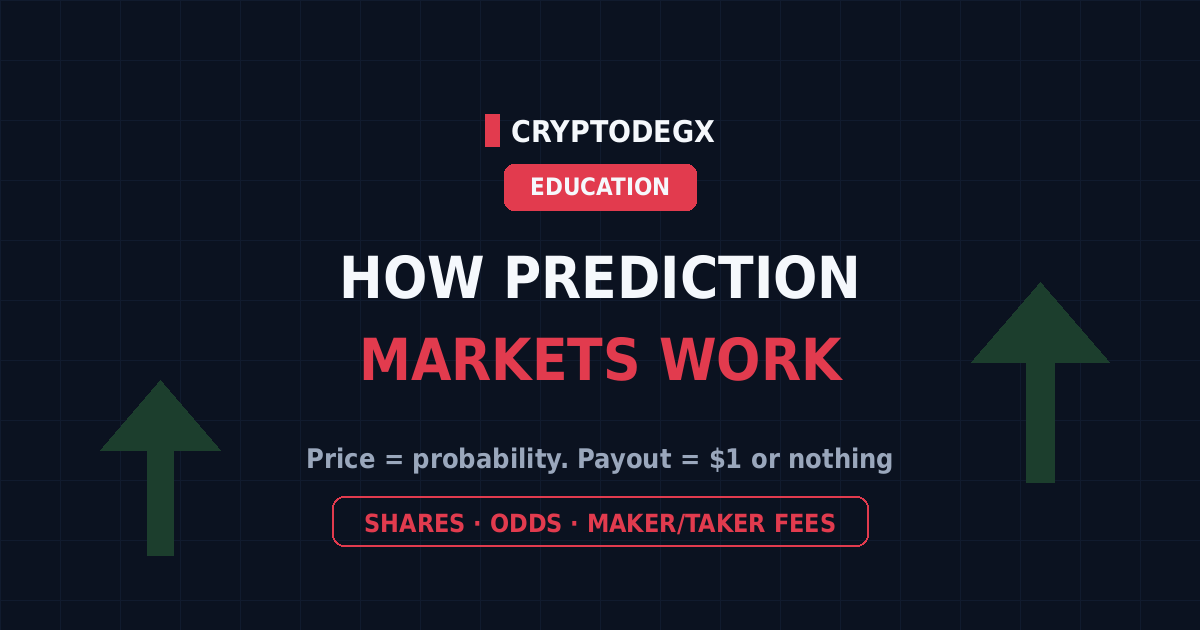
That’s a prediction market. Price = probability, payout = $1 or nothing.
Price is just the probability, in cents
This is the one insight that makes prediction markets make sense: the share price is the implied probability. A Yes share at 60 cents means a 60% chance. At 25 cents, 25%. At 92 cents, the market is nearly certain.
And because Yes and No always add up to $1, the two prices mirror each other: if Yes is 60 cents, No is 40 cents. Buy whichever side you think the crowd has mispriced. If you believe rain is really 80% likely while the market says 60%, those 60-cent Yes shares look cheap to you, and buying them is the entire game.
You don’t have to wait for the outcome
A point beginners miss: you can sell your shares before the event resolves, at whatever the price is then. These are tradeable, like stocks, not locked bets.
Say you bought Yes at 60 cents, and the next morning forecasts worsen and Yes jumps to 85 cents. You can sell right there, pocketing 25 cents a share, without waiting to see if it actually rains. That’s how active traders operate: they’re trading the movement of the probability, not just betting on the final result. It also means you can cut a losing position early instead of riding it to zero.
Where the prices come from: the order book
Prices aren’t set by the platform. They come from an order book, the same mechanism stock exchanges use, where buyers and sellers post the prices they’ll accept and trades happen when they match. If lots of people suddenly want Yes, they bid the price up; heavy selling pushes it down. The market price is wherever supply and demand currently meet.
This is why prediction markets are often eerily accurate: thousands of people putting real money behind their opinions tends to produce a sharper forecast than any single pundit, because being wrong costs you. It’s the same wisdom-of-crowds effect that makes market prices informative generally, applied to future events.
The fees: makers, takers, and why it matters
Here’s the cost structure, because it’s where returns quietly leak. Most platforms (Kalshi, Polymarket) use a maker-taker model, borrowed from crypto and stock exchanges.
A taker places a market order that fills instantly against existing orders, and pays a small fee. A maker places a limit order that waits at a chosen price, adding liquidity, and usually pays nothing (sometimes earns a rebate). The practical lesson: if you’re patient and use limit orders, you can often trade for free; if you always hit “buy now,” the taker fee eats into every trade.
What you can trade on
The range got wide in 2026. The classic categories are elections and politics, Fed and economic data (rate decisions, inflation prints), and sports. Newer additions include entertainment (award shows), weather, crypto price targets, and even outcomes for private companies, like IPO timing. If it has a clear, verifiable yes-or-no (or numeric) resolution, someone has probably made a market on it.
The resolution is the crucial bit: every market needs an agreed, objective source to settle it, so “will it rain” resolves to a weather service, an election to the official result. Ambiguous resolution is where disputes happen, which is why the wording of a market matters as much as your opinion on the outcome.
The honest part: this is hard, and risky
Prediction markets are genuinely useful and genuinely easy to lose money on, both at once. A wrong call is a total loss on that position, since losing shares settle at exactly $0. And beating the market consistently is hard for the same reason beating the stock market is: the price already reflects everyone else’s information, so your “edge” has to be real, not just confidence.
Treat it as what it is. Whether it’s investing or betting is a question we dig into separately, and the honest answer for most people is that it sits closer to informed gambling than investing. The platforms collect their fee whether you win or lose, the sharp traders on the other side of your order are often better informed than you, and “the market was obviously wrong” is a thought that has emptied a lot of accounts. Stake only what you can afford to lose, and keep the positions small while you learn how the mechanics actually feel.
FAQ
How do prediction markets work in simple terms?
You buy shares of an outcome at a price between 1 and 99 cents, and each share pays $1 if you’re right and $0 if you’re wrong. The price reflects the market’s estimated probability, so a share at 70 cents means a 70% implied chance. You can also sell your shares before the event resolves, trading the odds as they move.
What does the price on a prediction market mean?
The share price is the market’s implied probability of that outcome, expressed in cents. A Yes share at 35 cents means roughly a 35% chance, and since Yes and No prices always sum to $1, the No share would be 65 cents. You profit by buying the side you think is mispriced relative to the real odds.
Can I sell before the event happens?
Yes. Prediction-market shares are tradeable like stocks, so you can sell at the current price any time before resolution, locking in a gain or cutting a loss without waiting for the final outcome. Active traders often trade the movement of the probability rather than holding to settlement.
How do prediction markets make money?
Mainly through trading fees, typically a maker-taker model where takers (instant market orders) pay a small fee and makers (resting limit orders) pay little or nothing and may earn rebates. The platform earns its fee on trading activity regardless of who wins the bets, which is why limit orders can be much cheaper than market orders.
Why are prediction markets considered accurate?
Because they aggregate the money-backed opinions of many people through an order book, and being wrong costs real money, which tends to produce sharper forecasts than individual experts. This wisdom-of-crowds effect is why prediction-market odds are often cited alongside polls, though they can still be wrong and can be moved by large or manipulative traders.
What happens if a market’s outcome is unclear?
Each market defines a resolution source in advance (an official result, a data provider, a named authority) to settle it objectively. Disputes arise when the wording is ambiguous or the resolution source is contested, which is why reading exactly how a market will be decided matters as much as having a view on the outcome itself.
Is trading prediction markets profitable?
It can be, but it’s hard, because the price already reflects the crowd’s information, so consistent profit requires a genuine informational or analytical edge rather than confidence. Fees and spreads add friction, and many participants lose over time. Treat it as high-risk, size positions small, and don’t assume an obvious-looking mispricing is really there.