Ethereum Staking ETF: ETHB vs the Alternatives (2026)
 October 4, 2026
6 min read
October 4, 2026
6 min read
Disclosure: This article is information and opinion, not financial or investment advice. Figures are as of 2026 and change; confirm current fund details before investing. See our full disclaimer.
BlackRock launched an Ethereum ETF that pays you to hold it. That’s the headline, and it’s true. The part the launch coverage mostly skipped: the advertised yield and the yield you actually keep are different numbers, and the gap is bigger than the fund’s fee suggests. If you’re choosing an Ethereum staking ETF, that gap is the whole decision.
So here’s the real math on ETHB and its rivals, and the honest answer to whether the wrapper is worth what it quietly costs.
What ETHB actually is
BlackRock’s iShares Staked Ethereum Trust (ETHB) launched March 12, 2026 on Nasdaq, the firm’s third crypto ETF after its Bitcoin fund (IBIT) and its plain spot Ethereum fund (ETHA). Unlike ETHA, which just tracks ETH’s price, ETHB holds Ethereum and stakes between 70% and 95% of its holdings through Coinbase, paying the rewards to you as monthly distributions. Price exposure plus income, in a brokerage account, which is the whole point of the staking ETF category.
The net yield, which is the only number that matters
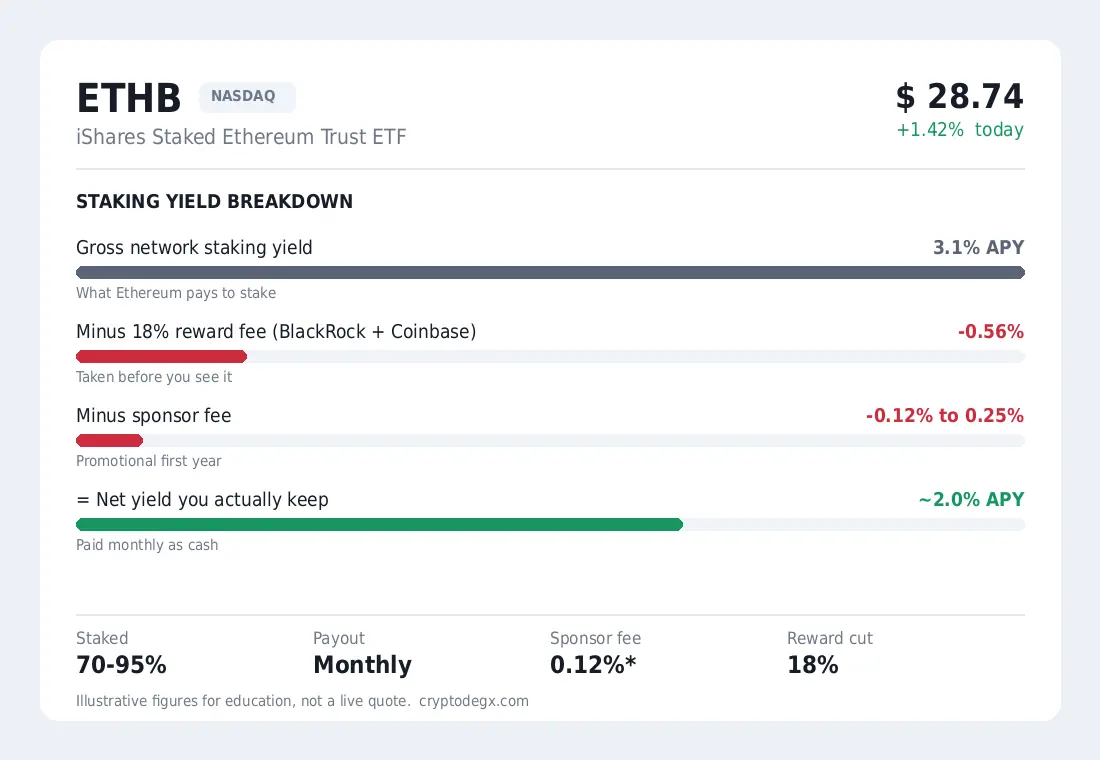
Here’s where the brochure and the bank statement diverge. Ethereum’s network staking yield runs around 3.1% annually. That’s the number that sounds good. But ETHB keeps 18% of the staking rewards (split between BlackRock and Coinbase) before anything reaches you, and then the sponsor fee comes on top. Investors end up with roughly 1.9% to 2.2% net.
Read that again, because it reframes the product. Nearly a third of the yield you came for is skimmed before you see it. The 0.12% promotional sponsor fee (rising to 0.25% after the first year or above $2.5 billion) is the small cost; the 18% reward haircut is the big one, and it’s the number the marketing leads away from.
ETHB vs the alternatives, honestly
ETHB isn’t the only staking ETF, and on pure yield efficiency it isn’t the best. The real field:
Grayscale’s Ethereum products. Grayscale’s mini trust passes a far larger share of rewards (around 94% versus ETHB’s 82%) at a low management fee, making it more yield-efficient than BlackRock’s on paper. Its older ETHE product passes less and charges a steep 2.5%, a reminder to read each fund rather than trust the brand.
REX-Osprey (ETH + Staking). The first mover, live since September 2025, passes 100% of staking rewards to investors at a flat 0.75% fee. More of the yield, higher flat fee: the trade that suits larger holders.
The honest comparison. Reward pass-through matters more than the headline sponsor fee, because 18% of your yield dwarfs a 0.12% expense ratio. Rank candidates by what reaches you after both cuts, not by whose name you recognize, and the BlackRock default isn’t automatically the winner.
ETHB vs staking ETH yourself
The comparison that decides whether the ETF makes sense at all. Stake ETH directly (or through liquid staking) and you keep essentially the full ~3.1%, paying only a tiny protocol fee. Buy ETHB and you keep ~2%, trading that ~1% gap for professional custody, zero effort, and the one thing self-staking can’t offer: eligibility inside an IRA or 401(k).
So the decision is clean. If this lives in a retirement account, or you will never touch a wallet, ETHB’s ~1% yield haircut is a fair price for access you otherwise can’t get. If you’re comfortable with self-custody and holding in a taxable account anyway, you’re paying BlackRock and Coinbase a third of your yield for convenience you may not need. Our is staking worth it breakdown runs the same math across assets.
The bigger truth under the ticker
A ~2% net yield is modest, and worth keeping in proportion: this is still first and foremost a bet on Ethereum’s price, which can move more in a week than the yield delivers in a year. The staking income is a bonus on a volatile holding, never a reason to treat ETH as a bond. If you wouldn’t buy plain ETH at zero yield, the staked wrapper doesn’t change the underlying question, it just adds a monthly distribution to the same ride.
What ETHB really signals is structural: Ethereum ETFs now compete on yield, not just price, and the same template is rolling out across other proof-of-stake assets, with Solana staking ETFs already trading and Cardano and others in the queue. The wrapper is here to stay; the job now is reading the fine print it ships with.
FAQ
What is ETHB?
BlackRock’s iShares Staked Ethereum Trust, a Nasdaq-listed ETF launched March 12, 2026 that holds spot Ethereum, stakes 70-95% of it through Coinbase, and pays the staking rewards to investors as monthly distributions. It’s the yield-bearing counterpart to BlackRock’s plain spot ETH fund, ETHA.
What is the real yield on ETHB?
About 1.9% to 2.2% net, despite Ethereum’s gross staking yield of roughly 3.1%. The gap exists because ETHB keeps 18% of staking rewards (shared by BlackRock and Coinbase) before distribution, plus a sponsor fee of 0.12% promotionally, rising to 0.25%. The reward haircut, not the sponsor fee, is the main cost.
Is ETHB better than buying ETH directly?
Only if you value the wrapper. Direct staking keeps nearly the full ~3.1% yield for a tiny protocol fee; ETHB keeps ~2% but adds professional custody, zero effort, and retirement-account eligibility. For IRA or 401(k) holders and the hands-off, ETHB’s roughly 1% haircut buys real access; for wallet-comfortable taxable-account investors, it’s paying a third of the yield for convenience.
ETHB vs Grayscale: which is better?
On yield efficiency, Grayscale’s mini trust often wins, passing around 94% of rewards versus ETHB’s 82% at a comparable or lower fee, while Grayscale’s older ETHE passes less and charges 2.5%. Compare funds by reward pass-through and total fees rather than by issuer name, since the familiar brand isn’t automatically the most efficient.
How often does ETHB pay out?
Monthly, as cash distributions of the staking rewards it collects, after the 18% service cut. Some competing structures accumulate rewards into the fund’s value instead of distributing them, which changes both your cash flow and your tax treatment, so confirm how any given fund delivers yield before buying.
What are the risks of ETHB?
Primarily Ethereum’s price volatility, which far outweighs the ~2% yield, plus fee and reward-haircut drag, the variable (not guaranteed) nature of staking yield, and staking-specific operational and slashing risk that the plain ETHA fund avoids. It remains fundamentally a leveraged bet on ETH’s story with an income feature attached.
Can I hold ETHB in a retirement account?
That eligibility is its central advantage over self-staking, which is impractical inside an IRA or 401(k). Availability depends on your broker and plan, so confirm with them, but bringing Ethereum staking yield into tax-advantaged accounts is precisely the gap ETHB exists to fill.
Why does ETHB keep 18% of the staking rewards?
That cut covers the staking service, split between BlackRock and its staking provider Coinbase, and is separate from the sponsor fee. It’s the price of outsourcing validation and custody, and it’s why direct staking is more yield-efficient, since staking ETH yourself avoids handing nearly a third of the rewards to intermediaries.