Stablecoin Cards Are Quietly Becoming the Real Crypto Use Case
 October 9, 2026
6 min read
October 9, 2026
6 min read
Disclosure: This article is analysis and opinion, not financial advice. Figures are cited from 2026 industry reports and change. See our full disclaimer.
For a decade, the honest answer to “what is crypto actually for?” was a shrug. Trading, mostly. Speculation dressed up as revolution. The grand use cases, banking the unbanked, replacing the dollar, decentralizing finance, kept arriving late or not at all.
Then, while everyone argued about Bitcoin ETFs and memecoins, something unglamorous happened: people started spending stablecoins with a plastic card at the supermarket. And the numbers got big, fast.
The quiet number that reframes everything
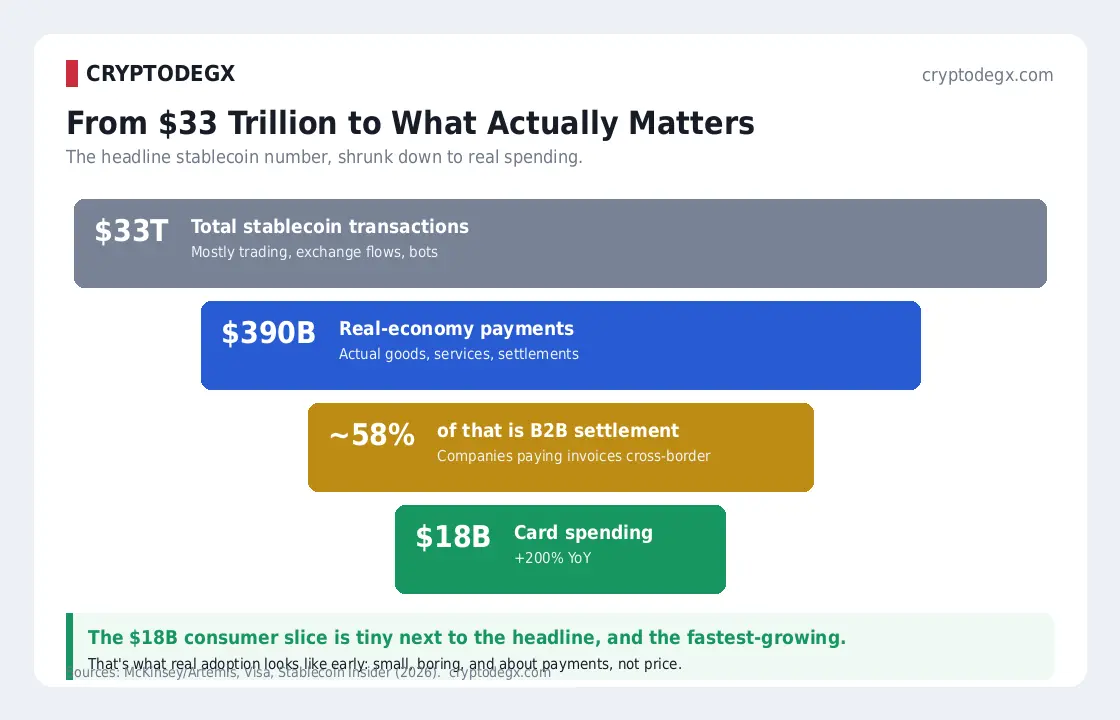
Card-linked stablecoin spending reached roughly $18 billion on an annualized run rate by 2026, and Visa now runs more than 160 stablecoin card programs with card payment volume growing around 200% year-over-year. That’s not a pilot. That’s a payment rail finding product-market fit in real time.
Step back and the shift is obvious once you see it. The crypto use case that’s actually working at consumer scale isn’t trading, lending, or NFTs. It’s the boring one: holding dollars as a stablecoin and spending them like cash, with a card that converts at the till. No price charts, no yield farming, no vocabulary to learn. Just a dollar that happens to live on a blockchain.
Why a stablecoin card beats the thing it replaces
The reason this works isn’t ideology, it’s that the product is genuinely better for specific people in specific situations.
If you earn in crypto, a stablecoin card skips the whole exchange-and-withdraw dance: no selling to fiat, no bank transfer delay, no off-ramp fee. If you live somewhere with a weak local currency, holding dollars as a stablecoin and spending them is a better deal than the local bank offers, which is why USDT became default digital cash across Latin America. And if you travel, the better cards charge 0% FX, quietly beating the 1-3% that traditional cards skim on foreign spend.
None of those are crypto-bro fantasies. They’re ordinary financial problems that a stablecoin card solves better than the incumbent, which is the only reason any technology ever gets adopted.
The cards themselves got good
The infrastructure caught up, and that’s the part that changed in 2026. The cards we’ve reviewed this year are no longer clunky crypto experiments. They’re genuinely competitive consumer products: self-custodial so no exchange holds your money, cashback paid in stablecoins you keep at face value, 0% FX, and spendable at the same 150 million Visa and Mastercard merchants as any normal card.
The category even developed internal competition worth having. Gnosis Pay made self-custody the selling point. Bleap made stable-currency cashback the differentiator. Plasma One bolted on a yield vault. When a category starts competing on nuance instead of just existing, it has matured past novelty.
The honest counterweight: most of the volume isn’t you
This is where a thesis piece earns trust by arguing against itself. The eye-popping “$33 trillion in stablecoin transactions” headline is mostly not real-world payments. Strip out trading, exchange flows, and automated blockchain mechanics, and verified real-economy payment volume was around $390 billion in 2025, with roughly 58% of that being business-to-business, not consumers buying coffee.
So the consumer card story is real but still the smaller slice. The giant growth is companies settling invoices across borders, not individuals tapping to pay. Anyone telling you stablecoin cards have already won is overselling it; the honest version is that consumer card spend is the fastest-growing visible edge of a trend whose bulk is currently corporate plumbing.
What this means for a normal person
Not “buy a card today.” The practical read is calmer than that. If you hold stablecoins anyway, a self-custodial card is now a legitimately good way to spend them, often better than off-ramping to a bank, especially outside the US and especially when traveling. The yield question and the custody question still matter, and the usual rule holds: understand who holds your money and where the rewards come from before you commit.
But the bigger takeaway is about reading the industry. For years, “crypto adoption” meant more people speculating. The stablecoin card suggests a different, quieter definition is taking over: more people using a dollar that happens to settle on a blockchain, without caring or even knowing that it does. That’s what actual adoption usually looks like, invisible, boring, and about payments, not price.
FAQ
What is a stablecoin card?
A debit card that spends stablecoins (dollar-pegged tokens like USDC or USDT) by converting them to local fiat at the point of sale, usable anywhere Visa or Mastercard is accepted. The best ones are self-custodial, meaning you hold the funds until the moment you tap, and many charge 0% foreign-exchange fees and pay cashback in stablecoins.
Why are stablecoin cards growing so fast?
Because they solve real problems better than the alternative: spending crypto income without an exchange off-ramp, holding dollars in weak-currency regions, and avoiding the 1-3% foreign-exchange fees traditional cards charge. Card-linked stablecoin spending reached roughly an $18 billion annualized run rate in 2026, with Visa card volume growing about 200% year-over-year.
Are stablecoin payments actually mainstream now?
Partly. Real-economy stablecoin payment volume hit around $390 billion in 2025, which is genuine mainstream scale, but roughly 58% of that is business-to-business settlement rather than consumer spending. Consumer card spend is the fastest-growing visible slice, but it’s still smaller than the corporate cross-border payment activity driving the overall numbers.
Is spending stablecoins better than using a normal bank card?
For specific people, yes: those earning in crypto, living with a volatile local currency, or traveling frequently benefit from no off-ramp friction, dollar stability, and 0% FX. For someone in a stable-currency country who already banks normally, the advantage is thinner. It’s a better tool for particular situations, not a universal upgrade.
What are the risks of stablecoin cards?
The stablecoin can depeg or its issuer can fail, self-custodial cards put security responsibility on you, cashback paid in a volatile token carries price risk, and regulation is still shifting in major markets. A stablecoin card is a useful spending tool for active funds, not a risk-free bank-account replacement.
Which stablecoin card is best?
It depends on what you weight: self-custody and euro spending point toward Gnosis Pay, stable-currency cashback toward Bleap, and a built-in yield vault toward Plasma One. All are self-custodial with 0% FX; the real differences are the reward currency, regional availability, and whether you want extras like a savings vault. Match the card to your spending and region.
Does this mean crypto is finally being used for payments?
Increasingly, yes, but quietly and specifically. The dominant real-world use isn’t exotic DeFi or buying things with Bitcoin; it’s holding a dollar-pegged stablecoin and spending it like cash, often without the user thinking of it as crypto at all. That invisible, payments-first adoption looks very different from the speculative story that dominated crypto’s first decade.