Solana Staking ETF: Which One, and Is the 7% Yield Real?
 October 5, 2026
6 min read
October 5, 2026
6 min read
Disclosure: This article is information and opinion, not financial or investment advice. Figures are as of 2026 and change; confirm current fund details before investing. See our full disclaimer.
Solana ETFs arrived with something Bitcoin and Ethereum ETFs didn’t have at launch: yield, from day one, around 7%. That’s a real number, not a marketing one, and it flips the usual question. With most crypto ETFs you ask whether the yield survives the fees. With Solana staking ETFs, the yield is big enough that it swallows the fee whole, and the actual decision becomes which fund, and one tax detail nobody mentions.
Here’s how the real contenders differ, and why “best” has a fairly clear answer right now.
Why Solana ETFs are different
Solana’s network staking yield runs high, historically around 7%, far above Ethereum’s ~3%. Nearly every Solana ETF staked from day one, so unlike the first Bitcoin funds (price only) or early Ethereum funds (price only until 2026), these pay income out of the gate. The result is unusual: a management fee of 0.20% against a ~7% yield is a rounding error, which is why the Solana funds compete on how much of that 7% they pass through, not on fee alone. The staking ETF category as a whole works this way, but Solana shows it most clearly.
Is the 7% real? Here, mostly yes
This is where Solana differs sharply from ETHB’s story, where an 18% reward cut shrank 3.1% gross to ~2% net. The leading Solana fund takes a very different approach: Bitwise’s BSOL stakes 100% of its holdings and targets the network’s full ~7% reward, with only a tiny fee applied to the rewards after its waiver. On Solana, the fund structures mostly pass the yield through rather than skimming a third of it, so the headline number survives largely intact. The asterisk is which fund, because they don’t all behave the same.
The real contenders, compared
Bitwise BSOL: the current frontrunner. A 0.20% fee (waived early), 100% staking through a top Solana validator, and the market has voted with its feet, BSOL has pulled the large majority of all Solana ETF inflows since launch, capturing about 68% of a record $188M inflow week in late September 2026. Its rewards accrue into the fund’s value (lifting the share price) rather than paying out as cash. Low fee, full staking, deep liquidity: hard to argue against for most buyers.
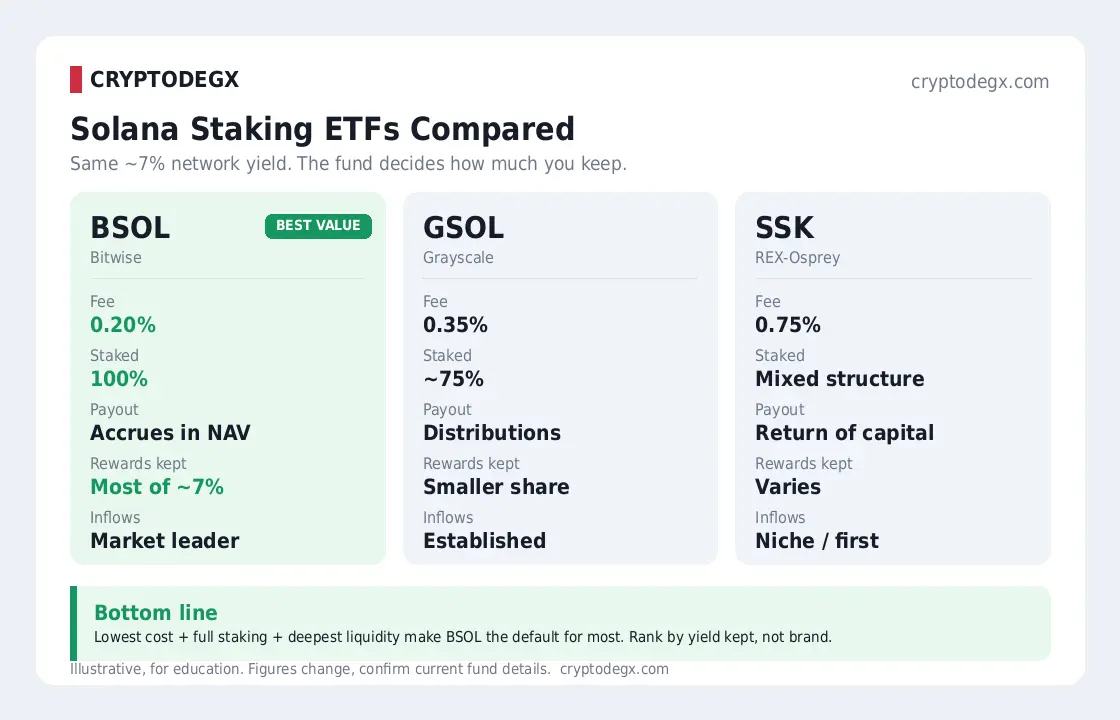
Grayscale GSOL: the familiar name, higher cost. Converted from Grayscale’s old Solana trust, carrying brand recognition and a longer track record, at a higher 0.35% fee and a prospectus that lets it keep a larger slice of staking rewards. You trade yield efficiency for a familiar issuer, which is rarely the better deal on the numbers.
REX-Osprey SSK: the structurally weird one. The first mover, but built differently: a 0.75% fee (the priciest), and a mix of direct SOL, a Swiss-listed ETP, and liquid-staking tokens rather than clean spot-plus-staking. Its monthly rewards are classified as return of capital for tax purposes, which is either a feature or a complication depending on your situation. Niche, not default.
The rest. Fidelity, VanEck, Franklin, 21Shares and others round out a crowded field, mostly competing in the 0.19% to 0.30% fee band. For most investors the choice collapses to the low-fee, high-staking leaders rather than the long tail.
The detail nobody mentions: how the yield reaches you
This matters more than the fee difference, and it’s the easiest thing to miss. Two models exist. Accrual funds (like BSOL) reinvest staking rewards into the fund, so your yield shows up as a rising share price, not cash in your account, which defers and simplifies the tax event for many holders. Distribution funds pay rewards out as cash, which you may owe tax on as received. Same underlying 7%, two very different experiences at tax time and for anyone wanting actual income versus compounding growth. Decide which you want before picking the ticker.
So which is best, and the part that outranks all of it
On the current numbers, BSOL is the straightforward pick for most: lowest effective cost, full staking, and the liquidity that comes from dominating inflows. Grayscale suits those who want the familiar brand and don’t mind paying for it; REX-Osprey suits a specific tax-and-structure niche. Rank by net yield kept and payout model, not by issuer fame.
But hold the whole thing in proportion. A 7% yield on Solana, an asset that has swung between roughly $60 and $150 in 2026 alone and once fell 97% in a single cycle, is a bonus on a volatile ride, not a safe income stream. The yield is real and genuinely useful; it is not a reason to own SOL if you wouldn’t own it at zero yield. The ETF makes Solana’s income accessible in a brokerage or retirement account without a wallet, which is the real convenience worth paying a fifth of a percent for. The 7% is what gets you in the door; the price risk is the house you’re walking into.
FAQ
What is a Solana staking ETF?
An exchange-traded fund holding Solana (SOL) that stakes its holdings on the network and passes the roughly 7% staking rewards to investors, giving price exposure plus income in a brokerage account with no wallet required. Nearly all Solana ETFs staked from launch, making yield a built-in feature rather than an add-on.
Is the 7% Solana ETF yield real?
Largely yes, which sets it apart from Ethereum staking ETFs: Solana’s network yield genuinely runs near 7%, and leading funds like Bitwise’s BSOL stake 100% of holdings and pass most of it through, with only a small fee applied. Unlike ETHB’s 18% reward cut, the Solana structures mostly keep the headline yield intact, though the net still varies by fund.
Which Solana ETF is best?
On current numbers, Bitwise’s BSOL leads for most investors: a low 0.20% fee, 100% staking, and dominant inflows giving it deep liquidity. Grayscale’s GSOL offers a familiar brand at a higher 0.35% fee with a larger reward retention, and REX-Osprey’s SSK is a pricier, structurally different niche product. Compare net yield kept and payout method, not issuer name.
BSOL vs GSOL: what’s the difference?
BSOL charges 0.20%, stakes 100%, accrues rewards into its share price, and has captured most Solana ETF inflows; GSOL charges 0.35%, carries Grayscale’s brand and longer track record, and its structure retains a larger share of staking rewards. For cost and yield efficiency BSOL wins; GSOL’s appeal is familiarity, which the numbers don’t reward.
How is the yield paid, as cash or growth?
It depends on the fund. Accrual funds like BSOL reinvest rewards into the fund so your yield appears as a rising share price, which can defer and simplify taxes; distribution funds pay cash you may owe tax on when received. Choose based on whether you want compounding growth or actual income, since the tax experience differs.
Can I hold a Solana ETF in my IRA?
Yes, and that tax-advantaged access is a core advantage over staking SOL yourself, which is impractical inside retirement accounts. Availability depends on your broker and plan, but bringing Solana’s ~7% yield into an IRA or 401(k) without managing a wallet is much of why these funds exist.
Is a Solana ETF better than staking SOL directly?
Direct staking keeps the fullest yield for a tiny validator fee but requires self-custody; the ETF skims a small fee while adding professional custody, zero effort, and retirement-account eligibility. Because Solana ETFs pass through most of the yield (unlike Ethereum’s), the ETF’s cost here is low enough that convenience often wins, especially for hands-off or tax-advantaged holders.
What are the risks of Solana staking ETFs?
Overwhelmingly Solana’s price volatility, which has ranged from roughly $60 to $150 in 2026 and historically crashed far harder, dwarfing any 7% yield. Add fund fees, variable (not guaranteed) staking rewards, Solana’s history of network outages, and staking operational risk. The yield is a bonus on a volatile asset, never a fixed-income substitute.