Stablecoin “Staking”: The Yield Is Real, the Word Is a Costume
 September 2, 2026
6 min read
September 2, 2026
6 min read
Disclosure: This article is information and opinion, not financial advice. Rates are approximate as of August 2026 and float constantly. See our full disclaimer.
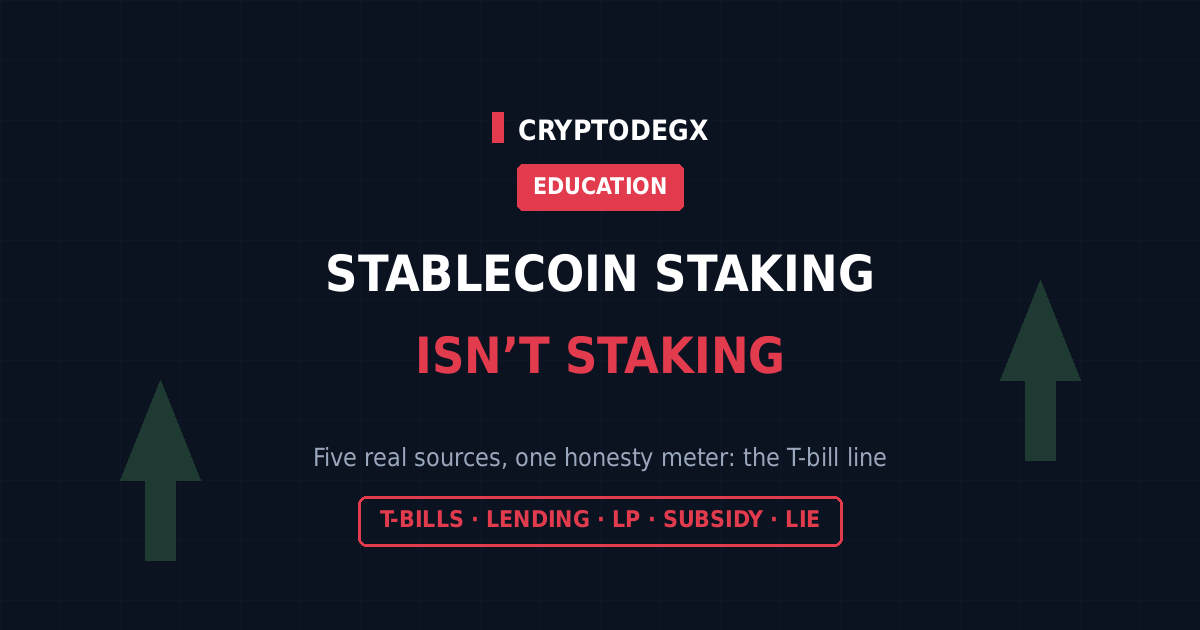
Here’s a strange fact about “stablecoin staking”: it doesn’t exist. There is no dollar-pegged token you can stake, because staking means locking coins to secure a proof-of-stake network, and no stablecoin runs one.
The stranger fact: most articles ranking for this term admit that in their second paragraph, then proceed to rank platforms by “staking APY” anyway, with affiliate links attached. The word is a costume, and the costume is doing sales work.
So this page does the job those pages skip. Every product sold as stablecoin staking is one of five real things, each with a different payer, a different risk, and a different honest ceiling. Learn the five, and you can decode any “earn on your USDC” screen in about thirty seconds, forever.
The honesty meter: the T-bill line
One number grades every stablecoin yield before you even ask where it comes from: the current 3-month US Treasury bill rate (findable in five seconds, roughly 4% as of late 2026, always moving).
Why that number: the reserves behind major stablecoins sit largely in exactly those T-bills, which is the machine that prints Tether about $1.5 billion a quarter. A platform passing you part of that interest can honestly pay up to roughly the T-bill rate, minus its cut.
Which yields the rule this whole article compresses into: at or below the T-bill line, a stablecoin yield can be boring and real. Above the line, every extra point is coming from somewhere riskier, and the label won’t tell you where. The rest of this page is just the “where.”
Source one: Treasury passthrough (the real one)
The sentence, per the house test: “my dollars sit in government debt and the platform shares the interest.” Rewards programs on major regulated platforms for USDC-type tokens mostly live here, typically paying a few percent, below the line, with the platform keeping the spread.
This is the closest thing crypto has to a money-market account, with two differences worth respecting: no deposit insurance, and the token itself remains an issuer’s IOU with its own risk anatomy. Fine product, honestly sourced, structurally incapable of paying double digits.
Source two: lending (real, with a counterparty attached)
The sentence: “someone borrows my stablecoins and pays interest.” On DeFi protocols like Aave, this is transparent: overcollateralized loans, rates floating with borrowing demand (low single digits in quiet markets, spiking when leverage is hungry), smart-contract risk instead of balance-sheet risk. On centralized “earn” desks, the same activity happens behind a curtain, and the curtain is the risk: the entire Celsius category was this source wearing the savings-account costume, at 18%, until withdrawal day.
Lending yield above the T-bill line is legitimate payment for risk: someone wants leverage badly enough to pay for it. The mistake is collecting the payment while believing you’re holding a savings product.
Source three: stable-stable liquidity pools
The sentence: “traders pay fees to swap between dollar tokens in a pool holding mine.” Curve-style pools pairing USDC with USDT keep divergence loss near zero (both tokens hug $1), leaving fee income of low single digits in normal times. Real, modest, and carrying the risk people forget: if either token depegs, the pool mechanically fills up with the broken one. You’re not just earning fees; you’re selling depeg insurance and calling the premium “APY.”
Source four: subsidies (real money, someone else’s marketing budget)
Promotional rates, launch incentives, points campaigns, “boosted” APYs: yield paid not by any economic activity but by a project’s growth budget to attract deposits. The sentence completes honestly (“a startup is paying me to be a statistic”), which makes it collectible, and it has an expiry date by definition. Fine for mercenaries who know they’re mercenaries; a trap for anyone building plans on the number lasting.
Source five: the unexplainable tier
Fixed double-digit “stablecoin staking” with guaranteed daily payouts and a paragraph of adjectives where the source should be. Anchor promised a stable 20% on UST right up until $40 billion evaporated in a week, and its descendants rebrand annually. The sentence, honestly written: “new deposits pay old ones until they don’t.” The red flags guide covers the costume details; the T-bill line catches them all from a distance.
The decoder, applied in thirty seconds
Any “stablecoin staking” screen, anywhere: find today’s T-bill rate. If the offer sits at or under it, ask only “who’s the platform and what’s their cut” (the license check answers the first). If it’s a few points over, find the lending or LP mechanism and price the added risk consciously. If it’s double digits and “guaranteed,” you’ve found source five, and the research phase is complete.
One regional footnote that surprises people: in the EU, MiCA prohibits regulated platforms from paying interest on stablecoins at all, which is why European users don’t see these offers on licensed venues, and why offers that do reach them come, by definition, from platforms outside that perimeter. The absence of yield is sometimes the compliance showing.
FAQ
What is stablecoin staking?
A marketing term, not a technical one: stablecoins can’t be staked because they don’t secure proof-of-stake networks. Products sold under the name are actually Treasury-interest passthrough, lending, liquidity provision, promotional subsidies, or, at the fraudulent end, deposit-recycling schemes. The name tells you nothing; the yield source tells you everything.
Is stablecoin staking safe?
As safe as its real source: Treasury passthrough on licensed platforms is the conservative end, DeFi lending adds smart-contract risk, centralized earn desks add opaque counterparty risk, and anything guaranteed at double digits is unsafe by construction. In all cases the stablecoin itself remains an issuer IOU without deposit insurance.
What’s a realistic APY on stablecoins in 2026?
Anchor it to the 3-month T-bill rate, around 4% as of late 2026: honest passthrough pays somewhat below that, transparent lending and stable-pool fees can pay a few points above it in active markets as compensation for real risk, and fixed rates far above it aren’t yields, they’re warnings.
Is staking USDT or USDC better?
The platform and source matter far more than the token: identical mechanisms pay similar rates on both. The tokens differ in issuer risk profile and regional availability (USDT was pushed off EU-licensed venues under MiCA), so the choice is really about which issuer’s IOU and which jurisdiction’s rules you’re comfortable holding.
Why can’t Europeans earn interest on stablecoins?
MiCA prohibits regulated platforms from paying interest on e-money tokens, so licensed EU venues simply don’t offer it. Offers reaching EU users therefore come from platforms outside that regulatory perimeter, which is a risk datapoint in itself, not a loophole discovery.
Are stablecoin yields taxed?
In most jurisdictions yes, typically as income at value when received, with each payout potentially its own taxable event even though the token’s price barely moves. The stable price actually simplifies the math; the record-keeping obligation is identical to any other yield.
Can I lose money on stablecoin yield products?
Yes, through every layer: platform insolvency (the Celsius path), smart-contract exploits, depegs (where stable-pools concentrate the damage), subsidy withdrawal repricing your “yield” to near zero, and outright fraud in the guaranteed-double-digit tier. The stable peg removes price volatility, not the product’s risks.
What’s the safest way to earn on stablecoins?
Treasury-passthrough rewards on a licensed, withdrawal-tested platform, at rates at-or-below the T-bill line, with the position sized like any crypto exposure rather than like a bank account. Boring, verifiable, and structurally incapable of surprising you, which around here is the entire compliment.