Gnosis Pay Card Review (2026): The Self-Custody Card
 October 5, 2026
12 min read
October 5, 2026
12 min read
Disclosure: This review is information and opinion, not financial advice. We do not hold or promote GNO. Figures are as of late 2026 and change, especially the cashback program. See our full disclaimer.
Most “crypto cards” are a debit card bolted onto an exchange account. You top up, the exchange holds your money, and you spend it. Gnosis Pay is the one that actually broke that pattern: your money sits in a smart-contract wallet you control, and the card spends from it directly, settled on-chain. For anyone who takes self-custody seriously, that’s a genuinely different product.
So does it hold up? Mostly yes, with two catches the glossy reviews bury. Here’s the honest read after going through the fee schedule, the setup, and the cashback fine print.
What it is, quickly
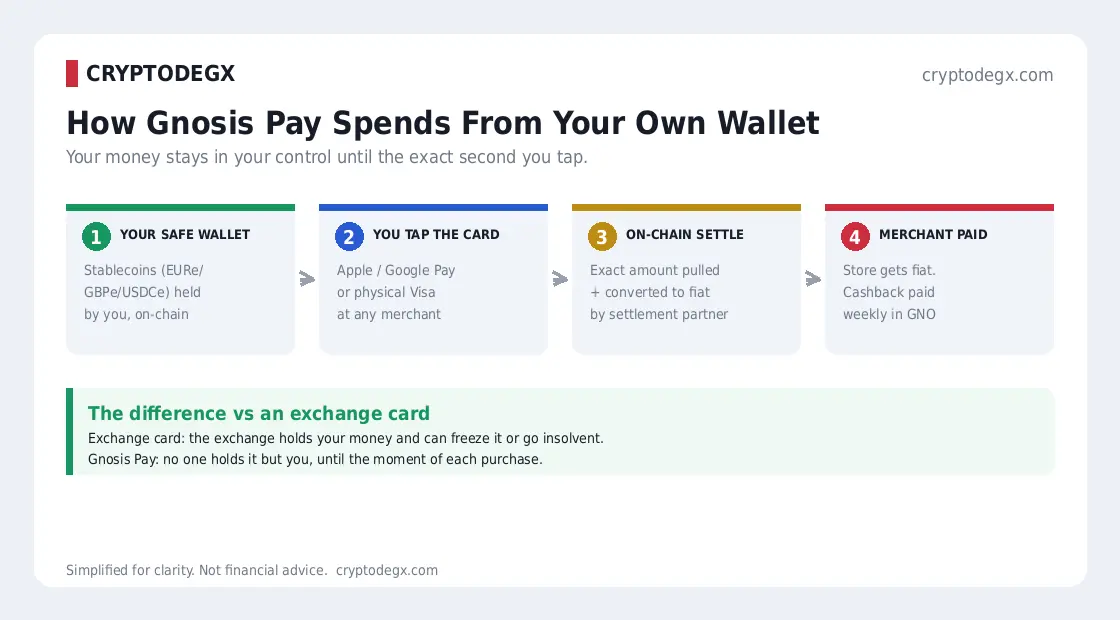
Gnosis Pay is a self-custodial Visa debit card linked to a Safe smart account on Gnosis Chain. You fund it with a regional stablecoin (EURe in the EEA, GBPe in the UK, USDCe elsewhere), and when you tap the card, a settlement partner converts to fiat at the point of sale. The money never leaves your control until you spend it, which is the whole point, and the thing no exchange card offers.
| Type | Self-custodial Visa debit |
| Custody | Your own Safe smart wallet (Gnosis Chain) |
| Funded with | EURe (EEA), GBPe (UK), USDCe (other regions) |
| Cashback | 1% to 5% in GNO, tier-based |
| Card fee | ~€30 one-time issuance (sometimes waived) |
| FX fee | 0% on euro; Visa network spread on other currencies |
| Availability | EEA, UK, and select markets |
| Mobile pay | Apple Pay, Google Pay |
How Gnosis Pay works, day to day
The flow is different from a normal card, and worth understanding before you decide. There’s no account you top up and no balance the company holds. Your stablecoins sit in your own Safe wallet on Gnosis Chain, and the card pulls from it the moment you tap.
When you pay, a settlement partner takes the exact amount in your regional stablecoin, converts it to fiat, and the merchant gets paid in their currency. It happens in the usual card-tap second, so the on-chain part is invisible at the till. The practical upshot: your money stays in your control right up until the instant you spend it, which no exchange card can claim.
That design changes a few things. You can watch every transaction settle on-chain if you want, there’s no overdraft or credit line (strictly debit from what you hold), and if the card service ever goes down, your funds are untouched in a wallet you can open with any Safe-compatible tool.
Setting it up: what to actually expect
This is where Gnosis Pay loses beginners, so here’s the honest version of the process rather than the marketing one.
You apply through the Gnosis Pay app and clear a standard identity check (ID plus a selfie). It’s a regulated card, so KYC is required despite the self-custody, which surprises people who assume self-custodial means anonymous. It doesn’t.
The app sets up a Safe smart account on Gnosis Chain that you control. This is the wallet the card spends from. If you already use Safe for DeFi, this is familiar; if not, it’s your first smart-contract wallet, and worth reading the wallet basics first.
Here’s the friction point. You fund the card with your region’s stablecoin on Gnosis Chain: EURe in the EEA, GBPe in the UK, USDCe elsewhere. If your money is sitting as USDC on Ethereum or Solana, you’ll bridge and swap it to the right token on Gnosis Chain first, matching networks the way the wrong-network guide drills. Get this wrong and funds land in the wrong place.
Cashback only kicks in once you hold GNO in the Safe wallet, at the tier you’re aiming for. This is optional, you can run the card at 0% cashback with no GNO, but if rewards are the point, this is the step that costs real capital.
Once verified and funded, add the card to Apple Pay or Google Pay and tap anywhere Visa is accepted. A physical card is available too. From here it behaves like any contactless card, with the on-chain settlement happening quietly behind each payment.
Realistic time from zero: under an hour if you already hold crypto and know how to bridge, a frustrating afternoon if you don’t. This is not a first-ever-crypto-product card, and pretending otherwise does beginners no favors.
The cashback, and the part the listicles skip
Every review leads with “up to 5% cashback,” so let’s be precise about what that costs. Cashback is tiered by how much GNO you hold in your Safe wallet (not staked or locked, just held, and you can sell anytime):
| 0.1 GNO | 1% cashback |
| 1 GNO | 2% cashback |
| 10 GNO | 3% cashback |
| 100 GNO | 4% cashback |
| + OG NFT | +1% (5% maximum) |
The honest math: to earn a meaningful 3%, you hold roughly 10 GNO, which at recent prices is a few thousand dollars parked in a volatile token. That’s not a fee, but it’s capital at risk in GNO’s price, and your cashback is also paid in GNO, so the whole reward is a bet on one token. If GNO drops 30%, your “3% cashback” quietly shrank. The listicles print the 5% and move on; you should know the reward currency is the catch.
What the cashback is really worth: a worked example
Headline rates are easy to print and hard to feel, so here’s a concrete case. Say you’re a European putting €2,000 a month of everyday spending through the card, holding 10 GNO to sit at the 3% tier.
At 3%, that’s roughly €60 a month, around €720 a year, paid weekly in GNO. Against that, you tie up the value of 10 GNO (a few thousand euros at recent prices) in a token whose price moves, plus the one-time ~€30 issuance fee. If GNO holds its value, you’re genuinely ahead, and the 0% euro fees mean nothing eats into it. If GNO falls 25% over the year, a chunk of that €720 reward, and the capital you parked, shrinks with it.
Two caps matter here and rarely make the listicles. Cashback-eligible spend is limited on a weekly basis, so very high spenders don’t earn the headline rate on everything. And the rate is only “up to” your GNO tier, so someone spending €2,000/month at the 1% tier (0.1 GNO held) earns closer to €20/month, not €60. Match the tier to how much you’ll actually spend, or the GNO you hold for rewards is working harder as a bet on GNO than as a cashback engine.
Where it genuinely wins
The fee structure is the real draw, not the cashback. Zero fees on card transactions, zero FX on euro spending, zero gas (Gnosis subsidizes it), and zero off-ramp fees. For a European who spends in euros, the all-in cost of using this card is close to nothing, which beats basically every custodial competitor once you read their fine print.
And the self-custody is real, not marketing. Your stablecoins sit in a Safe smart account whose keys you hold, every transaction is verifiable on-chain, and there’s no exchange that can freeze your balance or go insolvent with your money, the exact failure mode our red flags guide exists for. If “not your keys, not your coins” is a principle you actually live by, this is the only card at scale that honors it.
Where it falls short
Pros
- Genuine self-custody, on-chain settlement
- 0% transaction, FX (euro), gas, and off-ramp fees
- Up to 5% cashback, paid weekly
- Apple Pay and Google Pay
- No APR, no debt, no credit check
Cons
- Cashback paid in volatile GNO
- Top tiers need thousands held in GNO
- Headline rate is a temporary program
- EEA / UK only, stablecoin-only funding
- Setup is fiddly for non-DeFi users
The setup friction is worth flagging for beginners: you’re funding a Safe wallet with a specific stablecoin on Gnosis Chain, which is second nature if you already use DeFi and genuinely confusing if you don’t. This is a card for people already comfortable with self-custody wallets, not a first crypto product.
Gnosis Pay vs the other self-custody cards
Gnosis Pay isn’t the only card that keeps you in custody. The two it’s actually compared against are MetaMask (broader reach, lower cashback) and Bleap (higher cashback, paid in a stablecoin instead of a volatile token). The honest layout:
| Feature | Gnosis Pay | MetaMask Card | Bleap |
|---|---|---|---|
| Max cashback | Up to 5% ✓ | 3% (Metal tier) | Up to 20% headline |
| Cashback paid in | GNO (volatile) | Crypto rewards | USDC (stable) |
| FX fee (euro) | 0% ✓ | 0% (Metal only) | 0% |
| Custody | Self-custody | Self-custody | Self-custody |
| Network / chain | Visa / Gnosis Chain | Mastercard / Linea, Base, Solana | Mastercard |
| Annual fee | ~€30 one-time | $0 (Metal $199/yr) | $0 |
| Availability | EEA + UK | 48 countries ✓ | Select markets |
The read: Gnosis Pay wins on euro fees and pure cashback headroom, MetaMask wins on reach and chain flexibility, and Bleap wins on reward quality by paying in a stablecoin you don’t have to babysit. If the GNO-denominated reward bothers you, that’s the single biggest reason to look at Bleap instead. If on-chain euro settlement is the point, Gnosis Pay is still the cleanest version of it.
Is Gnosis Pay safe, and is it legit?
It’s legitimate, and the safety story is actually its strongest argument. Because it’s self-custodial, your money sits in a Safe smart account you control, so there’s no exchange that can freeze your balance or collapse with your funds, the failure mode that took down Celsius and FTX. Safe is among the most battle-tested smart-wallet systems in crypto, securing billions.
The risks that remain are different in shape. Your cashback is held in GNO, so a token-price drop is a real loss of reward value. The settlement partner and card issuer are third parties, so a card outage is possible even though your underlying funds stay yours. And self-custody means self-responsibility: lose your keys, lose access, with no support line to reset anything. It’s safe in the ways that matter most for your principal, with the normal self-custody trade-off that the safety net is you.
Who should get it, who shouldn’t
Get it if: you’re in the EEA or UK, you already use self-custody wallets, you spend in euros, and keeping control of your money matters more to you than chasing the highest headline cashback number. For that person, nothing else comes close.
Skip it if: you’re outside its regions, you want simple custodial convenience, you’re a crypto beginner, or you don’t want cashback denominated in a token you have to hold and watch. A custodial exchange card will be simpler, and some competitors pay cashback in stablecoins instead of a volatile token.
FAQ
Is the Gnosis Pay card worth it?
For self-custody-focused spenders in the EEA or UK who spend in euros, yes: the near-zero fee structure and genuine on-chain settlement are unmatched. For everyone else, the volatile GNO cashback, regional limits, and setup complexity make a simpler custodial card the better fit. It’s an excellent card for the right person, not a universal recommendation.
How does Gnosis Pay cashback actually work?
Cashback is tiered by how much GNO you hold in your Safe wallet: 0.1 GNO earns 1%, 1 GNO earns 2%, 10 GNO earns 3%, 100 GNO earns 4%, plus a 1% boost for OG NFT holders, up to 5%. The GNO is held, not staked or locked, so you can sell anytime, though your tier adjusts. Rewards are paid weekly in GNO.
Is Gnosis Pay really self-custodial?
Yes. Your funds sit in a Safe smart-contract account on Gnosis Chain whose keys you control, and the card spends directly from it with on-chain settlement. No exchange holds your balance, which eliminates the counterparty risk behind most exchange collapses. It’s the main reason to choose this card over a custodial one.
What are the real fees on Gnosis Pay?
A roughly €30 one-time card issuance fee (sometimes waived), then 0% on card transactions, 0% FX on euro spending, 0% gas, and 0% off-ramping. The Visa network spread may apply on non-euro currencies. The genuine “cost” is the capital you tie up in GNO to unlock higher cashback tiers, which is price risk rather than a fee.
What’s the catch with the 5% cashback?
Two catches. It’s paid in GNO, a volatile token, so the real value of your rewards moves with GNO’s price, and reaching the top tiers requires holding a meaningful amount of GNO. The current rates also run under a temporary program with a 2026 expiry, so the headline number is current rather than guaranteed long-term.
How do I set up and fund a Gnosis Pay card?
Apply in the app and pass a KYC identity check, after which a Safe smart wallet is created for you on Gnosis Chain. You then fund it with your region’s stablecoin (EURe, GBPe, or USDCe), optionally add GNO to unlock cashback tiers, and add the card to Apple or Google Pay. Expect under an hour if you already use crypto, longer if bridging is new to you.
Which countries can use Gnosis Pay?
It’s available across the EEA and UK, with select other markets, and funding uses a region-specific stablecoin (EURe in the EEA, GBPe in the UK, USDCe elsewhere). Availability and the supported stablecoin depend on your country, so confirm both on the official site before applying.
Is Gnosis Pay safe and legit?
Yes to both. It’s a real Visa card issued through a regulated settlement partner, and its self-custodial design is safer for your principal than custodial exchange cards, since no third party holds your balance to freeze or lose. The remaining risks are GNO price exposure on your cashback, possible card-service outages, and the self-responsibility of holding your own keys.
Gnosis Pay vs Bleap, which is better?
Gnosis Pay pays a higher headline rate (up to 5%) but in volatile GNO, while Bleap pays cashback in stablecoin, which many people prefer because the reward value doesn’t swing. If you want on-chain euro settlement and don’t mind holding GNO, Gnosis Pay; if you want simpler, stable rewards, Bleap is the stronger pick. Both are self-custodial.
Do I need to understand DeFi to use it?
Somewhat. Funding a Safe smart wallet with a specific stablecoin on Gnosis Chain is straightforward if you already use self-custody wallets and genuinely confusing if you don’t. It’s best suited to people already comfortable with on-chain wallets rather than complete beginners making their first crypto move.