MetaMask Money Account Review (2026): The Honest Take on the 4% Yield
 October 10, 2026
8 min read
October 10, 2026
8 min read
Disclosure: This review is information and opinion, not financial advice. Figures are as of late 2026 and change; the APY is variable and not guaranteed. See our full disclaimer.
MetaMask, the wallet a hundred million people already use, launched something that looks a lot like a bank savings account: deposit stablecoins, earn up to 6% (now ~4%), spend them with a card, and keep your own keys the whole time. On June 30, 2026, Consensys shipped the Money Account, and the pitch is seductive: earn, spend, and trade from one balance, no bank involved.
It’s a genuinely clever product. It’s also not a savings account, and the gap between how it feels and what it actually is deserves a clear-eyed look before you move money in.
What the Money Account actually is
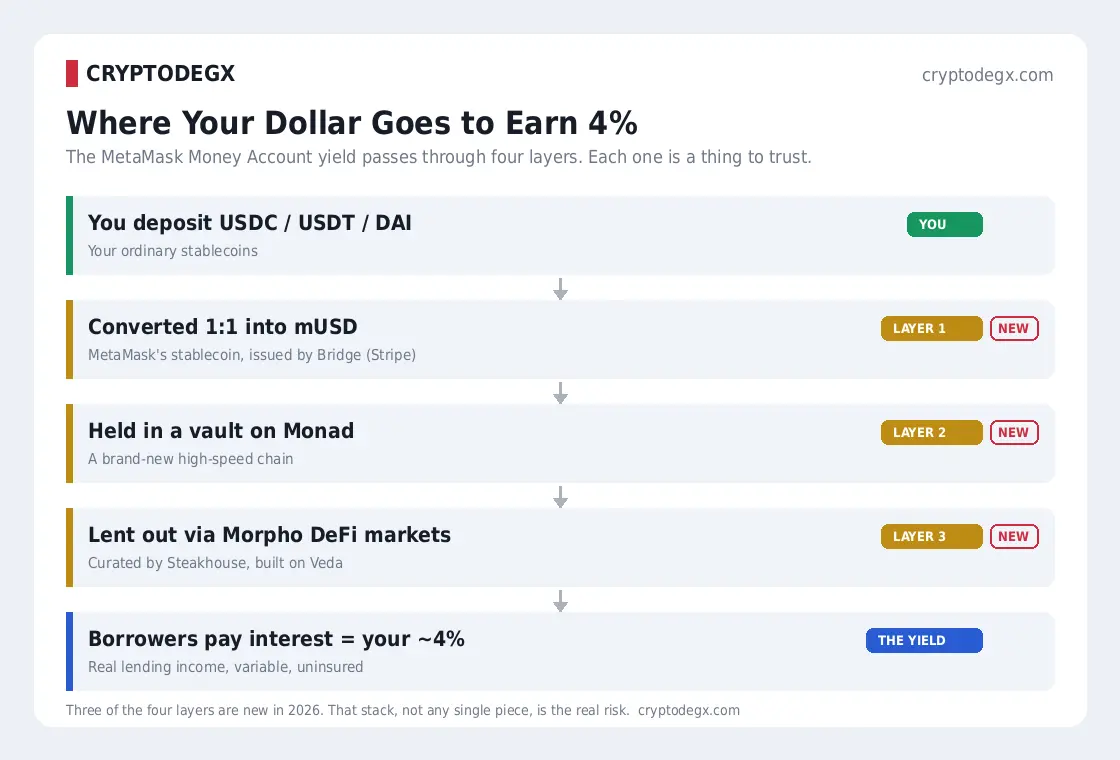
Strip the “savings account” framing and here’s the mechanic. You deposit a stablecoin (USDC, USDT, DAI, and others), which converts 1:1 into mUSD, MetaMask’s own dollar-denominated stablecoin issued by Bridge, a Stripe company. That mUSD sits in a DeFi vault that lends it out, and the lending interest flows back to you as yield. You can spend the balance anytime via the MetaMask Card, and it keeps earning right up to the moment you tap.
The clever part is the integration: historically, earning yield meant one protocol, spending meant another, and moving between them meant bridging. The Money Account folds all three into one self-custodial balance. You hold the keys throughout, and can exit to a normal wallet whenever you want.
| Type | Self-custodial yield + spending account (in MetaMask Mobile 8.0+) |
| Yield | Up to ~6% promo (ended Sep 30, 2026), ~4% variable after |
| Yield source | DeFi lending (Morpho vaults, Aave planned), via Veda / Steakhouse |
| Chain | Monad only (exclusive home chain) |
| Balance token | mUSD (issued by Bridge, a Stripe company) |
| Lockup | None, fully liquid |
| Fees | No open, minimum, or withdrawal fees |
| Spending | MetaMask Card (Mastercard), up to 3% back |
Where the yield actually comes from
This is the question that matters most, and to MetaMask’s credit, the answer is honest: the yield is real lending income, not a marketing subsidy paid out of thin air. Your mUSD is lent to borrowers through DeFi protocols (Morpho at launch, with Aave planned), curated by Steakhouse Financial on infrastructure from Veda. Borrowers pay interest, and that interest, minus protocol and product costs, is your APY.
That’s genuinely better than the fake-yield products our stablecoin yield decoder exists to catch. But “real” doesn’t mean “risk-free.” DeFi lending carries smart-contract risk (a bug or exploit in the vault), and the rate is variable, so it moves with lending demand. When you can explain who’s paying you (borrowers) and why (they want leverage), you’ve passed the test this whole site runs on. Just don’t confuse passing that test with the safety of a bank.
Why Monad, and why that’s a double-edged sword
The Money Account runs exclusively on Monad, a new high-throughput chain targeting 10,000 transactions per second with sub-second finality. The technical reason is sound: real-time card authorization and pull-from-yield-the-instant-you-spend only work if the chain settles fast and gas is predictable, which Ethereum mainnet and most L2s can’t reliably guarantee.
The trade-off is concentration. Your funds, your yield, and your spending all depend on one brand-new blockchain’s uptime and security. Monad is fast and well-funded, but it doesn’t have Ethereum’s years of battle-testing. You’re trusting a new chain, a new stablecoin (mUSD), and a DeFi vault, three newer pieces stacked together. That stack is the real risk surface, more than any single component.
mUSD: one more layer of trust
Worth its own note, because it’s easy to miss. When you deposit, your dollars don’t stay as USDC or USDT; they become mUSD, MetaMask’s own stablecoin, issued by Bridge (owned by Stripe) on M0 infrastructure. It’s a reputable issuer, and mUSD is Treasury-backed, so this isn’t a red flag. But it is another entity you’re trusting in the chain between your dollars and your yield. The same stablecoin-risk questions apply to mUSD as to any other: who backs it, with what, and how verifiably.
The card and the bigger strategy
The Money Account connects to the MetaMask Card (Mastercard), so you spend your yield-earning balance directly, with up to 3% back on eligible purchases, and the rest of your balance keeps earning while you spend. It slots into the broader trend we covered in stablecoin cards becoming crypto’s real use case: a wallet that earns, spends, and trades from one balance, which is MetaMask’s answer to Trust Wallet, Rabby, and the other wallets eating its market share. For MetaMask, Money Account is a retention play as much as a product. For you, it’s a convenience worth weighing against the stacked-newness risk.
How it compares
| Feature | MetaMask Money | Plasma One | Plain stablecoin |
|---|---|---|---|
| Yield | ~4% (was 6% promo) | ~4% Earn vault | 0% (issuer keeps it) |
| Yield source | DeFi lending (disclosed) | DeFi lending | n/a |
| Custody | Self-custody ✓ | Self-custody | Depends on wallet |
| Spend + earn together | Yes ✓ | Yes | No |
| Chain | Monad only | Plasma only | Any |
| Extra trust layer | mUSD + Monad + vault | XPL + Plasma + vault | Just the issuer |
The read: MetaMask Money and Plasma One are close cousins, both fold DeFi yield into a self-custodial spending account. MetaMask’s edge is the brand, the 100M-user distribution, and not forcing you to hold a volatile token (Plasma ties tiers to XPL). The shared weakness is the stacked newness: a new chain, a new stablecoin, and a yield vault, all young. Against just holding a stablecoin, Money Account’s obvious win is that you actually earn the Treasury-rate interest the stablecoin issuer would otherwise pocket.
Who it’s for, who it isn’t
Get it if
- You already use MetaMask and hold stablecoins
- You want ~4% on idle dollars, kept liquid
- You value self-custody over bank-style insurance
- You’ll spend via the card and want earn-while-you-spend
- You understand DeFi lending risk
Skip it if
- You expected the 6% promo rate (it ended)
- You want FDIC-style deposit protection
- New chains and new stablecoins make you uneasy
- You don’t want another trust layer (mUSD)
- You’re not comfortable in a self-custody wallet
FAQ
Is the MetaMask Money Account worth it?
For existing MetaMask users who hold stablecoins and understand DeFi lending risk, yes: it pays a real ~4% on fully liquid, self-custodial dollars and lets you spend them via a card while they earn. It’s not worth it if you expected the expired 6% promo, want bank-style deposit insurance, or aren’t comfortable with a self-custody wallet on a new chain.
Is the MetaMask Money Account really 6% APY?
Not anymore. The ~6% was a promotional rate that ended September 30, 2026; the ongoing rate is up to about 4% variable, roughly tracking short-term Treasury yields. The APY is not guaranteed and moves with DeFi lending demand, so treat any current claim of 6% as outdated.
Where does the Money Account yield come from?
From real DeFi lending: your deposit converts to mUSD, which is lent to borrowers through protocols like Morpho (with Aave planned), curated by Steakhouse Financial on Veda’s infrastructure. Borrowers’ interest, minus protocol and product costs, is your yield. It’s genuine lending income, not a subsidy, but it carries smart-contract risk and a variable rate.
Is the MetaMask Money Account safe?
It’s self-custodial, so MetaMask can’t freeze or move your funds, which removes exchange-style counterparty risk. The real risks are DeFi smart-contract risk in the lending vault, the newness of the Monad chain it runs on, reliance on the mUSD stablecoin, and a variable rate. It is safer than custodial earn products in some ways and riskier than a bank in others, and carries no deposit insurance.
What is mUSD?
MetaMask’s own dollar-denominated stablecoin, issued by Bridge (a Stripe company) on M0 infrastructure, that your deposits convert into 1:1. It’s the token that earns yield and funds card spending inside the Money Account. Being a newer, Treasury-backed stablecoin, it adds one more issuer to trust between your dollars and your returns.
Why does it only run on Monad?
Because real-time card authorization and spending yield-earning funds the instant you tap require sub-second finality and predictable gas, which Monad provides and Ethereum mainnet or typical L2s can’t reliably guarantee. The trade-off is concentration risk: your funds, yield, and spending all depend on one brand-new chain’s security and uptime.
Can I lose money in the Money Account?
Yes, through DeFi risk rather than market swings, since the balance is stablecoin-denominated. A smart-contract exploit in the lending vault, a depeg of mUSD or an underlying stablecoin, or a problem on the Monad chain could all cause losses. The principal doesn’t swing like a volatile token, but “stable” is not “guaranteed,” and there’s no insurance backstop.
MetaMask Money Account vs a bank savings account?
Different animals. A bank pays lower rates but carries deposit insurance and decades of regulation; the Money Account pays a comparable ~4% with self-custody and instant crypto spending, but no insurance and newer, DeFi-based risk. Use it as a crypto-native yield-and-spending tool for funds you’re comfortable exposing to DeFi, not as a replacement for your emergency savings.