Walt (Telegram) Review: First Look at the Billion-User Crypto Platform
 October 8, 2026
7 min read
October 8, 2026
7 min read
Disclosure: This is a first-look review of a product launched in late September 2026. Details are early and will change as Walt and Gram Wallet roll out; we’ll update as more is confirmed. Information and opinion, not financial advice. See our full disclaimer.
On September 28, 2026, Telegram did something that could put crypto in front of more people than any exchange ever has. It split its in-app crypto service into two: Gram Wallet, a dead-simple self-custodial wallet rolling out to Telegram’s billion-plus users, and Walt, the rebranded trading platform (formerly “Wallet in Telegram”) for people who want to do more than send and receive.
The scale is the story. But there’s a detail in that split almost every headline glosses over, and it changes how you should treat each product. Here’s the first-look breakdown, with the one thing you need to understand before using either.
Walt vs Gram Wallet: the split, explained
Telegram’s crypto started years ago as a bot for buying Toncoin and Bitcoin. It grew into a full trading hub, and the company decided one product couldn’t serve both “I want to send a friend $10” and “I want to trade perpetuals.” So it split them.
| Gram Wallet | Walt | |
|---|---|---|
| Role | Everyday wallet | Trading & investing platform |
| Custody | Self-custodial ✓ | Custodial (holds your assets) |
| Built for | Transfers, payments, gifts | Trading, earn, tokenized assets |
| KYC | None for basic use | Likely for advanced features |
| Where to find it | Default in Telegram settings | Search bar / @walt |
| Fees | Zero-fee GRAM transfers | Trading fees apply |
Think of Gram Wallet as the on-ramp built for a billion people, and Walt as the destination for the fraction who want to actually trade. They connect: Walt lets you top up your Gram Wallet directly. For most people reading this, the honest advice is that Gram Wallet is the safer default and Walt is an optional power-user layer, not a requirement.
What Walt actually offers
Walt is the serious product, and on paper it’s genuinely broad. Based on launch details, it supports 200-300+ assets across multiple blockchains, with cross-chain transfers, and goes well beyond buying and selling.
| Type | Custodial multi-chain trading platform (in Telegram) |
| Assets | 200-300+ across several chains |
| Trading | Spot, plus perpetual futures |
| Beyond crypto | Tokenized stocks, ETFs, gold |
| Earn | Yield / earn programs |
| Access | Inside Telegram, no separate app |
| Custody | Custodial (platform holds assets) |
The tokenized stocks and gold are the eye-catching part: buying exposure to equities or commodities from inside a chat app is a genuinely novel consumer experience, and Telegram’s reach could make it mainstream in a way standalone apps haven’t. The earn products and perpetual futures put it in the same risk territory as any trading venue, which means the usual cautions apply, perps especially, as our perpetuals explainer covers.
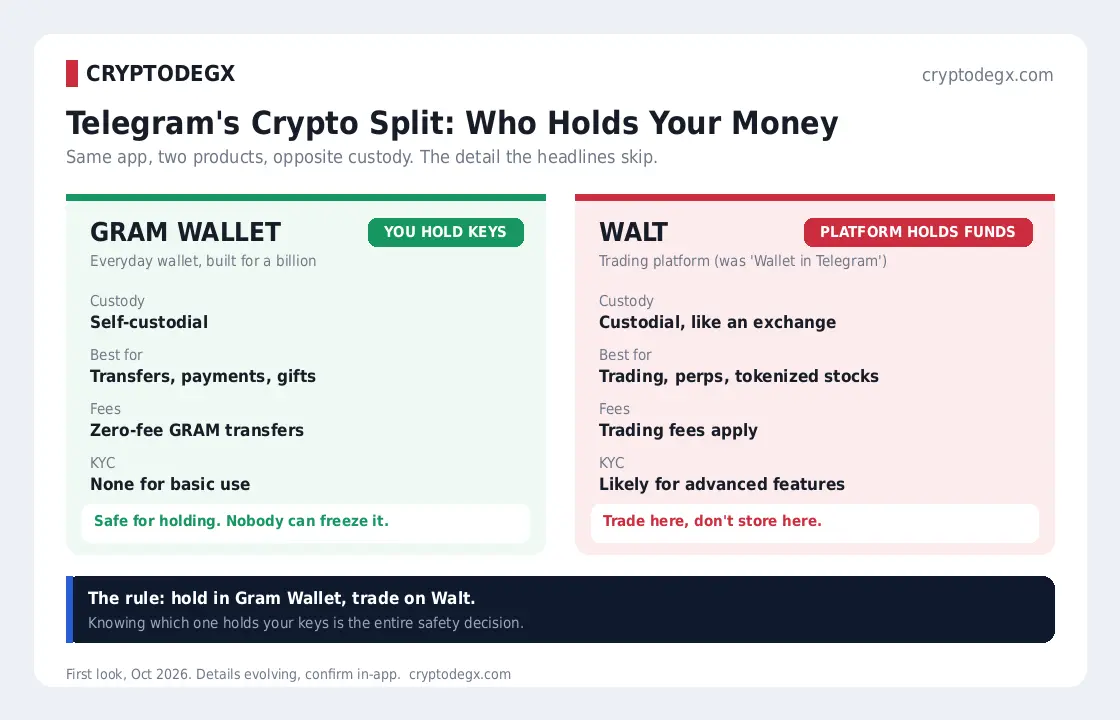
The convenience-versus-control trade, which is the whole decision
Here’s what makes Walt different from a self-custody card or wallet, and it’s not a flaw so much as a choice you’re making. Because Walt is custodial, using it means Telegram’s crypto arm holds your assets while they’re on the platform, the same arrangement as a centralized exchange. You get convenience (no seed phrase, instant access, everything in one app) in exchange for counterparty risk (if the platform has problems, your funds are exposed).
That’s a reasonable trade for small, active trading balances, and a poor one for savings. The same rule from every exchange we cover applies here: a trading platform is for trading, not storing, and meaningful holdings belong in self-custody, which, conveniently, is exactly what Gram Wallet provides in the same app. Use each for its job.
Why the scale genuinely matters
Set the caution aside for a second, because the upside is real. Most crypto onboarding fails at step one: download a wallet, write down a seed phrase, buy crypto somewhere else, send it over. Telegram skips all of that by putting a self-custodial wallet inside an app a billion people already open daily.
If even a small percentage activate Gram Wallet, it becomes one of the largest self-custodial wallet deployments in history, and Walt becomes a trading platform with a built-in audience no competitor can match. For crypto adoption broadly, that’s significant. For you specifically, it means the tools are convenient and worth understanding, with the custody distinction firmly in mind.
Who should use what
Gram Wallet makes sense if
- You want simple, self-custodial transfers
- You already live in Telegram
- You send crypto to friends or for gifts
- You want an easy first self-custody wallet
- Zero-fee GRAM transfers appeal to you
Walt makes sense if
- You want to trade from inside Telegram
- Tokenized stocks / gold interest you
- You understand it’s custodial, like an exchange
- You’ll keep only active-trading funds on it
- You want earn products in one place
FAQ
What is Walt?
Walt is Telegram’s rebranded in-app crypto trading and investing platform, formerly called “Wallet in Telegram.” It’s a custodial multi-chain hub supporting 200-300+ assets with spot trading, perpetual futures, earn products, and tokenized stocks, ETFs, and gold, all accessible inside Telegram via the search bar or @walt.
What’s the difference between Walt and Gram Wallet?
They’re two separate products with opposite custody models. Gram Wallet is a simple self-custodial wallet (you hold the keys) for everyday transfers and payments, now the default in Telegram’s settings. Walt is a custodial trading platform (it holds your assets, like an exchange) for advanced activity. Walt can top up your Gram Wallet, but the custody difference is the key distinction.
Is Walt self-custodial?
No. Walt is custodial, meaning it holds your assets while they’re on the platform, the same as a centralized exchange. Gram Wallet is the self-custodial product in Telegram’s crypto lineup. If self-custody matters to you, use Gram Wallet for holding and treat Walt as a trading venue only.
Is Walt safe to use?
As a brand-new product (launched late September 2026) with a short track record, it warrants caution. Walt being custodial adds counterparty risk, so the sensible approach is keeping only active-trading funds on it and holding the rest in self-custody. Gram Wallet’s self-custodial design is structurally safer for storage. Start small while the products mature.
Does Walt or Gram Wallet require KYC?
Gram Wallet enables basic self-custodial transfers without KYC. Walt, as a custodial platform offering trading and tokenized securities, is likely to require identity verification for advanced features, in line with how regulated trading services operate. Confirm current requirements in-app, since this is evolving.
Can I buy stocks on Walt?
Walt’s launch materials include tokenized stocks, ETFs, and gold, meaning you can get price exposure to those assets from inside Telegram. Tokenized stocks are a representation of the underlying asset rather than direct share ownership, so understand what you’re actually holding and the issuer behind it before buying.
Do I have to use Walt if I use Telegram?
No. Gram Wallet is becoming the default crypto wallet in Telegram’s settings, while Walt is an optional platform you access separately via search or @walt. Most users only need Gram Wallet for simple transfers; Walt is for those who specifically want trading and investing features.
Is this the same as Telegram’s old TON wallet?
It’s the evolution of it. Telegram’s crypto began as a bot for buying Toncoin and Bitcoin, grew into the “Wallet in Telegram” trading hub, and that hub is what’s now rebranded as Walt, while the new native Gram Wallet handles simple self-custodial use. GRAM is the associated token and the name of the native wallet.