5 Crypto Trends to Watch in 2027: What the Data Actually Shows
 November 6, 2026
14 min read
Disclosure: This trend analysis is information and opinion, not financial or investment advice. Crypto is volatile, narratives fade, and most tokens tied to a “hot sector” still lose money. Figures are as of early November 2026 and move fast. See our full disclaimer.
Every cycle gets a story. 2017 had ICOs. 2020 had DeFi summer. 2021 had NFTs and a pile of “Ethereum killers.” 2024 had spot ETFs and memecoins. So it’s tempting to pick five buzzwords for 2027, call it a supercycle, and move on.
We’re not going to do that. Bitcoin is sitting around $75,800, roughly 40% below its October 2025 high of $126,080, and down about 13.5% this year, while Ethereum and Solana fell harder over the past month (Yahoo Finance). Binance just lost a record $6.3 billion to a hack attributed to North Korea (Reuters). And the CLARITY Act, the market-structure bill a lot of people were counting on, failed in the Senate in September and now looks likely to lapse with this Congress (Troutman Pepper Locke).
That’s the backdrop. Not a supercycle. A market that’s being forced to show what actually gets used. Which, honestly, is the best time to look at trends, because the hype has been sanded off and you can see the numbers underneath.
Below are the five crypto trends for 2027 we think are worth tracking, what the real data says about each one, where the catch is, and the free tools you can use to check it yourself instead of trusting us (or anyone on X).
Real but early: stablecoin payment chains like Circle’s Arc and Stripe’s Tempo, plus AI agents paying with stablecoins over x402. The rails exist. The volume is still tiny.
Show me the revenue: DePIN and the new parallel EVM layer 1s. Some networks earn real money, but tokens have mostly collapsed, and big unlocks are coming.
The pattern for 2027 is simple: follow fees and usage, not narratives.
Quick note on that score, because it’s not a price prediction. It rates how much real usage and revenue sits behind each trend today. A low score doesn’t mean a token can’t pump. It means you’re paying mostly for the story.
Key takeaways
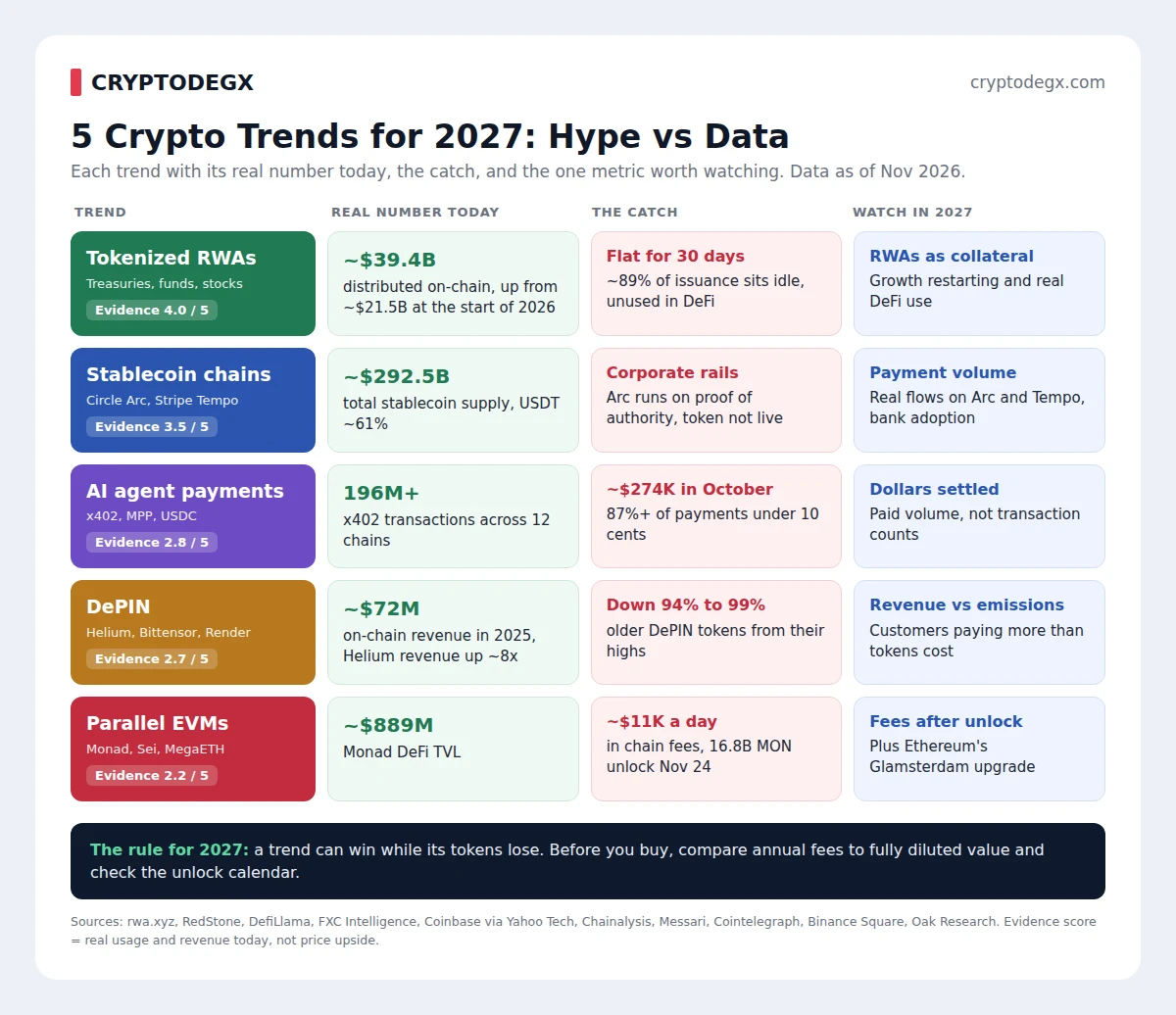
- Tokenized RWAs have the strongest evidence of real demand, with about $39.4 billion distributed on-chain. Growth was nearly flat over 30 days, and an estimated 89% of issuance is unused in DeFi.
- Stablecoin supply is about $292.5 billion, but new payment chains are still early. Arc uses permissioned validators, and its ARC token has not launched.
- x402 has processed more than 196 million transactions, but October’s 5.1 million transactions settled only about $274,000. Transaction counts alone can exaggerate demand.
- DePIN generated about $72 million in on-chain revenue in 2025, yet tokens launched from 2018 to 2022 are down 94% to 99% from their highs. Network use does not guarantee token value.
- Parallel EVMs still need to prove their economics: Monad has about $889 million in DeFi TVL but collected only around $11,000 in daily fees, with a large MON unlock approaching.
- For 2027, follow fees and usage rather than narratives. Compare annual fees with fully diluted value, and check upcoming token unlocks.
1. Tokenized Real-World Assets (RWAs): the one with actual money behind it
If you only track one 2027 narrative, make it this one. Tokenization means putting a traditional asset, like a Treasury bill, a money market fund, a loan or a share of stock, on a blockchain as a token that can settle 24/7.
The numbers are real. According to rwa.xyz, distributed RWAs (tokens you can actually move between wallets) stand at about $39.4 billion, versus roughly $21.5 billion at the start of 2026 (Blockchain Reporter). Tokenized US Treasuries alone are around $14.2 billion (GlobeNewswire via Fidelity).
The biggest names are familiar ones. BlackRock says its BUIDL fund holds about $2.3 billion (Bloomingbit). Ondo’s USDY shows about $2.39 billion in TVL (Ondo Finance). On the chain side, Solana’s RWA value has passed $5 billion (Yahoo Finance).
Tokenized stocks are the sibling trend to watch
Tokenized stocks went from a curiosity to a real market this year. One count puts them at $3.69 billion across 4.75 million holders, led by bStocks, Ondo and xStocks, with Robinhood Chain opening its mainnet in July (Blockchain Reporter). CoinDesk’s broader count hit a record $4.87 billion with about $15.6 billion in monthly volume (CoinDesk). Different trackers, different methods, same direction.
Now the catch. Two of them, actually.
First, growth has stalled. That same $39.4 billion is up just 0.02% over 30 days on rwa.xyz, and BUIDL slipped 4.72% over a recent 30-day window (HOGE Wire). Second, most of this stuff just sits there. RedStone estimates around 89% of RWA issuance isn’t used anywhere in DeFi (RedStone). A Treasury bill on a blockchain that nobody lends against or trades is basically a Treasury bill with extra steps.
For investors, the important point is that a BlackRock fund going on-chain doesn’t automatically send any token up. The fund holders get Treasury yield. Token holders only win if a protocol actually captures fees from it. That’s the question to ask about ONDO, LINK (oracles and cross-chain messaging for tokenized funds), AVAX and ENA, whose USDtb stablecoin uses BUIDL as its main reserve asset (CCN).
2. Stablecoin Chains: Arc, Tempo and the fight to own payments
Stablecoins are the part of crypto that already works. DefiLlama puts total supply at about $292.5 billion, with USDT holding around 61% of it (DefiLlama). It’s actually shrinking a little right now, down about 3% over 30 days (Au79 Macro Research), which tells you money is leaving the market, not that stablecoins failed.
The 2027 story is who owns the rails. Two big launches this year:
- Tempo, the payments layer 1 from Stripe and Paradigm, went to mainnet in March 2026 (FXC Intelligence).
- Arc, Circle’s own chain, opened its public mainnet on September 16 with founding validators including BlackRock, DTCC, Mastercard, Visa and Standard Chartered (Circle). We explain how it works in our Circle Arc guide.
Here’s what most trend articles skip. Arc still runs on proof of authority, meaning a permissioned set of validators, and its ARC token has been minted but not launched (FXC Intelligence). These are corporate chains first. They may be great for payments and still not great for anyone hoping to buy a token early.
The likely investor angle in 2027 is indirect: which chains and apps win stablecoin flow, and which issuers (Circle is public as CRCL) earn on the float. If you want the basics, start with what stablecoins are, then USDT vs USDC, and our take on stablecoin cards, the most real consumer use case so far.
3. AI Agents That Pay: x402 and agentic payments
This is the trend everyone wants to talk about, and the one where the gap between headline and reality is widest.
The idea: AI agents need to pay for things like data, API calls and compute, often in amounts too small for a card. x402, an open standard backed by Coinbase, lets a website ask for a stablecoin payment in the same request. Coinbase says more than 97% of on-chain agent transactions in Q2 2026 went through x402, and the protocol has processed over 196 million transactions across 12 chains, settling more than $42 million in total (Yahoo Tech). Nearly all of it is in USDC (Yahoo Finance).
Sounds big. Then you look closer.
More than half of that activity came from a late-2025 memecoin frenzy, and in October 2026 x402 handled 5.1 million transactions worth only about $274,000 (Yahoo Tech). Chainalysis found more than 87% of payments were between a hundredth of a cent and 10 cents (Yahoo Finance). In a BeInCrypto sample, 6.4 million payments moved less than $120,000, and one eight-day burst on Solana made up 94.5% of the transactions (Yahoo Finance).
So is it fake? No. Micropayments between machines are a real use case cards can’t serve. But in 2027 terms, it’s a plumbing story, not a token story. Most payments settle in USDC on Base and Solana, which helps those networks a bit and helps Circle a bit. There is no “x402 token” to buy, and you should be suspicious of anyone selling you one.
The shopping side, often called agentic commerce, tells a similar story. The Agentic Commerce Protocol (ACP) retired its in-chat card checkout in March 2026, and the market split into two stablecoin-native rails: x402 and the Machine Payments Protocol (MPP), launched the same month by Stripe and Tempo, which reports 46,198 cumulative events (Yahoo Finance). Forty-six thousand. That’s a pilot, not an economy. Assistants like ChatGPT agent and Claude can already browse and shop, but crypto is one payment rail among several, and the card networks aren’t sitting still.
4. DePIN: real revenue, brutal token charts
DePIN (decentralized physical infrastructure networks) uses tokens to pay people for running hardware: hotspots, GPUs, mapping cameras, storage. It’s one of the few crypto sectors that can point to paying customers.
Messari’s State of DePIN report put the sector at about a $10 billion market cap with roughly $72 million of on-chain revenue in 2025, and noted leaders now trade at around 10 to 25 times revenue versus more than 1,000 times in 2021 (Messari). Helium is the poster child: its revenue grew about eight times in 2025 (Cointelegraph), and Helium Mobile reached a record 2.9 million subscribers this spring, according to Syndica. On the AI compute side, Bittensor is often cited, with an estimated $43 million in Q1 2026 revenue (Chainfir).
And yet. HNT fell 77% in the same year Helium’s revenue jumped, and DePIN tokens launched between 2018 and 2022 are down 94% to 99% from their highs (Cointelegraph). A network can work while its token doesn’t, usually because emissions to hardware operators outrun the revenue being burned or shared.
One more thing to watch for: revenue numbers in this sector are messy. Some projects self-report figures far above what on-chain trackers can see. When a pitch quotes “$500 million annualized,” check whether that’s on-chain, audited, or just a press release.
5. Parallel EVMs: fast chains still looking for demand
A parallel EVM runs non-conflicting Ethereum-style transactions at the same time instead of one by one. The pitch is Solana-like speed with Ethereum’s tools. The tech works. The economics are the problem.
Monad is the clearest case. It launched in November 2025 after a Coinbase token sale at $0.025, and MON now trades around $0.019, below the sale price. DeFi TVL is a healthy $889 million, but the chain itself collected only about $11,000 in fees in a day, a little over $4 million a year (Binance Square). Thirty-day fees are down about a third, and only around 12% of supply circulates against a $1.8 billion fully diluted value (Pintu). Then there’s November 24: roughly 16.8 billion MON unlocks, more than the entire current circulating supply of about 11.8 billion (Oak Research).
MegaETH is worse. Oak Research says its TVL fell 91%, from a $245.6 million peak to about $21.7 million, and MEGA trades around 58% below its sale price (Oak Research).
Sei took a different path. It went EVM-only, fully shut off IBC on July 31, and shipped the first parts of its Giga upgrade in August, though the high-throughput Autobahn testnet hasn’t launched yet (Sei docs). You can follow SEI on our price page.
The bigger threat might be Ethereum itself. Its next upgrade, Glamsterdam, adds block-level access lists, which let clients process transactions in parallel, plus enshrined proposer-builder separation. It’s live on the Sepolia testnet, but the Hoodi testnet date was postponed and there’s no mainnet date yet (Ethereum Foundation, ethereum.org). If Ethereum gets meaningfully faster in 2027, the “we’re Ethereum but quicker” pitch gets a lot harder to sell. Meanwhile, Solana already has the users, and apps like Hyperliquid show that one great product on its own chain can beat a generic fast chain.
2027 Crypto Trends at a Glance
| Trend | Real number today | The catch | What to watch in 2027 | Names in the space |
|---|---|---|---|---|
| Tokenized RWAs | ~$39.4B distributed on-chain | Flat for 30 days, ~89% idle in DeFi | Growth restarting, RWAs used as collateral | BUIDL, Ondo (ONDO), Chainlink (LINK) |
| Stablecoin chains | ~$292.5B stablecoin supply | Permissioned validators, no live token | Arc and Tempo payment volume, bank adoption | Circle Arc, Tempo, USDC, USDT |
| AI agent payments | 196M+ x402 transactions | Only ~$274K settled in October | Paid volume, not transaction counts | x402, Base, Solana, USDC |
| DePIN | ~$72M on-chain revenue (2025) | Old tokens down 94% to 99% | Revenue that beats token emissions | Helium (HNT), Bittensor (TAO), Render |
| Parallel EVMs | Monad ~$889M TVL | ~$11K a day in chain fees, big unlock | Fees after the Nov 24 MON unlock, Glamsterdam | Monad (MON), Sei (SEI), MegaETH |
Free Tools to Track Each Trend Yourself
The best part of on-chain trends is that you don’t have to trust a forecast. You can watch the data move. These are the dashboards we actually use.
| Tool | Best for | What to check |
|---|---|---|
| rwa.xyz | Tokenized assets | Distributed RWA value, Treasuries, tokenized stocks, per-chain split |
| DefiLlama | TVL, fees, stablecoins | Chain fees vs TVL, stablecoin supply trend |
| Token Terminal | Protocol revenue | Revenue, P/F multiples, active users |
| Artemis | Stablecoin payments | Real payment volume vs trading flow |
| x402scan and agenteconomy.to | AI agent payments | Dollar volume settled, not just transaction count |
| DePINscan | DePIN networks | Devices, revenue, market cap per project |
| L2BEAT | Rollups and scaling | Activity and risk ratings for layer 2s |
| Tokenomist | Token unlocks | Upcoming unlocks vs circulating supply |
A simple habit that filters out most bad trades: before buying any “trend” token, open DefiLlama or Token Terminal and compare annual fees to fully diluted value, then check Tokenomist for unlocks in the next 12 months. If fees are tiny and unlocks are huge, you already know who the exit liquidity is. Our guide on how to research a crypto project walks through the full checklist.
Bull Case vs Bear Case
What could go right
- RWA growth restarts as tokenized funds become usable collateral on exchanges and in DeFi
- Stablecoin chains backed by Circle and Stripe pull real payment volume on-chain
- Agent micropayments grow from cents into a real revenue line for Base and Solana apps
- DePIN projects with paying customers cut emissions and start rewarding holders
- The GENIUS Act keeps stablecoin rules clear in the US even without CLARITY
What could go wrong
- US market-structure rules stay unclear, with CLARITY likely lapsing and a binding CFTC rule not expected before late 2027 (21Shares)
- Big unlocks, like Monad’s on November 24, flood thin markets
- Corporate chains capture payments without sharing value with token holders
- Agent wallets get exploited through prompt injection or loose permissions
- Another exchange hack on the scale of Binance’s $6.3B shakes trust again
- Macro stays risk-off and drags every narrative down regardless of fundamentals
Who This Trend Analysis Is For
Long-term investors who want to know which 2027 narratives have real usage behind them before adding exposure beyond BTC and ETH.
Narrative traders who want a checklist: fees, unlocks, and real volume to compare against the hype on social media.
Builders and curious readers who want to understand where stablecoins, tokenization and AI payments are actually heading.
It’s probably not for you if you’re looking for a list of 100x coins. We don’t do those, and the data above is a pretty good argument for why. If you’re wondering how we got here, read our take on the 2026 bear market, what survives crypto winters and what starts a bull market.
FAQ
What are the biggest crypto trends for 2027?
The five we’re tracking are tokenized real-world assets (RWAs), stablecoin payment chains like Circle Arc and Tempo, AI agent payments over x402, DePIN, and parallel EVM layer 1s such as Monad and Sei. RWAs and stablecoins have the strongest data today. The other three are real but still early, and their tokens have mostly struggled.
Are RWAs a good investment in 2027?
The sector is real, with about $39 billion of distributed tokenized assets, but owning an RWA product and owning a token tied to the sector are different bets. Tokenized Treasuries pay Treasury-like yield. Tokens like ONDO or LINK only benefit if their protocols capture fees from that growth, and RWA growth has been flat over the last month.
What is x402 and can I invest in it?
x402 is an open payment standard, backed by Coinbase, that lets AI agents and apps pay for web resources with stablecoins, mostly USDC. It has handled over 196 million transactions, but monthly dollar volume is small. There is no official x402 token. Exposure is indirect, through networks like Base and Solana or through Circle.
Is DePIN still worth watching after the token crash?
Yes, but for the businesses more than the tokens. Networks like Helium have grown revenue fast, while many older DePIN tokens are down 94% to 99%. The ones to watch in 2027 are those where customer revenue starts to outpace token emissions to hardware operators.
What is a parallel EVM and why do Monad and Sei matter?
A parallel EVM runs non-conflicting Ethereum-compatible transactions at the same time, which raises throughput while keeping Solidity tools. Monad and Sei are the best-known examples. The tech works, but fees are low relative to valuations, Monad faces a large unlock on November 24, 2026, and Ethereum’s Glamsterdam upgrade is bringing parallel execution to Ethereum itself.