Solana Price Prediction 2027: What Alpenglow, Firedancer and the Data Say About SOL
 November 8, 2026
12 min read
Disclosure: This long-term Solana outlook is information and opinion, not financial advice. Price scenarios are illustrations, not forecasts you should trade on. Network, staking and price data are as of early November 2026 and change daily. CryptoDEGX holds SOL and JitoSOL. See our full disclaimer.
Most Solana price predictions for 2027 start with a big number and work backwards. $400. $700. Sometimes $1,000. The problem is where SOL actually sits today.
As of November 6, 2026, Solana trades around $89 with a market cap near $53 billion (Bitget). It’s down about 26% in a month (Crypto Daily) and nearly 70% below its January 2025 high of $293 (CleaRank). That’s after the network shipped its biggest upgrade ever, two weeks ago.
So the honest question isn’t “how high can SOL go?” It’s this: Solana is clearly getting better as a network, so why isn’t the token following, and what would have to change in 2027 for it to start? That’s what this outlook tries to answer, with real numbers and three scenarios instead of one magic target.
What’s working: Alpenglow cut finality to about 150 milliseconds, Solana leads every chain in spot DEX volume, and app revenue jumped 48% in Q3.
What’s not: fees paid to the network have collapsed since the memecoin peak, staking yields are falling, validator numbers keep shrinking, and ETF money has been leaving.
The gap between “great network” and “great token” is the whole story for 2027.
That score rates the fundamentals behind SOL today, not how much the price might move. A strong network with weak fee capture gets a middling score, and that’s roughly where Solana is.
Key takeaways
- The end of 2027 scenarios range from $45 to $80 in a bear case, $120 to $200 in a base case, and $250 to $400 in a bull case. These are scenarios, not guaranteed targets.
- Alpenglow cut transaction finality to about 150 milliseconds. Firedancer is live with roughly 15% of network stake, but its 100,000-plus TPS figure comes from lab and test benchmarks.
- Solana’s activity is strong: apps earned $299.1 million in Q3, up 48% from Q2, and spot DEX volume reached a record $197.2 billion.
- The key weakness is value capture. Network revenue fell 87% in the first half of 2026, while Q3 real economic value reached $75.7 million, its first quarterly increase since late 2024.
- Staking yields and ETF demand are under pressure: average staking rewards were about 4.9%, and spot Solana ETFs saw roughly $71 million in outflows over one recent week.
Alpenglow and Firedancer: the tech story is real
Let’s give credit where it’s due. The tech in the bull case isn’t vaporware anymore.
Alpenglow went live on October 21, 2026. It replaced the consensus system Solana had run since 2020 and cut the time for a transaction to become irreversible from about 12.8 seconds to roughly 150 milliseconds, according to core developer Anza (Yahoo Tech, Solana). For payments, trading and tokenized stocks, that’s a real difference you can feel. Only half of it has shipped, though. Votor, the voting part, is live. Rotor, the new block propagation layer, doesn’t have a mainnet date yet (Crypffalo).
One side effect will confuse a lot of people. Validator votes no longer count as on-chain transactions, so dashboards will show TPS and transaction counts dropping sharply. That’s an accounting change, not a drop in real usage (Kiln). Expect a few “Solana activity crashes” headlines that are simply wrong.
Firedancer is live too, just not as dominant as the hype suggested. Jump Crypto launched the full client on mainnet at Breakpoint in December 2025, and it secured about 15% of network stake by mid-October 2026 (Datawallet). A quick correction to a myth that keeps circulating: the main client, Agave, is written in Rust, not C++. Firedancer is the one written in C, built from scratch by a different team. That independence is the point. If one client has a bug, the other can keep the chain running.
Not there yet, though. Firedancer and its hybrid sibling Frankendancer weren’t supported during the Alpenglow migration (Solana). And 15% is far from the one-third level where client diversity really protects finality. The “100,000+ TPS” figure comes from lab and test benchmarks. Real-world throughput depends on block limits, and the Firedancer team has proposed removing the 60 million compute unit cap per block now that Alpenglow is live (Yahoo Tech).
The reliability record has improved a lot, too. On November 2, Solana passed 1,000 straight days without a network-wide halt (CryptoTicker). For a chain that used to be a punchline for outages, that matters.
Usage: Solana is winning the activity game
This part of the bull case holds up well. Blockworks data shows Solana apps earned $299.1 million in Q3 2026, up 48% from Q2, while spot DEX volume hit a record $197.2 billion, about 36% of all chains (Blockworks). Tokenized stocks are a growing piece of that. October alone saw $4.12 billion in tokenized equity volume, the second-highest month on record (DeFi Development Corp.). Solana’s RWA value has also passed $5 billion (Yahoo Finance).
Now, about that “Jupiter processes $5 billion a day” claim you’ll see in a lot of predictions. It isn’t true. Over a recent 30-day stretch, Solana DEXs averaged about $2.2 billion a day across all venues, and the chain held around $15.8 billion in stablecoins (ChainCatcher). Jupiter is still the biggest aggregator anywhere, with about $13.5 billion routed in 30 days, but its share of Solana aggregator volume slid from 71% to 65% during Q3 (Cryptonews), and rivals like DFlow are taking a growing slice (The Chain Observer).
The problem: activity isn’t turning into fees for SOL
Here’s what most price predictions leave out. Apps on Solana are earning money. The network itself, and so SOL holders, is earning a lot less than it used to.
21Shares found Solana’s network revenue fell 87% in the first half of 2026. In H1 2025, 95% of gross revenue came from priority fees and Jito MEV tips, both driven by memecoin mania, and memecoins dropped from 40% to 16% of spot volume (Solana Compass). Real Economic Value (REV), the sum of fees and tips, did rise to $75.7 million in Q3, its first quarterly increase since late 2024 (Blockworks). Better. Still small.
Put that next to the valuation. At $400, SOL would be worth roughly $236 billion based on today’s circulating supply, not far off Ethereum’s entire market cap of about $273 billion (CoinGecko). At $700 it would pass $400 billion. Possible in a mania, sure. But you’d be paying that for a network earning about $300 million a year in REV at Q3’s pace. That’s the gap a 2027 bull case has to close.
Staking and JitoSOL: yields are falling, not rising
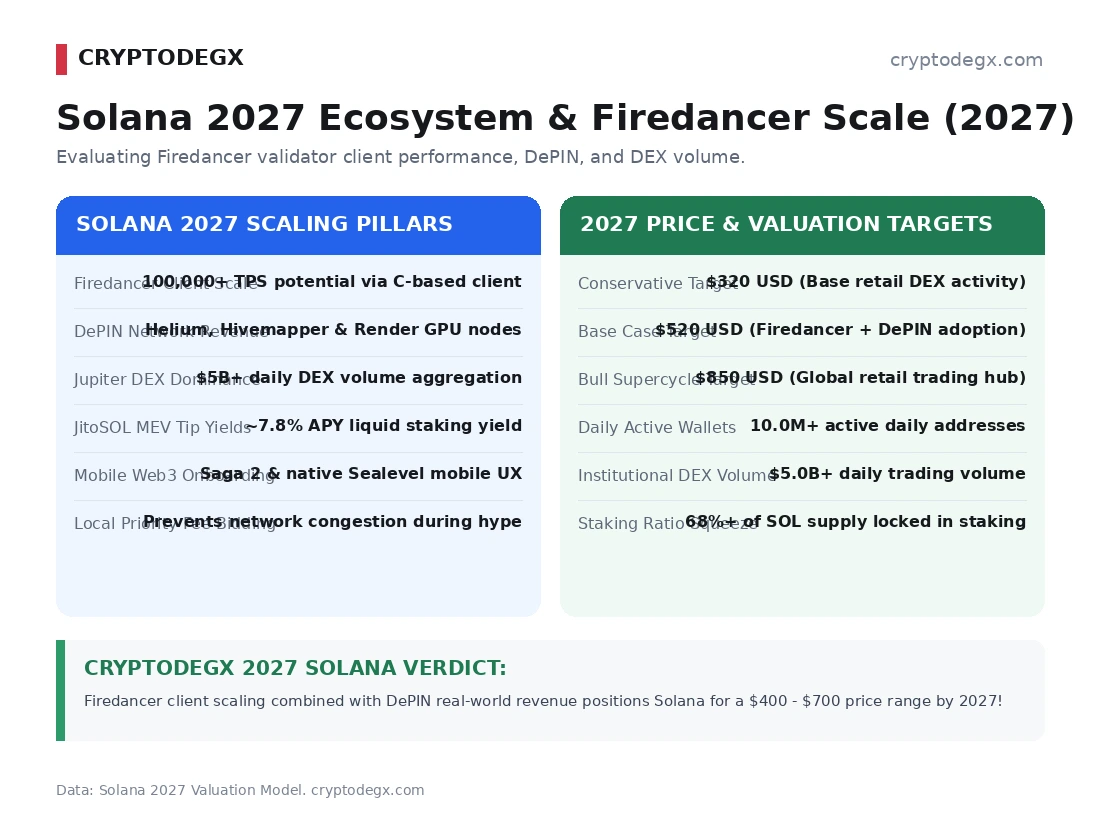
The old pitch said JitoSOL pays about 7.8% because it captures MEV tips. That was 2025.
Jito’s transaction ordering revenue fell about 50% in Q2 2026. JitoSOL supply dropped 20% to 9.86 million SOL, its share of the liquid staking market fell to 17.3%, and its median implied APY was around 5.7% (Solana Compass). In the latest epoch Solana Compass measured, the average staker earned about 4.9%, almost entirely from inflation, with MEV adding next to nothing (Solana Compass). Bitwise puts gross staking yield at 5.99%, down from 6.38%, with about 69% of supply staked (crypto.news).
And it’s going lower by design. In August, validators voted to make inflation fall twice as fast each year (Solana Compass). That’s SIMD-550, which 21Shares projects could take nominal staking yield to around 4.3% in year one and about 3% in year two. A separate proposal, SIMD-553, adds a burn on compute used by financial activity (21Shares).
Is that bad for holders? Not necessarily. Lower inflation means less dilution, which is arguably healthier for price over time. It just means staking stops being the main reason to hold SOL.
ETFs and institutions: access is here, demand is shaky
Spot Solana ETFs launched in late 2025, most of them with staking built in. US spot Solana ETFs now hold about $1.4 billion with roughly $1.48 billion in total net inflows (SolanaFloor). The biggest, Bitwise’s BSOL, has pulled in about $1.17 billion, and its shares are still down 44% (ETF.net). Recently the flow has turned negative, with about $71 million leaving in one week (CryptoTicker).
The lesson: an ETF opens the door, it doesn’t guarantee anyone walks through. We cover how these funds work in our guide to Solana staking ETFs.
On the brighter side, big finance keeps building on the chain. JPMorgan brought its MONY and JLTXX funds to Solana in October, according to Solana treasury company DeFi Dev Corp’s monthly recap, which also counted 2.84 million daily active addresses (DeFi Development Corp.). Treat a holder’s own numbers with some caution, but the institutional direction is clear.
DePIN and Seeker: real, but small for SOL
DePIN gets a lot of airtime in Solana predictions. The networks are real. Helium Mobile hit 2.9 million subscribers, but cumulative on-chain revenue across Solana DePIN since January 2025 is only a bit over $28 million (Syndica). Helium’s revenue grew about eightfold in 2025 while HNT fell 77% (Cointelegraph). Good businesses forming, not yet a needle-mover for a $50 billion asset. We go deeper in our 2027 crypto trends analysis.
Same with mobile. The original Saga phone has been replaced by the Seeker, and Solana Mobile says it has sold over 200,000 devices across both phones combined (TheStreet). On-chain, a bit over 121,000 Seeker Genesis Tokens had been minted by October 2026, one per phone set up (Cherry). A niche product, not a driver of 10 million daily users.
Solana 2027 Price Scenarios
Here’s how we’d frame 2027. These are scenarios, not targets, and the conditions matter more than the numbers.
| Scenario | SOL end of 2027 | Change from ~$90 | What has to happen |
|---|---|---|---|
| Bear | $45 to $80 | About -50% to -10% | Risk-off macro continues, fees stay low, ETF outflows persist, more validators leave |
| Base | $120 to $200 | About +35% to +120% | Steady growth in stablecoins, tokenized stocks and app revenue, REV keeps recovering, crypto stabilizes |
| Bull | $250 to $400 | About +180% to +345% | A new crypto bull market, strong ETF inflows, Solana becomes the default chain for payments and on-chain stocks |
| Hype range | $400 to $700 | About +345% to +680% | All of the bull case, plus a mania. SOL would be worth $236B to $413B |
For context, the most-quoted bull target comes from Standard Chartered, which has said SOL could reach $400 by the end of 2027, $700 in 2028 and $2,000 by 2030, on the idea that cheap transactions open a micropayments market (Yahoo Finance). VanEck’s long-range base case is far lower, about $335 by 2030 (WirtschaftsWoche). Published 2027 forecasts run anywhere from $79 to $600 (Axi). Worth knowing: Standard Chartered already cut its 2026 target from $310 to $250 (Bitget News), and later reports put it lower still (Nasdaq). Bank targets are opinions, and they move with the market.
Solana Then vs Now
| Metric | The common claim | Data as of Nov 2026 |
|---|---|---|
| Finality | ~400ms blocks | ~150ms with Alpenglow |
| Firedancer | Fully deployed, 100k+ TPS | Live, ~15% of stake |
| Jupiter volume | $5B+ per day | ~$13.5B per 30 days routed |
| JitoSOL yield | ~7.8% APY | ~5.7% median in Q2, falling |
| JitoSOL share | 30%+ of staked SOL | 9.86M SOL, 17.3% of the LST market |
| Daily active addresses | 10M+ | ~2.84M in October |
| Validators | Growing | 659 active, down ~30% in a year |
Tools to Track Solana Yourself
Don’t take our scenarios on faith. These free dashboards will tell you which one is playing out.
- Blockworks Analytics: app revenue, REV and quarterly reports. REV is the number that matters most for SOL.
- DefiLlama: DEX volume, chain fees, TVL and stablecoin supply on Solana.
- SolanaFloor ETF Tracker: daily flows into every US spot Solana ETF.
- Stakewiz: validator APY, commission and MEV share before you delegate.
- Jito: the live JitoSOL rate and stake pool stats.
- Solscan: wallets, tokens and transactions, plus staking accounts.
One simple routine: check REV and ETF flows once a month. If both are rising together, the base case is in play. If REV stalls while price runs, that’s a narrative rally, and you size accordingly.
Bull Case vs Bear Case
What could push SOL higher
- Alpenglow’s ~150ms finality makes Solana the obvious chain for payments and tokenized stocks
- Leading spot DEX share and app revenue up 48% in Q3
- Faster disinflation under SIMD-550 means less new supply hitting the market
- Staking ETFs give institutions easy access once flows turn positive again
- Firedancer’s share grows, cutting the risk of a single-client outage
What could hold it back
- Network revenue fell 87% in H1 2026 as memecoin fees disappeared
- Staking yields are falling toward 3% to 4% by design
- Validators dropped to 659, with about 72.8% of stake in Europe (crypto.news)
- ETF outflows and a broad risk-off market
- Competition from parallel EVMs, fast layer 2s and Ethereum’s own upgrades
- Upgrade risk: validators were told Agave 4.4.1 is a mandatory upgrade (CryptoTicker)
Who This Prediction Is For
Long-term SOL holders who want to know whether the fundamentals justify holding through a rough patch, and which numbers would change that view.
Stakers and JitoSOL users who need realistic yield expectations for 2027 now that MEV tips and inflation are both shrinking.
People thinking about buying who keep seeing $500 headlines and want to know what that would actually require.
Not for you if you want a single price to hold us to. Nobody knows where SOL will be at the end of 2027, and anyone who says otherwise is selling something. You can follow the live SOL price on our tracker.
FAQ
What is the Solana price prediction for 2027?
Our scenarios for the end of 2027 are about $45 to $80 in a bear case, $120 to $200 in a base case and $250 to $400 in a bull case, from roughly $90 today. Standard Chartered has published a $400 target for end of 2027, but bank targets have been revised often and are not guarantees.
Can Solana reach $500 or $1,000 by 2027?
It would take a full-blown mania. At $500, SOL would be worth roughly $295 billion on today’s circulating supply, more than Ethereum’s current market cap of about $273 billion, while the network earned about $75.7 million in fees and tips in Q3 2026. Not impossible, but not a base case.
What is Alpenglow on Solana?
Alpenglow is Solana’s new consensus protocol. It went live on mainnet on October 21, 2026 and cut finality from about 12.8 seconds to roughly 150 milliseconds. Its voting part, Votor, is live, while the new block propagation layer, Rotor, has no mainnet date yet.
Is Firedancer live on Solana?
Yes. Jump Crypto launched the full Firedancer client on mainnet in December 2025, and it secured about 15% of stake by October 2026. It’s written in C, separate from the Rust-based Agave client, which gives Solana client diversity, though 15% is still well short of the one-third share that would fully protect finality if Agave failed.
What is the JitoSOL APY in 2026?
Lower than the 7% to 8% people remember from 2025. Jito’s MEV revenue roughly halved in Q2 2026 and JitoSOL’s median implied APY was around 5.7%. With faster disinflation approved in August, Solana staking yields are expected to keep falling toward 3% to 4% over the next two years.
What is the best wallet for SOL?
Phantom and Backpack are the most popular software wallets for Solana. For long-term holdings, pair one with a hardware wallet such as the Keystone 3 Pro, which supports both, so your keys stay offline.