How to Stake Cryptocurrency: Any Coin, Three Doors, the Actual Steps
 August 30, 2026
6 min read
August 30, 2026
6 min read
Disclosure: This article is information and opinion, not financial advice. Yields are approximate as of late 2026 and float with network conditions. See our full disclaimer.
Staking is one of the few crypto activities where the honest instructions genuinely fit on one page. No trading skill, no timing, no charts: you lock coins you already hold, the network uses them as security collateral, and it pays you a share of its rewards.
The background (where yield comes from, what the risks really are) lives in the staking explainer. This page is the practical half: the actual steps, for any proof-of-stake coin, through each of the three doors. One rule before any of them: stake coins you already intended to hold. A yield of 3 to 7% is a bonus on conviction, never a reason to buy an asset, because the coin’s price will move more than the yield pays, in both directions.
First, thirty seconds of orientation
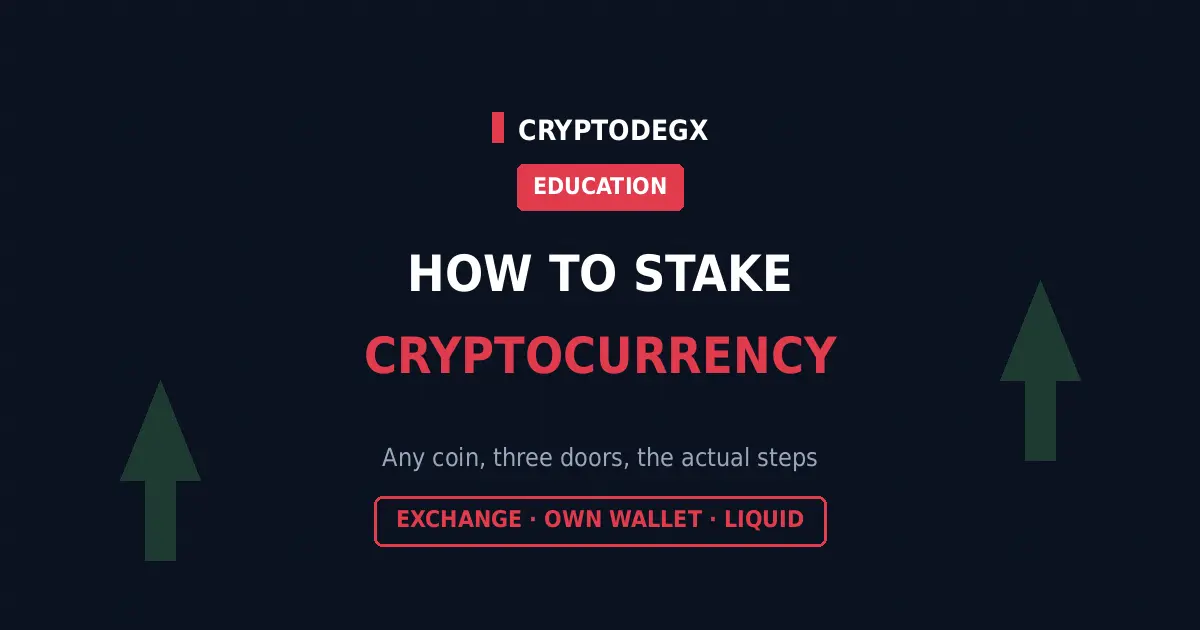
Check that your coin actually stakes: ETH (around 2.5-3%), SOL (6-7%), DOT, ADA, ATOM, AVAX, and most newer chains do; BTC does not, by design, so anything offering “Bitcoin staking” is lending wearing a costume. Then pick your door by how much custody you want to keep. Exchange staking: easiest, platform keeps 25-35% of rewards, your coins stay custodial. Native staking from your own wallet: full control, full rewards minus a validator’s small commission. Liquid staking: any amount, tradeable receipt token, smart-contract risk. (Ethereum specifically has extra wrinkles and its own detailed guide.)
Door one: staking on an exchange, step by step
1. Verify the platform first: two minutes with the license-checking routine, because staked balances on a frozen exchange are still frozen balances.
2. Find the Earn or Staking section, select your coin, and read one line most people skip: the net rate offered versus the network’s own rate. The gap is the platform’s cut, and knowing it is the difference between a choice and a default.
3. Check the lock terms before confirming: flexible (withdraw anytime, lower rate) versus fixed periods (higher rate, coins locked regardless of what the market does).
4. Confirm, then note the date. Rewards usually start accruing within a day or two and appear daily or weekly.
5. Log everything from day one: in many countries each reward is taxable income at its value on receipt, and reconstructing a year of daily drips later is misery on a spreadsheet.
Door two: native staking from your own wallet
This is the version the networks themselves designed, usually called delegation: your coins stay in your wallet, you point them at a validator, and they never leave your control.
1. Use the coin’s official or well-established wallet (Phantom for Solana, the Polkadot apps for DOT, Keplr in Cosmos country, and so on), installed from the official site only, with your seed phrase handled properly.
2. Move the coins in with a test send first, per the house religion.
3. Open the wallet’s Stake or Delegate tab and pick a validator. Three criteria beat any ranking: reasonable commission (typically 5-10%), a long uptime history, and not being one of the top few giants, since spreading stake keeps the network healthy and your risk uncorrelated. Skip anyone advertising 0% commission forever; validators have costs, and unsustainable pricing is a pre-announcement.
4. Delegate, confirm the transaction, done. Your coins remain yours; the validator never holds them. If the interface ever asks you to “send coins to stake them,” you’re on a phishing site, full stop.
5. Check in occasionally: rewards accrue automatically, some chains need a claim click, and a validator whose performance degrades can be switched with a redelegation.
Door three: liquid staking, in one paragraph
Protocols like Lido (Ethereum) or Jito (Solana) pool any amount, stake it, and hand you a receipt token that keeps trading while it earns. You gain flexibility and lose about 10% of rewards to the protocol, plus you add smart-contract risk. The receipt token is the part people underestimate: it can trade slightly below the real asset during stress, which matters exactly when you’d want to exit. Reasonable tool, eyes open.
The two numbers to check before confirming anything
The unbonding period: unstaking is not instant on most chains, with waits from hours to several weeks depending on the network. Your staked coins are unavailable during precisely the kind of week you might most want them liquid; stake only what can sit.
And the real net rate, which belongs in the staking calculator before you commit: the difference between an advertised 7% and a net 5% compounds into real money over the years staking is supposed to run. Project rewards in coins, treat any dollar figure as a separate bet on price, and re-read that sentence whenever a dashboard shows you a beautiful dollar number.
The mistakes that actually cost people
Staking money they needed within months, then meeting the unbonding queue. Chasing the highest APY chain on the list, which usually means the highest-inflation token, per the passive income ladder’s oldest lesson: yield size tells you nothing, yield source tells you everything. Clicking “migration” or “restake” links from messages and Discord, which is how staked positions get phished. And ignoring the tax log until April, retroactively, through gritted teeth.
None of these is exotic. That’s the comfort of staking done right: the failure modes are known, avoidable, and mostly administrative, which by this site’s standards makes it the best-behaved yield in the asset class.
FAQ
How do I stake cryptocurrency for the first time?
Simplest route: on a licensed exchange, open the Earn/Staking section, select a coin you already hold, check the net rate and lock terms, and confirm. More control: delegate from the coin’s official wallet to a validator with reasonable commission and strong uptime, where coins never leave your custody. Log reward dates from day one for taxes.
What is the minimum amount to stake?
On exchanges and liquid staking protocols, effectively none; delegation minimums on most chains are trivially small (often under a few dollars’ worth). The famous 32 ETH requirement applies only to running your own Ethereum validator, not to staking generally.
Can I lose money staking crypto?
Yes, through several doors: the coin’s price falling more than the yield pays (the most common by far), a platform failing (exchange route), a smart-contract exploit (liquid route), slashing for validator misbehavior (rare for delegators, real for operators), and phishing sites impersonating staking interfaces.
Which cryptocurrencies can be staked?
Proof-of-stake networks: Ethereum, Solana, Cardano, Polkadot, Cosmos, Avalanche, and most modern chains, at floating rates roughly between 2 and 10%. Bitcoin cannot be staked by design; offers of Bitcoin staking yield are lending products with counterparty risk.
How do I choose a validator?
Three filters: commission in the normal range (roughly 5-10%), a long clean uptime record, and not among the largest few validators, which supports decentralization and spreads risk. Permanent 0% commission is a red flag rather than a bargain.
How long does unstaking take?
It varies by network, from hours to several weeks, plus exchange-specific unbonding windows on custodial platforms. Liquid staking offers a faster exit by selling the receipt token at whatever the market pays. Check the number before staking, not after needing it.
Are staking rewards taxable?
In many countries, yes: income at market value when received, then capital gains on any appreciation at sale, with each reward payment potentially its own taxable event. Rules vary by jurisdiction; the universal advice is logging dates and values from the start.
Is staking crypto worth it?
For coins you’d hold anyway, usually yes: it’s the one crypto yield whose source is verifiable on-chain, paying single digits for known, mostly administrative risks. As a reason to buy an asset you otherwise wouldn’t, no: the price risk dwarfs the yield in both directions.