Uphold Review (2026): The Honest Take on Fees, Anything-to-Anything Swaps and Security
 November 9, 2026
10 min read
Disclosure: This review is information and opinion, not financial advice. Fees, spreads, supported assets and licensing were checked against Uphold’s own pages in early November 2026 and can change at any time. CryptoDEGX has no paid relationship with Uphold. See our full disclaimer.
Most exchanges work the same way. You deposit dollars or euros, buy Bitcoin, and trade against other people on an order book. Uphold does it differently, and that’s the whole reason people pick it.
On Uphold you can go from Bitcoin straight to gold, from XRP to euros, or from silver to USDC in one step, without first selling back to cash. It calls this “Anything-to-Anything” trading. The platform launched in 2015 and says it serves more than 10 million users (Yahoo Finance).
The catch is the price. Uphold doesn’t charge a commission, but it builds a spread into every quote, and in 2026 that spread is much wider than most older reviews say. Here’s what it really costs, how safe it is, and who should use it.
Key takeaways
- Uphold’s Anything-to-Anything feature lets you swap directly between crypto, metals and currencies without converting to cash first. Non-local currency balances are ledger entries, not withdrawable cash.
- Trading costs are high: BTC and ETH spreads are 2.00% to 2.20%, altcoins 2.45% to 3.8%, and trades under $500 usually add $0.99.
- A $1,000 Bitcoin buy costs about $20 to $22 on Uphold, compared with $4 to $8 on Kraken Pro and $5 to $9 on Coinbase Advanced in the US.
- Uphold reports live reserves above 100%, refreshed about every 30 seconds, but the figures are self-reported and don’t let users verify their individual balances.
- EU customers can still hold and withdraw, but crypto and euro deposits have been paused since July 1, 2026, pending MiCA authorization.
- Uphold suits occasional, long-term holders who value multi-asset convenience. Active traders and people buying Bitcoin or Ether in size can find lower costs elsewhere.
Uphold at a Glance
| Item | Details (Nov 2026) |
|---|---|
| Model | Broker style “Anything-to-Anything” swaps, no order book |
| Assets | 300+ cryptos, 4 precious metals, 27 national currencies; US users also get 4,000+ stocks and ETFs |
| Trading cost | No commission; spread of 2.00% to 2.20% on BTC/ETH, 2.45% to 3.8% on altcoins, 2.80% to 3.40% on metals |
| Small trade fee | $0.99 on most trades under $500 |
| Card deposits | About 2.5% into USD, 2.99% into other assets |
| Crypto withdrawals | Flat $0.99 on most networks; BTC, XRP and HBAR differ |
| Reserves | Self-reported assets and liabilities, refreshed about every 30 seconds |
| Licensing | FinCEN MSB in the US, FCA anti-money laundering registration in the UK, MiCA application pending in the EU |
| Self-custody option | Uphold Vault (multi-sig, paid subscription) for a short list of coins |
Sources for the table: Uphold’s service fees page, its fees and limits help article, Kiwi Reviews for card deposit rates, and Datawallet for the asset count.
Anything-to-Anything Swaps: The Best Thing About Uphold
On a normal exchange, turning Bitcoin into gold or euros is two trades and two fees. On Uphold you pick a “From” and a “To” and confirm. That’s it. It’s quick, and for people who move between asset types often, it’s genuinely handy.
A few things are worth knowing, though, because the marketing glosses over them.
- Foreign currencies aren’t real cash balances. Uphold says its non-local currencies are ledger entries that track the market price. You can trade them, but you can’t deposit or withdraw them (Uphold). So “hold euros on Uphold” isn’t the same as holding euros in a bank.
- Metals are held by a partner, not Brink’s. Uphold’s disclosures say metals are held with Gold Bullion International and can be redeemed for physical metal through AuSecure (Uphold). Gold now shows as “Gold (Legacy)” on Uphold’s site (Uphold), so check its status in your region before buying.
- Crossing categories costs more. When you swap between two asset types, the fee reflects both sides and can be higher than either rate alone (Uphold). An altcoin to silver swap is not cheap.
- Stocks are a two-step trade behind the scenes. US users got crypto-to-stock trading for 4,000+ stocks and ETFs in July 2026, but the crypto is first converted to dollars by Uphold, then sent to its broker-dealer arm to buy the shares (GlobeNewswire).
Uphold Fees in 2026: What You Actually Pay
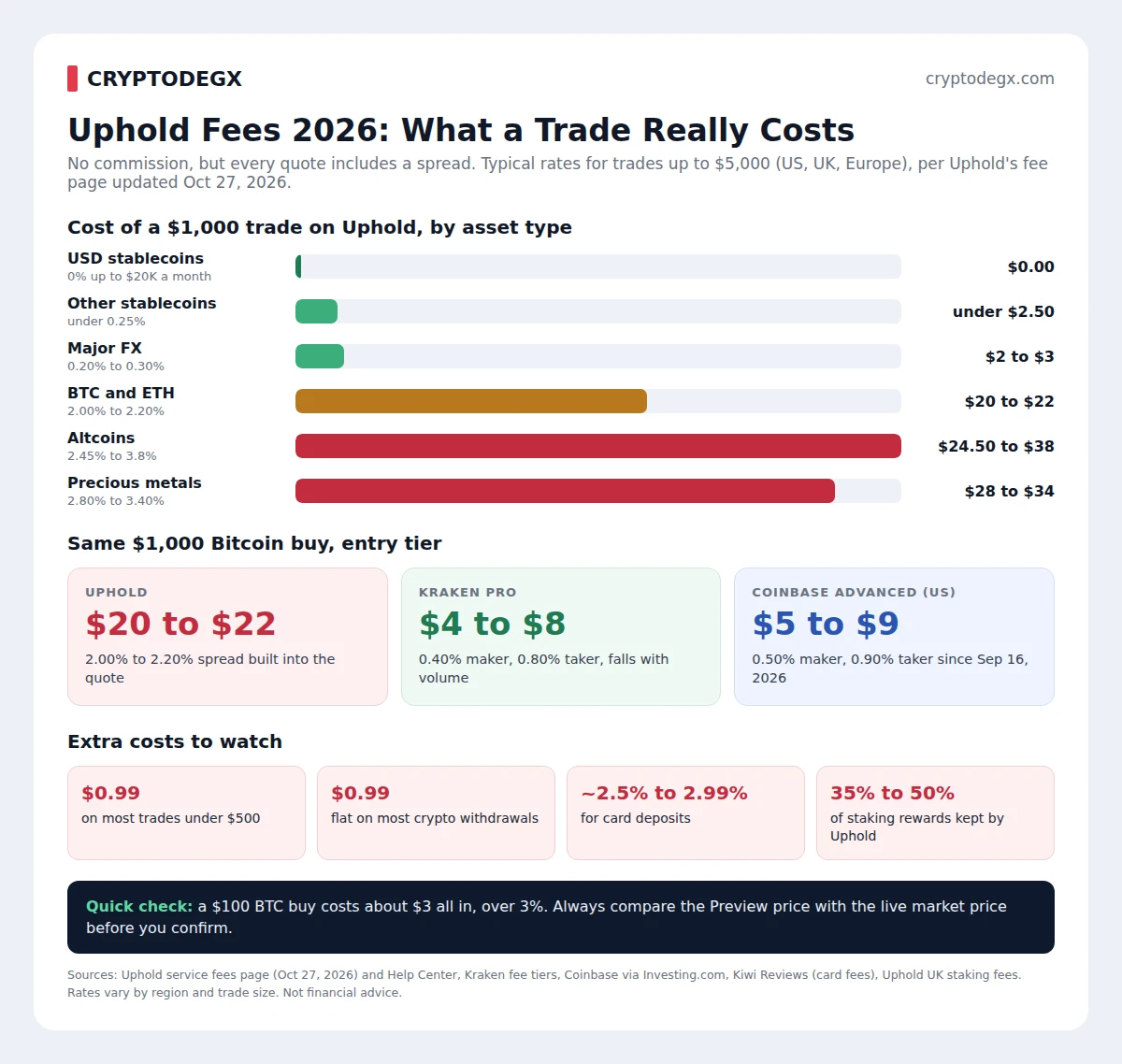
Uphold says “0% commission,” and that’s true. The cost sits inside the price. Its fee page, updated October 27, 2026, lists these typical spreads for trades up to $5,000 in the US, UK and Europe (Uphold):
- USD and supported USD stablecoins: 0% at 1:1, for the first $20,000 a month
- Other stablecoins: under 0.25%
- Major currencies (FX): 0.20% to 0.30%
- BTC and ETH: 2.00% to 2.20%
- Altcoins: 2.45% to 3.8%
- Precious metals: 2.80% to 3.40%
Larger trades can pay more, not less. That’s unusual. Most exchanges get cheaper as you trade bigger.
The numbers have also climbed during the year. A schedule dated July 1, 2026 listed BTC and ETH at 1.8% to 1.95% (Curio). If you read a review quoting 0.9% to 1.2%, it’s out of date.
Then there are the extras. Trades under $500 add a $0.99 fee, most crypto withdrawals cost a flat $0.99 (Uphold Help Center), and card deposits run about 2.5% into dollars or 2.99% into anything else (Kiwi Reviews). Put those together and a $100 Bitcoin buy from your dollar balance costs about $3, over 3% before the coin goes anywhere.
Uphold vs Kraken Pro vs Coinbase Advanced
Here’s the same $1,000 Bitcoin buy at each platform’s entry tier.
| Feature | Uphold | Kraken Pro | Coinbase Advanced |
|---|---|---|---|
| How you pay | Spread inside the price | Maker/taker fee | Maker/taker fee |
| Entry fee rate | 2.00% to 2.20% (BTC) | 0.40% maker / 0.80% taker | US: 0.50% / 0.90%; EU/UK: 0.25% / 0.50% |
| Cost on $1,000 BTC | About $20 to $22 | About $4 to $8 | About $5 to $9 (US), $2.50 to $5 (EU/UK) |
| Metals and FX in one account | Yes | No | No |
| Reserves reporting | Live, self-reported | Periodic proof of reserves | Public company filings |
| Charts and order types | Basic | Full order book, advanced orders | Full order book, TradingView charts |
| Best for | Multi-asset holders | Active traders | US users who want one big brand |
Kraken’s entry rates come from its fee tier page (they fall fast once you trade $10,000 a month or hold $20,000 on the platform). Coinbase cut its Advanced fees on September 16, 2026 (Investing.com). If you want to understand why the gap is so big, our guide on how crypto exchanges make money explains spreads versus order book fees.
Is Uphold Safe?
Mostly, yes, with some honest caveats.
Reserves. Uphold says it’s always 100%+ reserved, publishes assets and liabilities in real time, and doesn’t lend out customer funds unless you opt into staking or lending (Uphold). That’s better than most. But it’s self-reported. There’s no Merkle tree proof that lets you check your own balance is included, and the detailed reserve tiers now sit behind a login (CryptoSlate). Strong reassurance, not a cryptographic guarantee.
Licensing. In the UK, Uphold Europe Limited is on the FCA register for anti-money laundering purposes, and Uphold’s own footer says its crypto services are unregulated and not covered by the FSCS (Uphold UK). That’s a registration, not a full licence. In the US, USD balances sit at Cross River Bank with FDIC cover, but crypto and metals have no FDIC protection (Uphold). Learn how to read these entries in our guide on how to check a crypto exchange license.
The EU problem. Uphold’s Portuguese entity missed the July 1, 2026 MiCA deadline while its application was still under review. Since then, EU customers can’t deposit crypto or euros. They can still hold and withdraw (Uphold EU). As of mid-October there was still no decision date (EU MiCA tracker). If you’re in the EU, don’t open an account until this is fixed.
The Cred settlement. In April 2026, Uphold agreed to pay more than $5 million to settle a New York Attorney General case over how it promoted Cred’s failed CredEarn product in 2019 and 2020 (NY Attorney General). Uphold settled without admitting liability and says it was itself a victim of Cred’s fraud (Uphold). The events are old, but it’s worth knowing when a platform offers yield products.
The business side. Uphold cut about 17% of its staff in July 2026 as it moved resources toward its enterprise business (CoinDesk). Not a red flag on its own. Just something to keep an eye on.
Staking, Vault and the Newer Features
Uphold has added a lot this year. Some of it is useful. Some of it has a cost you should see first.
- Staking: Uphold keeps a big slice of rewards. In the UK, Boosted Staking takes 35% from October 15, 2026, and Flexible Staking takes 50% (Uphold UK). The advertised APY already includes that cut.
- RLUSD Earn: up to 7% variable APY on Ripple’s dollar stablecoin, with rates that move with borrowing demand (Business Insider). That’s lending risk, not a savings account.
- Uphold Vault: multi-sig “assisted self-custody” where you hold two keys and Uphold holds one, for BTC, XRP, HBAR and a few others (Uphold). It’s a paid subscription, listed in the UK at £4.99 a month (TradingPlatforms).
- UpHODL is going away. Uphold is retiring its separate self-custody wallet app and has posted migration steps (SpendNode).
- Autopilot investing: two automated, data-driven strategies that run inside your account (AP News).
For long-term holdings you don’t plan to swap, a hardware wallet is still the cleaner answer. We like the Keystone 3 Pro for that.
Pros and Cons
What we like
- One-step swaps between crypto, metals, currencies and (in the US) stocks
- Live reserves page, refreshed about every 30 seconds
- 300+ cryptos, including many smaller altcoins
- 0% spread on USD and USD stablecoin conversions up to $20,000 a month
- Vault gives a middle ground between exchange custody and self-custody
- Clean, simple app that beginners pick up fast
What holds it back
- BTC/ETH spreads of 2.00% to 2.20%, two to five times entry fees elsewhere
- Bigger trades can pay higher spreads, not lower
- Extra $0.99 fees on small trades and most withdrawals
- EU deposits paused since July 1, 2026 pending MiCA approval
- UK crypto services are unregulated beyond AML registration
- Staking commission of 35% to 50% of rewards
Who Uphold Is For
Good fit: long-term holders in the US or UK who want crypto, gold or silver and a few currencies in one place, buy a few times a year, and value being able to switch between them in one tap.
Okay fit: XRP and smaller altcoin holders who want a long-running US or UK platform that lists coins others don’t, and accept paying more for that.
Poor fit: active traders, anyone buying Bitcoin or Ether in size, and anyone in the EU right now. For trading, Kraken Pro or Coinbase Advanced will cost a fraction of the price.
FAQ
Is Uphold safe to use in 2026?
It’s a long-running platform with live, self-reported reserves above 100% and FinCEN registration in the US. The weak spots are that reserves aren’t independently verifiable per user, UK crypto services are only AML-registered, and EU deposits have been paused since July 1, 2026 pending MiCA approval.
What are Uphold’s fees?
Uphold charges no commission but builds a spread into prices. For trades up to $5,000, its October 2026 schedule lists 2.00% to 2.20% for BTC and ETH, 2.45% to 3.8% for altcoins and 2.80% to 3.40% for precious metals. Trades under $500 usually add $0.99.
Is Uphold cheaper than Kraken or Coinbase?
No. A $1,000 Bitcoin buy costs about $20 to $22 on Uphold, versus about $4 to $8 on Kraken Pro and about $5 to $9 on Coinbase Advanced in the US at entry tiers.
Can I buy physical gold on Uphold?
You can buy gold, silver, platinum and palladium in select regions. Uphold says the metal is held with Gold Bullion International and can be redeemed for physical metal through AuSecure. Metal spreads run 2.80% to 3.40%, and gold is currently listed as Gold (Legacy).
Can I withdraw crypto from Uphold to my own wallet?
Yes. Most crypto network withdrawals cost a flat $0.99, with BTC, XRP and HBAR handled differently. EU customers can still withdraw even though deposits are paused.
Is Uphold available in the EU?
Existing EU customers can hold and withdraw, but deposits of crypto and euros have been paused since July 1, 2026 while Uphold’s Portuguese entity waits for MiCA authorization. There is no public date for a decision.