What Is x402? The Standard Letting AI Agents Pay Each Other
 October 11, 2026
7 min read
October 11, 2026
7 min read
Disclosure: This article is information and opinion, not financial advice. x402 is a new and fast-moving standard; details will change. See our full disclaimer.
You keep seeing “x402” in crypto headlines and every prediction list for 2026, usually next to the phrase “AI agents paying each other.” If that sentence meant nothing to you, you’re in the right place. Here’s what it actually is, in plain English, without the whitepaper.
Short version: x402 is a way for software to pay for things on its own, instantly, in stablecoins, no human and no credit card involved. It sounds niche. It might end up being one of the bigger shifts in how money moves online.
The problem x402 solves
Think about how you pay for something online today. You enter a card number, a billing address, maybe a one-time code, and a payment processor takes a cut and a few days to settle. That whole dance assumes a human is sitting there, filling in forms.
Now imagine an AI agent (a piece of software doing tasks for you) that needs to buy something mid-task: pay for an API call, rent some computing power, buy a single data report. It can’t fill in a checkout form. It doesn’t have a credit card. And the amount might be a fraction of a cent, far too small for card rails to bother with. The web never had a clean way for machines to pay machines. x402 is the fix.
Where the weird name comes from
This part is genuinely a nice bit of trivia. When the web was built, its creators reserved an error code, HTTP 402: Payment Required, for exactly this situation: a server telling you “you need to pay to access this.” They left it in the spec as a placeholder for a future where the web had built-in payments.
Then they never finished it. For about 30 years, “402” sat there unused, a door with no room behind it. x402 is the crypto industry finally building the room. It takes that dormant error code and wires it to stablecoin payments, so a server can say “402, pay me first,” and the software asking gets charged automatically and granted access. Named after the code that waited three decades for a purpose.
Why stablecoins, and why crypto at all
The pieces only fit because of what stablecoins and blockchains can do that traditional payments can’t. Three things matter here. Payments settle in seconds, not days, so an agent isn’t left waiting. Amounts can be tiny (a fraction of a cent), which card networks can’t process profitably because their fixed fees dwarf the payment. And it’s permissionless, so any service and any agent can transact without signing up for a merchant account first.
A dollar-pegged stablecoin is the natural currency for this: stable enough to price things in, programmable enough for software to send automatically, and global by default. This is the machine-scale version of the same shift we wrote about in stablecoin cards becoming crypto’s real use case, just with robots instead of shoppers.
Is this real, or another crypto buzzword?
Fair question, and the honest answer is “early, but real.” x402 is backed by Coinbase, which built the standard to run on its Base chain, and by mid-2026 the protocol had reportedly processed over 50 million machine-to-machine transactions, with nearly 500,000 payments in a single peak week. Serious research shops put specific numbers on it: Galaxy Research predicted x402 payments could reach 30% of Base’s daily transaction volume during 2026.
That’s not nothing, but keep it in proportion. The numbers are growing fast from a small base, most of the activity is still API and data micropayments rather than a thriving agent economy, and competing standards (AP2, Stripe’s own agent tooling) are racing for the same space. x402 is an early leader in a new category, not a settled winner. Treat breathless “x402 will replace Visa” takes with the skepticism they’ve earned.
Why it might actually matter
Set the hype aside, and the idea underneath is big. For the first time, software can have its own money and spend it autonomously, in amounts too small for any existing payment system. That unlocks things that simply couldn’t exist before: pay-per-use APIs with no subscription, AI agents that hire other AI agents for sub-tasks and settle instantly, content that charges a hundredth of a cent per read instead of a monthly paywall, and machines negotiating and paying each other with no human in the loop.
Whether the “agent economy” grows into the trillion-dollar thing its boosters promise is unknown. But the plumbing for machines to pay machines now exists and works, and that’s the kind of quiet infrastructure shift that tends to matter more in five years than it does in the headlines today.
FAQ
What is x402 in simple terms?
A standard that lets software pay for things automatically using stablecoins, without a human, a credit card, or a subscription. It’s built so that AI agents and online services can charge and pay each other instantly, even for amounts as small as a fraction of a cent. The name comes from the long-unused HTTP 402 “Payment Required” error code it finally puts to work.
Is there an x402 coin or token I can buy?
No. x402 is a payment standard, like a protocol or a set of rules, not a cryptocurrency, so there’s nothing to buy. Anyone offering an “x402 token,” “x402 presale,” or “x402 coin” is running a scam, since the standard has no token of its own. It uses existing stablecoins like USDC for the actual payments.
How does x402 actually work?
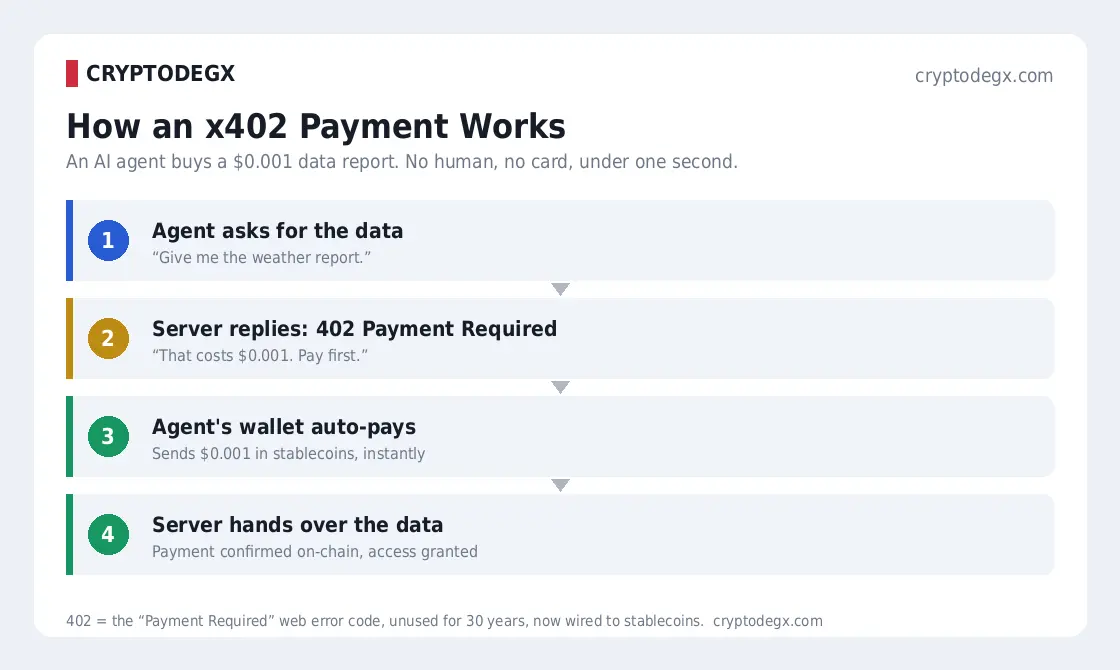
When software requests a paid resource, the server responds with an HTTP 402 “Payment Required” message and a price. The requesting software’s crypto wallet automatically sends the stablecoin payment, it confirms on-chain in under a second, and the server grants access. The whole exchange happens without forms, invoices, or human involvement, integrated into normal web requests.
Why do AI agents need their own payment system?
Because AI agents performing tasks often need to buy small things mid-task (an API call, a data report, some computing power) and can’t fill in a checkout form or use a credit card, and the amounts are often too tiny for card networks to process. A standard like x402 lets them pay instantly in stablecoins, permissionlessly, which existing payment rails can’t do at that scale or speed.
Is x402 actually being used, or is it hype?
It’s early but genuinely in use: backed by Coinbase and running on its Base chain, the protocol reportedly processed over 50 million machine-to-machine transactions by mid-2026, with research firms projecting it could reach a meaningful share of Base’s daily volume. The activity is still mostly small API and data payments, and rival standards are competing, so it’s an early leader rather than a proven winner.
What’s the difference between x402 and a normal crypto payment?
A normal crypto payment is usually a one-off transfer a person initiates. x402 is a standard that bakes payment directly into the way software requests resources online, so the payment happens automatically as part of accessing something, designed for machines and micropayments rather than human-initiated transfers. It’s less a new way to send money and more a way to make the web itself chargeable per request.
Could x402 affect regular crypto investors?
Indirectly, over time. There’s no token to invest in, but if agent payments grow as predicted, they could drive real transaction demand on chains like Base and for stablecoins, which are assets some investors already hold. For now it’s a trend to understand and watch rather than something to trade, and the main immediate relevance is knowing that any “x402 token” offer is fraudulent.