lasma One Card Review (2026): The Honest Take on the XPL Loop
 October 6, 2026
10 min read
October 6, 2026
10 min read
Disclosure: This review is information and opinion, not financial advice. We do not hold or promote XPL. Figures are as of late 2026 and change frequently; confirm current rates before committing. Plasma One is restricted for US residents. See our full disclaimer.
Plasma One is two products in one app: a self-custodial Visa card that spends your stablecoins, and a neobank with a built-in yield vault on the stablecoins you’re not spending. Launched mid-2026 on a blockchain built only for stablecoin payments, it’s one of the faster-growing cards in the category, with transaction volume up 327% in a single month earlier this year.
The headline numbers (up to 4% cashback, up to 5% yield) look great. The structure underneath them is where this review earns its keep, because Plasma One runs on a closed loop built around one volatile token, and whether that’s clever or a trap depends entirely on what you expect that token to do.
What Plasma One actually is
Start with the chain, because it’s the reason this card exists. Plasma is a Layer-1 blockchain purpose-built for stablecoin payments, with roughly one-second block times. Plasma One is the consumer app sitting on top: a stablecoin account, a Visa card, local fiat funding rails, and an Earn balance, all in one place. Think of it as a crypto-native bank account rather than just a card.
You deposit USDT or USDC, it lives in a smart wallet you control, and you spend it anywhere Visa is accepted via the physical card or Apple/Google Pay. Idle balance can sit in the Earn vault for yield. Cashback comes back weekly, paid in XPL, the chain’s native token.
| Type | Self-custodial Visa + stablecoin neobank |
| Chain | Plasma (Layer-1 for stablecoins) |
| Funded with | USDT / USDC |
| Base cashback | 2% to 4% (tiered), paid in XPL |
| Earn vault | ~4% APY variable, on idle stablecoins |
| Tiers | Lite (free), Core, Platinum |
| Availability | 150+ countries, NOT US residents |
| Mobile pay | Apple Pay, Google Pay |
The three tiers, and what they really cost
This is where the token loop starts, so read the cost column carefully, not just the cashback column.
| Tier | Base cashback | Cost to unlock | Extras |
|---|---|---|---|
| Lite | 2% (first $500/mo, then 0.1%) | Free ✓ | Virtual card, Earn vault |
| Core | 3% (first $1,000/mo, then steps down) | $199/yr or lock 20,000 XPL | +5% on AI spend, ChatGPT Go rebate |
| Platinum | 4% (tiered by spend) | Lock 100,000 XPL (12 months) | +10% AI, +10% flights (cap ~$600/yr) |
Two things the headline “up to 4%” hides. First, cashback is stepped, not flat: Lite pays 2% on your first $500 of monthly spend and then drops to 0.1%, so the real blended rate for most spenders is well under the headline. Second, the paid tiers are unlocked either with cash ($199/yr for Core) or by locking XPL for a year, and Platinum is XPL-lock only, at 100,000 tokens. That’s a serious capital commitment in a volatile asset you can’t touch for 12 months.
The XPL loop: the thing to actually understand
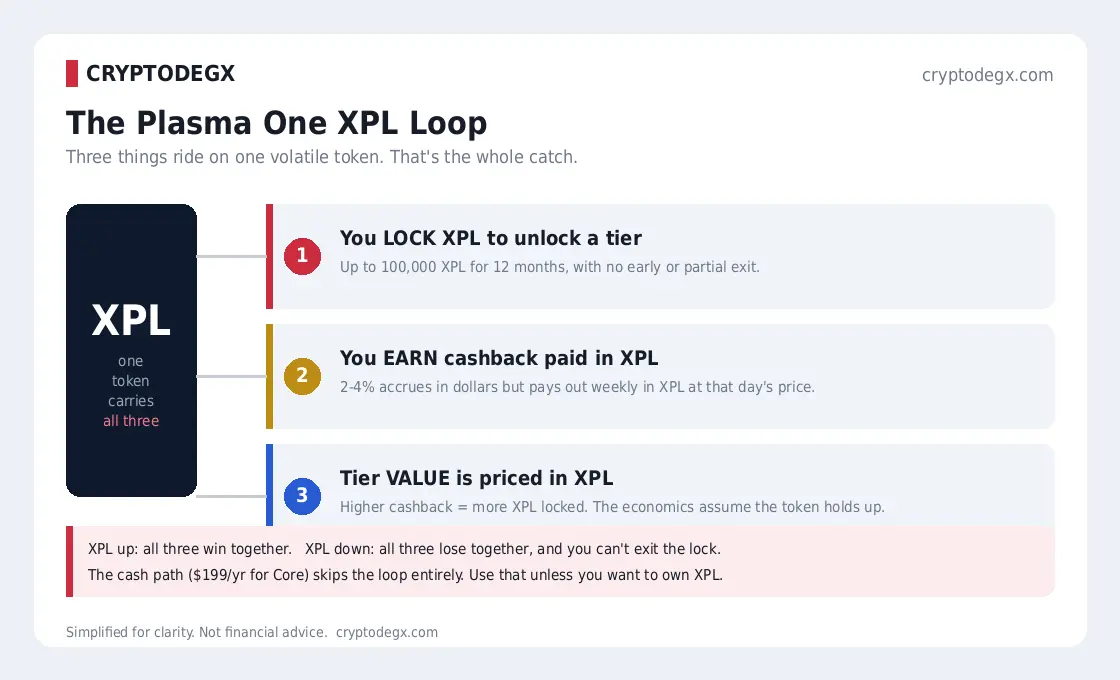
Here’s the defining feature, and the reason the score isn’t higher. Plasma One is built as a closed token loop. You lock XPL to unlock a tier, you earn cashback paid in XPL, and the value of both moves with XPL’s price. Stack those up and a Platinum membership is effectively three simultaneous bets on one token: the capital you locked, the rewards you’re paid, and the tier economics that assume the token holds value.
If XPL rises, this is brilliant: your locked stake appreciates, your cashback is worth more, and the “cost” of the tier shrinks. If XPL falls, all three move against you at once, and you can’t exit the lock to stop the bleeding, because there’s no early or partial unlock. The same mechanic powers exchange-token card models like Crypto.com’s CRO staking, and it has the same honest problem: the rewards are real only as long as the token cooperates, and the token is the riskiest part of the whole arrangement.
The Earn vault: the part that’s actually clean
Credit where it’s due. The Earn vault is the most honest feature here. Idle stablecoins (not the ones earmarked for spending) earn a variable yield, reported recently around 4.34% APY, sourced from third-party DeFi lending vaults operated by a dedicated provider. There’s no lockup on it, so your balance stays liquid right up to the moment you spend.
The yield is paid on stablecoins, not XPL, which means it doesn’t carry the token-price risk that the cashback does. It’s close to what a tokenized-Treasury or stablecoin yield product pays, delivered inside a spending account, which is a genuinely nice piece of design. Apply the usual rule: the yield comes from DeFi lending, so it carries smart-contract and counterparty risk, and “up to 6%” marketing should be read as the variable rate it is, not a guarantee.
Fees, and the US problem
The fee structure is competitive once you’re past the tier cost. No monthly fee on any tier, 0% APR (it’s debit, not credit), free virtual cards, and FX markup that scales with tier: 1% on Lite, 0.5% on Core, 0% on Platinum. Stablecoin funding is generally free on Plasma’s own network, though bridging from Ethereum can incur gas.
The hard limit: Plasma One is not available to US residents. It covers 150+ countries otherwise, but if you’re in the US, this review is academic, and a card like Coinbase’s or the MetaMask Card is your lane instead.
Plasma One vs the alternatives
| Feature | Plasma One | Gnosis Pay | Bleap |
|---|---|---|---|
| Cashback paid in | XPL (volatile) | GNO (volatile) | USDC (stable) |
| Built-in yield | ~4% Earn vault ✓ | None | None |
| Tier unlock | Cash or 12-mo XPL lock | Hold GNO (no lock) | No tiers |
| Custody | Self-custody | Self-custody | Self-custody |
| US available | No | No | No |
| Best for | Yield + XPL bulls | Euro self-custody | Stable rewards |
The read: Plasma One’s genuine edge over both self-custody rivals is the integrated Earn vault, which neither Gnosis Pay nor Bleap offers. Where it loses is reward quality, Bleap pays in a stablecoin you don’t have to watch, while Plasma makes you hold and (for top tiers) lock a volatile one. If the yield vault is the draw, Plasma One is unique; if clean cashback is, Bleap is simpler.
Is Plasma One safe?
The custody model is sound: your funds sit in a smart wallet you control, so there’s no company balance to freeze or lose, the failure mode behind most exchange collapses. Spending and Earn are built on-chain and transparent.
The real risks are economic, not custodial. XPL price volatility is the big one, hitting your cashback and any locked stake. The Earn vault carries DeFi smart-contract and counterparty risk, since the yield is generated by third-party lending protocols. The 12-month lock is a liquidity risk. And as a newer product (mid-2026), it has a shorter track record than Visa cards from longer-established issuers. None of this is disqualifying; all of it should be sized consciously.
Who it’s for, who it isn’t
Get it if
- You’re outside the US and spend stablecoins
- You want yield on idle balance in the same app
- You’re bullish on XPL (for the lock tiers)
- You value self-custody over simplicity
- The free Lite tier covers a no-risk trial
Skip it if
- You’re a US resident (not available)
- You want cashback in a stable currency
- You won’t hold or lock a volatile token
- You want a simple card, not a neobank
- A 12-month lock makes you uneasy
FAQ
Is the Plasma One card worth it?
For non-US users who want a self-custodial card plus built-in stablecoin yield, the free Lite tier and Earn vault are genuinely worth using. The paid Core and Platinum tiers are only worth it if you’re comfortable holding or locking XPL, since that’s where the real cost and risk sit. It’s an excellent product for the right person and an awkward fit for anyone wanting simple, stable cashback.
How does Plasma One cashback work?
You earn tiered cashback (2% Lite, 3% Core, 4% Platinum) on a stepped basis, meaning the headline rate applies only to the first band of monthly spend before dropping. It accrues as a dollar value but is paid weekly in XPL at the token’s price at payout, so the final value depends on where XPL is trading when you’re paid.
What is the Plasma One Earn vault?
An integrated yield feature that puts your idle stablecoins (not the balance you’re spending) into third-party DeFi lending vaults, paying a variable rate reported recently around 4.34% APY with no lockup. Unlike the cashback, this yield is paid on stablecoins, so it doesn’t carry XPL price risk, though it does carry DeFi smart-contract and counterparty risk.
Do I have to lock XPL to use Plasma One?
No for the free Lite tier, which needs no XPL at all, and no for Core if you pay the $199 annual fee instead. Locking XPL is only required for Platinum (100,000 XPL for 12 months) or as an alternative way to unlock Core (20,000 XPL). The cash path lets you avoid XPL exposure entirely while still using the card and Earn vault.
What’s the catch with Plasma One?
The closed XPL token loop. Cashback is paid in XPL, the top tiers require locking XPL for 12 months with no early exit, and both move with the token’s price, so a Platinum membership is effectively a leveraged bet on XPL. If the token falls, your rewards and locked capital fall together with no way to exit mid-lock.
Is Plasma One available in the US?
No. Plasma One is restricted for US residents, though it operates in 150+ other countries. US users wanting a self-custodial or crypto card should look at options like the MetaMask Card or Coinbase Card instead.
Is Plasma One safe?
Its custody model is safe in the sense that matters most: you hold your own funds in a smart wallet, so no company can freeze or lose your balance. The real risks are economic, XPL price volatility affecting cashback and locked stake, DeFi risk in the Earn vault, the 12-month lock’s illiquidity, and a relatively short track record as a 2026 product.
Plasma One vs Gnosis Pay or Bleap?
Plasma One’s unique edge is the built-in Earn vault, which the others lack, making it attractive if you want yield and spending in one app. Gnosis Pay is the cleaner euro self-custody card, and Bleap wins on reward quality by paying cashback in stablecoin rather than a volatile token. Choose Plasma One for the yield vault, Bleap for stable rewards, Gnosis Pay for euro-focused self-custody.
How is Plasma One cashback taxed?
Cashback paid in a token is generally treated as income at its value when received in most jurisdictions, and later selling the XPL can trigger a separate capital gain or loss. Because it’s paid weekly in a volatile token, the record-keeping is more involved than stablecoin or cash rewards. Confirm the treatment in your country rather than assuming.