Staking ETFs Explained: How to Earn 6-7% Crypto Yield in a Brokerage Account
 October 4, 2026
6 min read
October 4, 2026
6 min read
Disclosure: This article is information and opinion, not financial or investment advice. Yields and products are as of 2026 and change; confirm current details before investing. See our full disclaimer.
For two years, crypto ETFs did one thing: track a coin’s price. If you held an Ethereum ETF, you got Ethereum’s ups and downs and nothing else, while people holding the actual coin could stake it and earn yield on top. The ETF was the worse deal, and ARK’s Cathie Wood said out loud what everyone knew, that the ban on staking was a big reason Ethereum ETFs underperformed early.
That changed in 2026. A single regulatory ruling flipped crypto ETFs from price-trackers into income products, and a wave of staking-enabled funds launched within weeks. If you’ve seen “6-7% yield” next to an ETF ticker and wondered whether it’s real, this is what happened and how to think about it.
What a staking ETF actually is
A normal crypto ETF holds the coin and tracks its price. A staking ETF holds the coin, stakes it on the network (the process that secures proof-of-stake chains and pays rewards, explained in our staking guide), and passes some of that yield to you, either baked into the fund’s value or paid out. You get price exposure plus income, inside an ordinary brokerage account, with zero wallets, seed phrases, or validator setup.
The plain version: it’s the yield-bearing crypto product traditional finance couldn’t legally sell until this year, and now resembles a dividend-paying stock more than a plain commodity fund.
The ruling that unlocked it
The hinge was specific and datable. On March 17, 2026, the SEC and CFTC issued a joint interpretive release classifying staking rewards as non-securities across 16 digital commodities including ETH, clearing the legal ambiguity that had blocked staking inside US funds. The products came fast: BlackRock’s iShares Ethereum Staking Trust (ETHB) launched March 12, 2026 on Nasdaq, Solana staking ETFs had already arrived from Grayscale and Bitwise with staking built in from day one, and staking-enabled structures reached about 36% of active ETF inflows in 2026. The category went from illegal to a third of the flow in months.
Is the 6-7% yield real? Mostly, with asterisks
The yields are genuine network rewards, not marketing numbers: Solana staking ETFs target roughly 6-7% annualized, Ethereum products land lower in the low single digits, matching each network’s actual staking rate. But read the asterisks before you treat it as a savings account.
The fund takes a cut. The management fee comes out of your yield first. A 7% network reward minus a fee is your real number, and some issuers cleverly use the staking yield to offset the fee rather than charging you separately, which is the arrangement to look for.
The yield is in the coin, riding the coin’s price. Earning 6% on an asset that can fall 50% in a quarter is not a bond. The yield is a bonus on a volatile holding, never a reason to treat the holding as safe, which is the same lesson from our is staking worth it breakdown.
It’s still the asset’s risk. A staking ETF of a coin you wouldn’t hold at zero yield is still a coin you shouldn’t hold. The wrapper changes the convenience, not the underlying bet.
Staking ETF vs staking it yourself
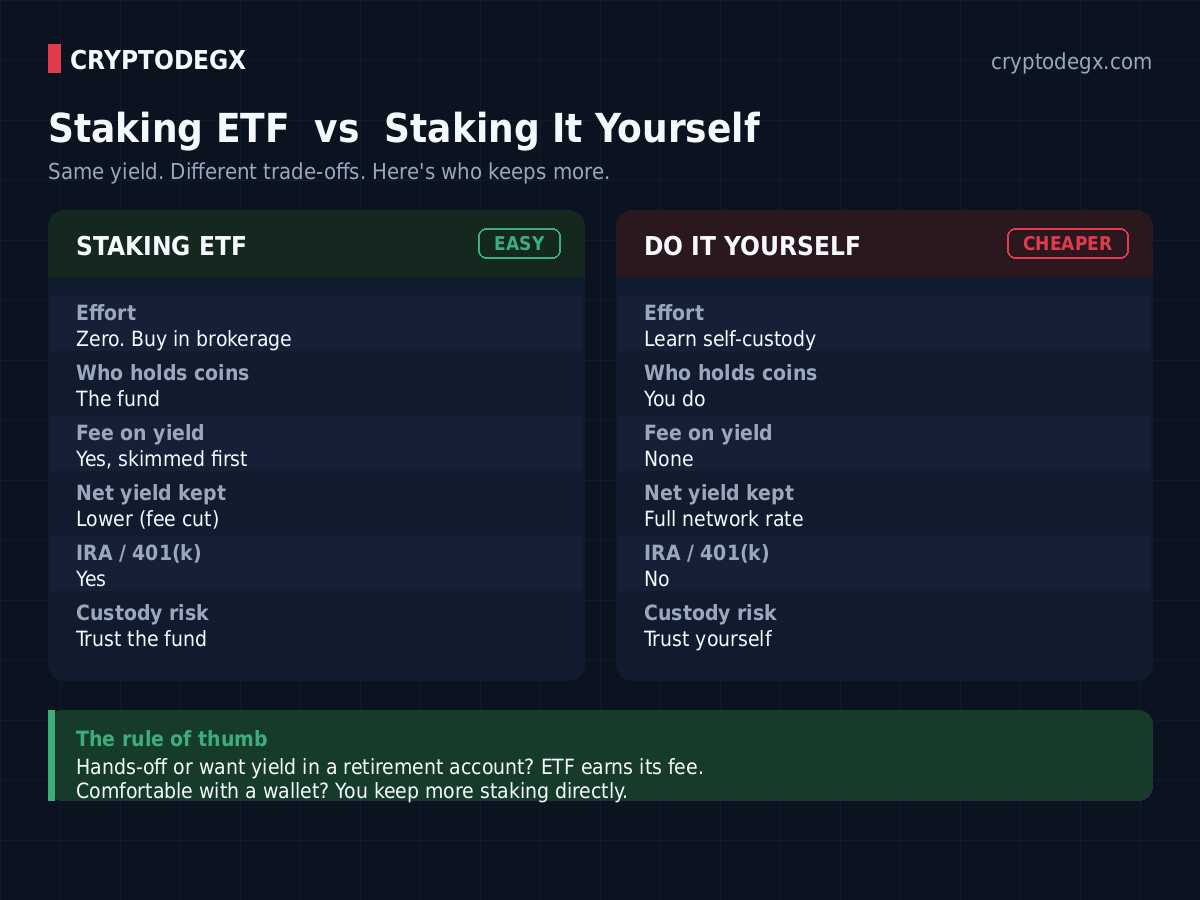
The honest trade, because the ETF is not automatically the better choice. Doing it yourself (delegating from your own wallet) keeps the full network yield with no management fee and no custodian, at the cost of learning self-custody and running it. The ETF hands you professional custody, retirement-account eligibility, and zero effort, minus the fee it skims and minus actually owning your coins.
The clean rule: hands-off holders, or anyone wanting crypto yield inside an IRA or 401(k), the ETF earns its fee. Anyone comfortable with a wallet keeps more by delegating directly, since the fee compounds against you over years. Neither is wrong; they price convenience differently.
What to check before buying one
Four things, quickly. The fee, and whether staking yield offsets it. The actual net yield after that fee, not the headline network rate. How the yield reaches you, reinvested into the fund’s value or paid as distributions, which changes your tax picture. And the underlying asset, because this is first a bet on that coin and only second a yield product. If you wouldn’t buy the plain price ETF, the staking version isn’t a fix.
Where this fits the bigger picture: staking ETFs are one slice of 2026’s shift from price-only crypto products toward yield-bearing ones, alongside tokenized Treasuries and yield-bearing stablecoins. Same question underneath all of them, the one that runs this whole site: who is paying the yield, and why. For staking ETFs the answer is clean, the network pays it for securing itself, which puts them well above most things wearing a yield badge.
FAQ
What is a staking ETF?
An exchange-traded fund that holds a proof-of-stake cryptocurrency, stakes it to earn network rewards, and passes some of that yield to investors, giving you price exposure plus income inside a regular brokerage account with no wallet or self-custody required. It resembles a dividend-paying equity more than a plain price-tracking fund.
Are staking ETF yields real?
Yes, they’re genuine on-chain network rewards, not promotional rates: Solana products target roughly 6-7% and Ethereum ones lower single digits, matching each network’s actual staking rate. The catches are that the management fee comes out of the yield first and the yield accrues in a volatile asset, so it is not a fixed-income substitute.
When did staking ETFs become legal in the US?
The decisive moment was a joint SEC and CFTC interpretive release on March 17, 2026, classifying staking rewards as non-securities across 16 digital commodities including Ethereum. Products launched rapidly around it, with BlackRock’s ETHB listing March 12, 2026 and Solana staking ETFs already live, and staking structures quickly captured a large share of ETF inflows.
Which staking ETFs can I buy?
By 2026 the field includes Ethereum staking products such as BlackRock’s ETHB and Solana staking ETFs from issuers like Grayscale and Bitwise, with more filings in the pipeline across other proof-of-stake assets. Rather than fixate on tickers that change, compare the net yield after fees, how yield is delivered, and the underlying asset.
Is a staking ETF better than staking crypto myself?
It depends on effort versus cost. Self-staking keeps the full yield with no fee but requires self-custody and setup; the ETF gives professional custody, retirement-account access, and zero effort while skimming a fee and holding the coins for you. Hands-off and tax-advantaged-account investors favor the ETF; wallet-comfortable holders keep more staking directly.
Can I hold a staking ETF in my IRA or 401(k)?
That retirement-account eligibility is one of the main advantages over self-staking, which is impractical inside such accounts. Availability depends on your broker and plan, so confirm with them, but the whole appeal of the ETF wrapper is bringing crypto yield into places a wallet can’t go.
What are the risks of staking ETFs?
Primarily the underlying asset’s price volatility, which dwarfs the yield, plus management fees eating into returns, the yield being variable rather than guaranteed, and the usual fund-structure and custody risks. The staking mechanism itself is mature, but a staking ETF is still fundamentally a bet on a volatile crypto asset wearing an income feature.
How is staking ETF yield taxed?
It varies by how the fund delivers it (reinvested into NAV versus paid as distributions) and by your jurisdiction, and the treatment can differ from both plain ETF gains and direct staking rewards. Because this is new territory, confirm the specific product’s tax reporting and consider professional advice rather than assuming it matches a stock dividend.