Polymarket Football Odds Explained: How to Read Them (UK Guide)
 October 31, 2026
8 min read
Disclosure: This article is information and opinion, not financial, betting, or legal advice. Prediction markets and their odds carry real risk of loss. UK access rules are as of late 2026 and can change. See our full disclaimer.
Search “Polymarket England vs Argentina” or “Polymarket Spain vs France” and you’ll land on a page of odds that look nothing like the fractional prices on a British bookmaker. No 5/2, no evens, just a number in cents that moves around. That number is the single most useful thing Polymarket offers a football fan, once you know how to read it.
Here’s how Polymarket’s football odds actually work, what they tell you that your bookie won’t, and the honest truth about using the platform from the UK, which is the part the VPN-pushing guides skip.
Key takeaways
- Polymarket football shares pay $1 if an outcome happens and $0 otherwise, so a 60-cent price represents roughly a 60% implied chance.
- Prices often add up closer to 100% than sportsbook implied probabilities, which include an overround, though Polymarket prices are not guaranteed to be exact probabilities.
- Track price movements, liquidity, and resolution rules: major fixtures tend to have deeper markets, while thin markets can be jumpy; check whether outcomes include extra time or penalties.
- UK users can view Polymarket odds but cannot open new positions from a normal UK connection. Using a VPN to bypass restrictions can breach the platform’s terms and leaves users without UK consumer protection.
- For football betting in the UK, a UK-licensed betting exchange offers a similar peer-to-peer model with GBP funding and regulatory protections.
How Polymarket football odds work
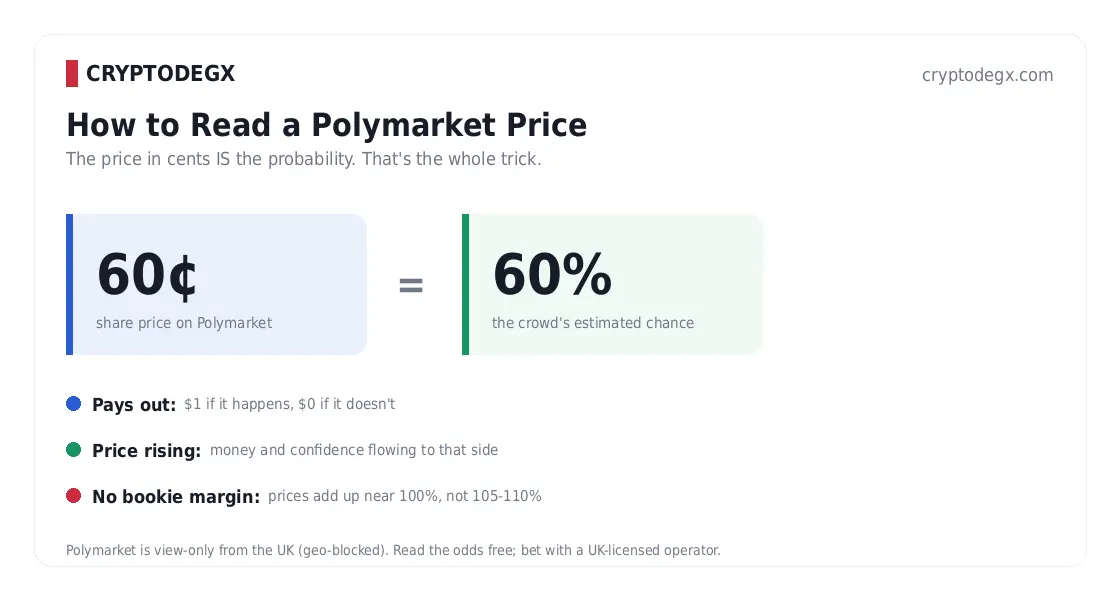
Forget fractional and decimal odds for a second. On Polymarket, every outcome is a share that pays out $1 if it happens and $0 if it doesn’t, and the price of that share is the crowd’s estimate of the probability.
So if England to beat Argentina is trading at 55 cents, the market is saying England has roughly a 55% chance. If it drifts to 65 cents, the crowd got more confident. If it drops to 40 cents, less so. The price is the probability, which is a much more intuitive way to read a match than translating 4/5 into a percentage in your head.
There’s one more quirk that makes it genuinely useful, covered next.
Why the odds are “cleaner” than a bookie’s
Reading a specific match (the practical bit)
Say you’re looking at a fixture like England vs Argentina or Spain vs France. On Polymarket you’ll typically see an outright-winner market with a price for each side. To read it:
- Convert to a percentage: the cent price is the probability. 48 cents = 48% implied chance. Easy.
- Watch the movement, not just the level: a price climbing from 45 to 58 cents over a few days means money (and confidence) is flowing to that side. Odds movement often says more than the snapshot.
- Check liquidity: big international fixtures (a World Cup knockout, England vs Argentina) attract deep liquidity and tighter, more reliable prices. An obscure friendly will have thin, jumpy prices you can trust less.
- Mind the market wording: “to win” usually means in 90 minutes for league games but including extra time and penalties for knockouts. Read exactly how the market resolves before reading anything into the price.
Used this way, Polymarket is a free second opinion on any big match, a crowd-sourced probability you can set against the bookmakers’ prices and the pundits’ hot takes.
The honest bit: can you actually use Polymarket in the UK?
Guides telling you to dodge that with a VPN are pushing you to break Polymarket’s own terms (which can get your funds frozen) and to bet with zero UK consumer protection: no Financial Ombudsman, no Gambling Commission recourse, no way to recover funds if something goes wrong. We’re not going to tell you to do that. View the odds freely; place real bets with a UKGC-licensed operator.
Polymarket vs a UK betting exchange
If the appeal of Polymarket is the exchange model (betting against other people, vig-free-ish prices) rather than Polymarket specifically, the UK already has a regulated version of exactly that.
| Feature | Polymarket | UK betting exchange (e.g. licensed exchanges) |
|---|---|---|
| Model | Peer-to-peer prediction market | Peer-to-peer betting exchange |
| Vig-free-ish odds | Yes ✓ | Low commission, similar idea ✓ |
| UK licence | No (geo-blocked) | Yes, UKGC-regulated ✓ |
| Consumer protection | None for UK users | Full UK protections ✓ |
| Funding | USDC crypto only | GBP bank/card ✓ |
| Football liquidity | Deep on big internationals | Deeper across all football ✓ |
| Non-sport markets | Politics, world events, more | Mostly sports |
The honest takeaway: for actually betting on football from the UK, a licensed exchange gives you the same vig-friendly exchange mechanics with proper regulation, GBP funding, and deeper football liquidity. Polymarket’s edge is its range beyond sport (politics, world events) and its genuinely clean probability reads, which you can use as a free signal without needing to bet there at all.
Beyond football: the Clacton-type markets
One reason “Polymarket” trends in UK searches isn’t football at all, it’s politics. Polymarket runs markets on UK events like by-elections (the Clacton seat being a recent example) and general-election outcomes, and people check the odds as a real-time gauge of who the betting crowd thinks will win, often faster-moving than the polls.
Same rules apply: the odds are a useful, vig-free probability read on a political outcome, and UK users can view them freely, but opening a position from the UK runs into the same access wall as the football markets. For a fuller picture of how these markets price political events, our guide to how prediction markets work breaks down the mechanics, and the legal status piece covers the regulatory side.
FAQ
How do you read Polymarket odds on a football match?
Polymarket prices each outcome as a share costing between 1 and 99 cents, and that price is the implied probability. A team priced at 60 cents means roughly a 60% chance of the outcome. Multiply the cents by one to get the percentage, watch whether the price is rising or falling for momentum, and check the market’s resolution rules (90 minutes versus extra time) before reading into it.
Why are Polymarket odds different from a bookmaker’s?
Because Polymarket is a peer-to-peer exchange with no bookmaker’s margin built in. A UK sportsbook’s odds include an overround (the house edge), so its implied probabilities add up to more than 100%. Polymarket’s prices come from traders betting against each other and tend to total much closer to a true 100%, making them a cleaner, vig-free probability estimate that many bettors check even if they bet elsewhere.
Can I use Polymarket in the UK?
You can view the odds, but you cannot legally open a new bet from the UK. Polymarket has no UK Gambling Commission licence and runs in “close-only” mode for UK users, geo-blocking new trades, partly because of FCA rules on crypto derivatives and binary options. UK residents can see markets and close existing positions but not open fresh ones from a normal UK connection.
Is it legal to use a VPN for Polymarket in the UK?
VPNs themselves are legal in the UK, but using one to access Polymarket breaches the platform’s own terms of service and can lead to account restrictions or frozen funds. More importantly, betting on an unlicensed platform leaves you with zero UK consumer protection, no Financial Ombudsman, and no Gambling Commission recourse. For actual football betting from the UK, a UKGC-licensed operator is the sensible route.
What is the best UK alternative to Polymarket for football?
A UK-licensed betting exchange offers the same peer-to-peer, low-margin model as Polymarket, with the advantages of full UKGC regulation, GBP funding, deeper football liquidity, and real consumer protections. You lose Polymarket’s wide range of political and world-event markets, but for betting on football specifically from the UK, a regulated exchange is the stronger, safer choice.
Why do people check Polymarket for England matches and UK politics?
Because its vig-free prices are a fast, crowd-sourced probability read. For a big England fixture or a UK by-election like Clacton, the Polymarket price shows what people betting real money think the chances are, often moving quicker than polls or pundit predictions. UK users can use that as a free signal even though they can’t open positions on the platform from the UK.