Solana vs Monad: Parallel EVM vs Native High-Throughput L1
 November 24, 2026
7 min read
Disclosure: This is information and opinion, not financial advice. Throughput, TVL, and token supply figures are from 2026 sources and change quickly. See our full disclaimer.
Monad’s pitch is simple: take what makes Solana fast, parallel execution, and bolt it onto the Ethereum Virtual Machine so every Solidity app and every MetaMask user can come along without rewriting anything. Its mainnet went live on November 24, 2025.
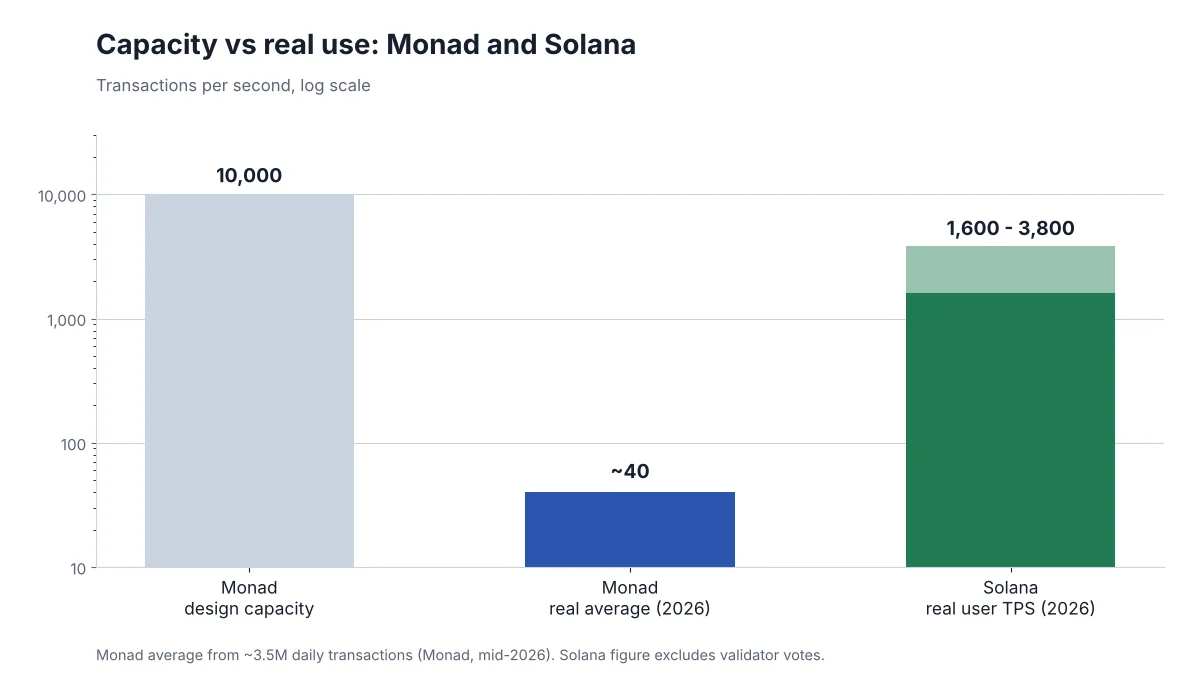
A year in, the comparison looks different from the launch hype. Monad has the better developer story for anyone already in the EVM world. Solana has the users, the volume, and a multi-year head start. And one number in the TPS debate is misleading on both sides, which we’ll get to.
The architecture, side by side
| Monad | Solana | |
|---|---|---|
| Execution model | Optimistic parallel EVM | Sealevel (declared parallelism) |
| Smart contract languages | Solidity, Vyper ✓ for EVM devs | Rust, C, Anchor |
| Consensus | MonadBFT (pipelined HotStuff variant) | Proof of Stake with Proof of History clock |
| State database | MonadDB, custom-built for parallel disk access | Accounts DB |
| Design throughput | 10,000 TPS | Tens of thousands (higher with Firedancer) |
| Real non-vote throughput | Tens of TPS on average | ~1,000-3,800 TPS ✓ |
| Wallets | MetaMask, Rabby, any EVM wallet | Phantom, Backpack, Solflare |
| Token | MON | SOL |
How Monad gets parallel speed out of the EVM
The standard EVM processes transactions one at a time, even when they touch completely unrelated contracts. Monad changes that with three pieces:
- Optimistic parallel execution. It runs transactions simultaneously across CPU cores and assumes they won’t conflict. If two of them touch the same state, it detects the clash and re-runs the dependent one. The final result is identical to sequential execution.
- MonadDB. Ethereum clients store state in general-purpose databases that choke on parallel reads. Monad wrote its own database designed for many simultaneous disk accesses, which is arguably the hardest engineering in the whole stack.
- Asynchronous execution. Validators agree on transaction order first and execute afterwards, so consensus isn’t waiting on computation.
The developer payoff is real. A Uniswap fork, a lending market, or an NFT contract deploys on Monad with no code changes, and users connect with the wallet they already have.
How Solana does it differently
Solana built parallelism in from day one. Every transaction declares upfront which accounts it will read and write, so Sealevel knows in advance which transactions can safely run together. No guessing, no re-runs.
The trade-off is the developer experience. Solana programs are written in Rust, the account model is unfamiliar to Ethereum developers, and porting a Solidity app means a rewrite. Solana has accepted that cost for years, and it built a large native ecosystem anyway: Jupiter, Raydium, Meteora, Phantom, and the memecoin economy all run there.
Running a node
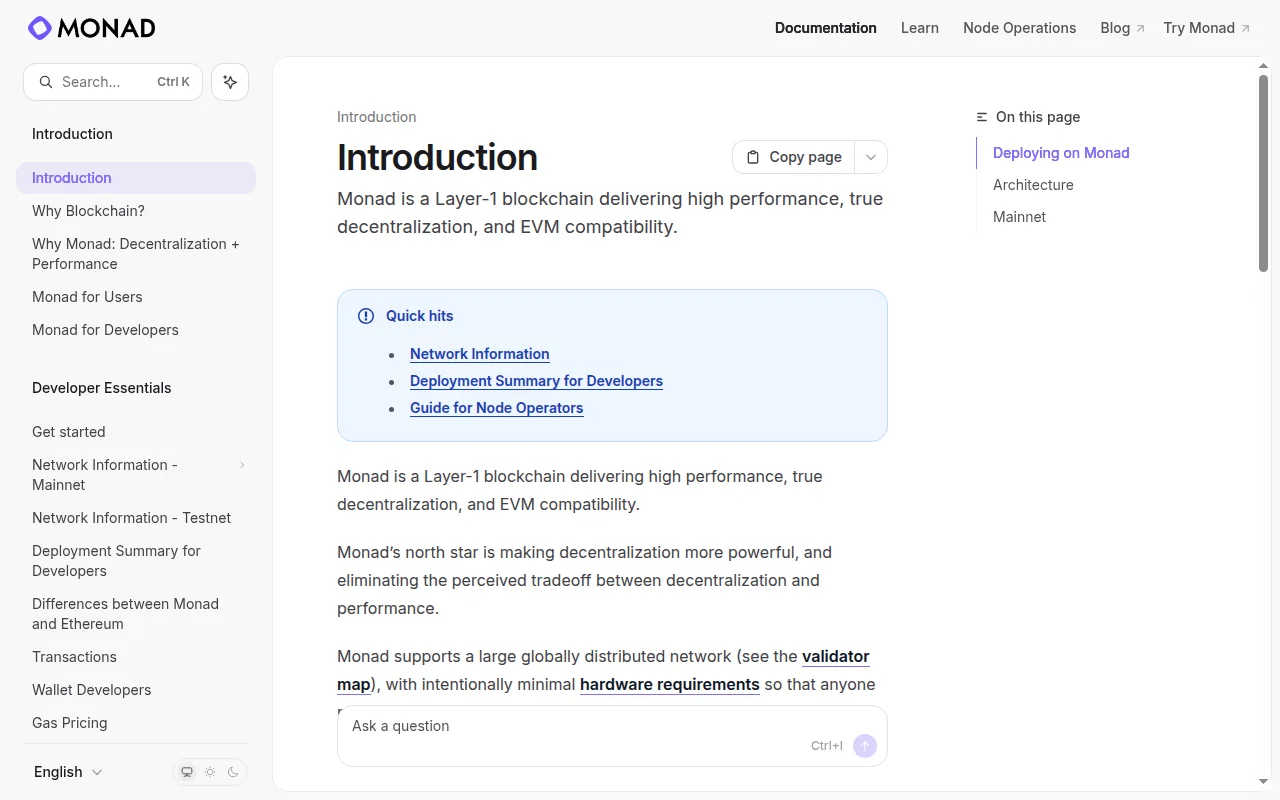
You’ll see claims that Monad needs a data-centre server. Monad’s own documentation lists something more modest: a 16-core CPU at 4.5 GHz or higher, 32 GB of RAM, a 2TB NVMe drive for state plus 500GB for consensus and the OS. That’s a high-end desktop, not a data-centre server, though it does have to run on bare metal rather than a cloud instance.
Solana validators need noticeably more: more cores, far more memory, and serious bandwidth. Lower hardware requirements are one of Monad’s genuine advantages for decentralization.
Where each chain stands a year after Monad’s launch
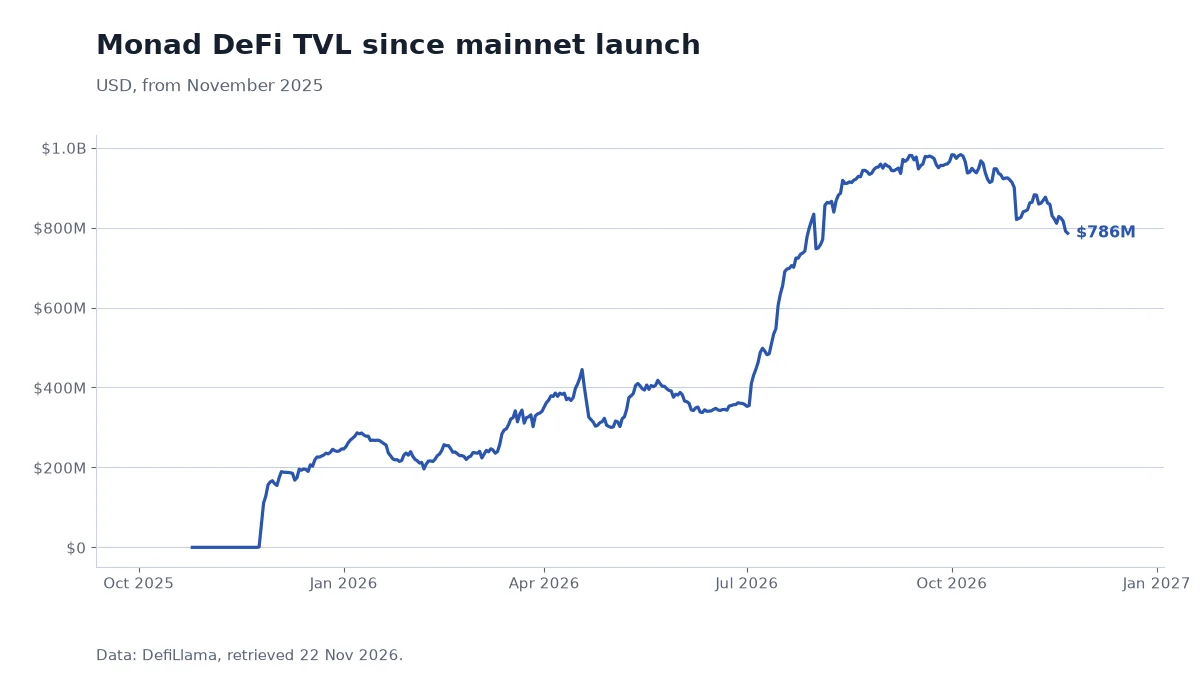
Monad grew faster than most recent L1 launches. It passed $300M in DeFi TVL within about four months, and Monad Foundation’s own July 2026 figures claimed more than $1.4B. Independent trackers have reported lower numbers at various points, so treat the exact figure with care. It has stablecoin card integrations, more than 30 fiat on-ramps, and a meaningful tokenized-asset presence. It’s still a small fraction of total crypto TVL.
Solana remains the retail volume leader across all of crypto. On some days in 2026 its spot DEX volume beat Ethereum plus all its Layer-2s combined, and it processes tens of millions of real transactions daily. Its roadmap (the Firedancer validator client and the Alpenglow consensus upgrade) targets more capacity and faster finality.
Strengths and weaknesses
Monad
- Full EVM bytecode compatibility: Ethereum apps deploy unchanged
- Works with MetaMask, Rabby, and existing EVM tooling
- Lower node hardware requirements than Solana
- Fast early ecosystem growth and payment integrations
- Real activity is a tiny fraction of capacity; huge token unlock pending
Solana
- Deepest retail trading liquidity of any chain
- Thousands of real user transactions per second, proven under load
- Mature native apps and wallets
- Rust-only development; EVM apps must be rewritten
- Heavier validator hardware; history of past outages
Which one should you use?
Ethereum developer looking for speed: Monad. You keep your code, your audits, and your users’ wallets.
Trader who cares about liquidity and fills: Solana. The volume is there, and slippage is lower when the pools are deep.
Investor choosing between SOL and MON: These are very different bets. SOL is an established network with real usage. MON is an early-stage network with a large supply overhang next week. Size accordingly.
Whichever chain you use, follow the basics in our DEX safety guide, and track SOL on our Solana price page. A multi-chain hardware wallet like the Keystone 3 Pro covers both EVM chains and Solana. For the technical specs, see Monad’s official documentation.
FAQ
What is a parallel EVM?
A blockchain that runs Ethereum-compatible smart contracts but executes multiple transactions at the same time across CPU cores, instead of one after another. Monad does this optimistically: it runs transactions in parallel and re-executes any that conflict, so the result matches sequential execution.
Is Monad faster than Solana?
On paper, Monad is designed for 10,000 TPS with fast finality. In practice, Solana handles far more real activity today, roughly 1,000-3,800 user transactions per second versus tens per second on Monad. Monad’s speed advantage over other EVM chains is real; its advantage over Solana is mostly theoretical so far.
Is Monad fully EVM compatible?
Yes, at the bytecode level. Contracts written in Solidity or Vyper deploy without changes, and standard Ethereum tools and wallets work out of the box.
When did Monad launch?
Monad’s mainnet and MON token went live on November 24, 2025, after a public token sale on Coinbase’s platform a week earlier.
What hardware do you need to run a Monad node?
According to Monad’s documentation, a 16-core CPU at 4.5 GHz or higher, 32 GB of RAM, a 2TB NVMe drive for execution state, and 500GB for consensus and the operating system. Nodes must run on bare-metal servers, not cloud instances.
Can I use MetaMask on Monad?
Yes. Because Monad is EVM compatible, MetaMask, Rabby, and other EVM wallets connect by adding the Monad network. Hardware wallets that support EVM chains work too.
What is the MON token unlock?
About 16.6 billion MON is scheduled to unlock on November 24, 2026, one year after mainnet launch. That’s more than the roughly 11.8 billion MON circulating before it, which means a large jump in supply that could put pressure on price.