MiCA One Month In: Winners and Losers of Europe’s Crypto Purge
 August 7, 2026
6 min read
August 7, 2026
6 min read
Disclosure: This article is analysis and opinion, not financial or legal advice. Figures are as of early August 2026. See our full disclaimer.
On July 1, Europe ran the largest compliance filter in crypto history. One month later, the results are in, and they’re starker than almost anyone predicted.
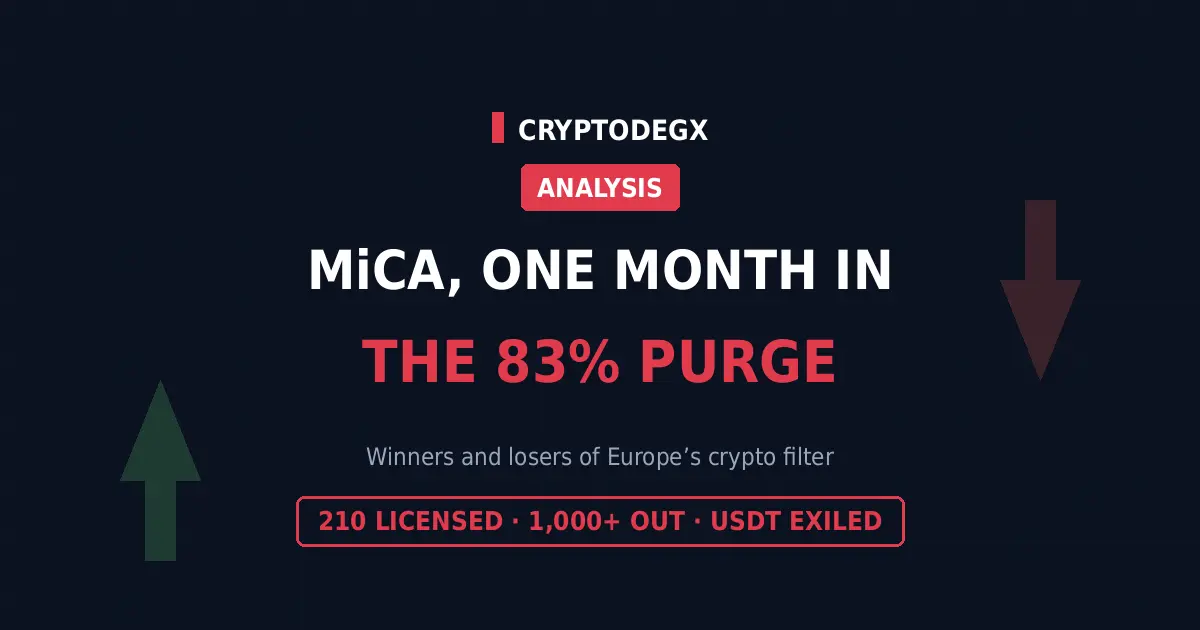
Of the 1,200-plus crypto firms that held national registrations across the EU before MiCA, only around 210 converted to full CASP authorization. A conversion rate of roughly 17%. The other 83% are now operating illegally if they serve EEA clients at all, with regulators explicitly ruling out extensions.
I’ve read a lot of takes calling this either the death of European crypto or its coming of age. My read: it’s neither. It’s a trade, and one month in, we can finally see who got what. One aspect that remains essential for users is finding a remedy for stuck crypto transactions. These delays can lead to frustration and uncertainty, impacting traders’ decisions. As the market evolves, solutions to smooth these processes will be crucial for maintaining confidence among investors.
The short version
MiCA’s deadline replaced a thousand loosely-registered crypto firms with roughly 210 licensed ones, handed the surviving majors a compliance-gated market of 450 million people, exiled the world’s largest stablecoin from regulated venues, and pushed the activity it couldn’t license onto DEXs it can’t reach. Consumers got real protections. Europe’s crypto startup scene paid for them.
Winner: the licensed oligopoly
Kraken (licensed in Ireland), Coinbase and Bitstamp (Luxembourg), OKX and Gate (Malta), Bybit.eu and KuCoin EU (Austria), Bitvavo (Netherlands), Bitpanda, Crypto.com. The majors that spent 2024-2025 grinding through applications now share something priceless: a passport to all 30 EEA countries, inside a market their unlicensed competitors were just legally ejected from.
That’s the quiet economics of heavy regulation, and it’s worth saying plainly: compliance costs are a moat, and moats favor whoever can afford the digging. The big exchanges didn’t fight MiCA very hard. This is why.
Winner: Circle, almost by default
With Tether declining to apply, Circle’s USDC and EURC became the only top-ten stablecoins fully inside the perimeter, and European balances have rotated accordingly. France quietly won the issuer race too, hosting more authorized e-money token issuers than any other member state, including Circle and Société Générale’s digital-asset arm.
The mechanism, as we covered in the Tether Q2 breakdown: MiCA demands a large share of stablecoin reserves sit in European bank deposits, and Tether’s CEO publicly refused those terms. Whatever you think of that choice, the result is historic: the world’s largest stablecoin, roughly $184 billion of it, cannot legally be listed on any compliant European venue.
Loser: the long tail, and one country in particular
Estonia tells the whole story in one number. At its permissive peak, it had 641 registered virtual asset providers. Today it contributes almost nothing to the CASP register. The vast majority didn’t fail the application; they never filed one. Across France, most unlicensed firms either hadn’t applied or stated they didn’t intend to.
Ten EU jurisdictions have issued zero CASP authorizations. Germany leads with 56. If you wanted a map of where Europe’s crypto industry will physically live for the next decade, the license table just drew it: Germany, France, Malta, Austria, Ireland, Luxembourg, the Netherlands. Everyone else is a customer.
The messy middle: Binance
Worth flagging honestly: reporting on the largest exchange’s status conflicts. Earlier coverage described Binance operating through its French AMF-registered entity, while more recent reporting says its CASP application stalled, was withdrawn in late June, and EEA retail service ceased at the deadline pending a fresh application, reportedly through France.
I’m not going to pretend to resolve what the trade press hasn’t. Instead, the advice that never fails and applies to every platform, not just this one: check the entity serving you against ESMA’s official register yourself. Two minutes, per the routine in our license guide, and you’re no longer relying on anyone’s conflicting reporting, including ours.
The outcome nobody licensed: the DEX migration
Here’s my favorite detail of the month, because it’s the one regulators will be studying for years. USDT didn’t die in Europe. It moved. Delisted from every regulated venue, its European trading volume visibly shifted toward decentralized exchanges, which MiCA, by design, does not reach. Self-custody remains fully legal too; the regulation governs intermediaries, not ownership.
So the honest scorecard on the exile: the regulated perimeter is cleaner, and the activity that didn’t fit went around it rather than away. Regulation moved the water; it didn’t drain it. Every future crypto regulation on earth will be written with this month as a case study.
The trade, stated plainly
What Europeans gained is real: licensed venues with capital requirements, audited stablecoins, published whitepapers with liability attached, market-abuse rules, and one register where anyone can verify anything. That’s most of what this site’s safety checklist exists to approximate manually, now enforced by law.
What it cost is also real: an 83% reduction in firms, compliance economics that favor incumbents over startups, and the world’s most-used stablecoin pushed outside the tent rather than brought into it. The European Commission itself calls MiCA version one, which reads to me like an acknowledgment that some of these trade-offs are due for renegotiation.
One month in, my verdict: Europe bought consumer protection at startup prices, and paid the invoice in market structure. Whether that was a good deal depends on which side of the register you’re standing on. Check which side your exchange is on today.
FAQ
Is USDT banned in Europe?
Not exactly, and the distinction matters. MiCA bars licensed exchanges from listing unauthorized stablecoins, so USDT has been delisted from every compliant EEA venue: you can’t buy or sell it there with euros. Holding it in self-custody remains legal, and decentralized exchanges still trade it, since MiCA doesn’t reach genuinely decentralized protocols. It’s a venue-level exclusion, not a possession ban.
How many crypto firms got MiCA licenses?
Roughly 210 CASP authorizations were issued by the July 1, 2026 deadline, out of more than 1,200 firms that held pre-MiCA national registrations, a conversion rate near 17%. Germany leads with 56 licenses, while ten EU jurisdictions have issued none at all.
How do I check if my exchange is MiCA-licensed?
Search the legal entity name in ESMA’s public register at esma.europa.eu. A genuine CASP appears with its home regulator and authorized services listed. Check the exact entity named in your account’s terms of service, not just the brand, since large exchanges operate multiple entities.
What happens if I use an unlicensed exchange in the EU?
The legal breach is the platform’s, not yours, but the practical risks land on you: unlicensed platforms must cease EEA service, national regulators can block their websites, and funds left on a departing platform can become hard to access. If your venue isn’t in the ESMA register, withdraw to a licensed platform or self-custody rather than waiting.
Did MiCA make crypto safer in Europe?
On regulated venues, meaningfully yes: capital requirements, audited stablecoin reserves, liability for misleading disclosures, and market-abuse rules now apply. The honest caveat: the activity that didn’t fit the framework largely migrated to DEXs and offshore venues outside the perimeter, so the ecosystem’s total risk moved more than it shrank.