Disclosure: This article is information and opinion, not financial or legal advice. See our full disclaimer.

Every scam exchange claims to be licensed. So did some of the real ones that collapsed anyway. The difference between a marketing claim and an actual license is that a real one sits in a government database you can search yourself — for free, in about two minutes, before you deposit a cent.

This guide shows you exactly how: the three-step routine that works in any country, the official register for each major jurisdiction, and the traps that catch people who only check the exchange’s own website.

The short version

To check if a crypto exchange is licensed: find the exchange’s exact legal entity name (footer or terms of service), find the regulator and license number it claims, then search that regulator’s official public register directly — never through links the exchange provides. The entity name on the register must match the one in the exchange’s terms.

Why bother — and what a license actually gets you

A license isn’t a badge; it’s a set of obligations with a supervisor attached. Depending on the jurisdiction, a licensed exchange typically must keep customer funds segregated from company money, meet capital requirements, run AML/KYC programs, maintain a formal complaints process, and answer to a regulator that can fine it or shut it down. An unlicensed platform owes you none of that. If it freezes your withdrawal, your recourse is a support ticket into the void.

Let’s be honest about the limits, though: a license is not a guarantee. FTX held licenses and registrations in multiple jurisdictions and still vaporized $8 billion of customer money. Regulation lowers your risk and gives you legal standing when things go wrong — it does not make an exchange fail-proof. Treat “licensed” as the minimum bar, not the finish line, and keep applying the other red-flag checks on top.

The 3-step routine (works everywhere)

Step 1: Find the legal entity name

Not the brand — the company. Scroll to the exchange’s footer or open its Terms of Service and find the registered entity, something like “Payward, Inc.” (Kraken) or “Coinbase Europe Limited.” Big exchanges operate through different legal entities per region, and the license belongs to the entity, not the brand. The entity serving you is the one that needs to be licensed for your country.

Step 2: Find the claimed regulator and license number

Licensed platforms display their credentials — regulator name and a reference number — usually in the footer, a “Legal” or “Licenses” page, or the ToS. A platform claiming to be “fully regulated” without naming any regulator or number has told you everything you need to know.

Step 3: Verify in the regulator’s own register

Type the regulator’s website address yourself or reach it from a search — don’t click a “verify our license” link on the exchange, because fake platforms link to fake register pages. Search the register for the entity name from Step 1. Confirm three things: the entity exists, the license covers crypto services (not some unrelated activity), and the status is active — not lapsed, suspended, or revoked.

Where to check, country by country

European Union / EEA — ESMA’s MiCA register

Since MiCA, the EU has one license type for crypto platforms: the CASP (Crypto-Asset Service Provider) authorization, granted by a national regulator and valid across the whole EU/EEA. The European Securities and Markets Authority (ESMA) aggregates every national authorization into one searchable register at esma.europa.eu. Note that your exchange might be authorized in Ireland or Luxembourg while serving you in Spain — that’s normal under passporting.

One thing that changed very recently: the transition period that let pre-MiCA platforms keep operating while their applications were pending closed on July 1, 2026. An exchange serving EU customers today without CASP authorization isn’t “waiting for its license” anymore — it’s operating outside the law, and your funds should not be on it.

United States — FinCEN plus your state

The US has no single crypto exchange license. At the federal level, exchanges must register with FinCEN as a Money Services Business — searchable at fincen.gov/msb-registrant-search. Important nuance: MSB registration is a filing, not an endorsement — anyone can register, and scam platforms wave it around as if it were a license. The real licensing happens at state level (money transmitter licenses), with New York’s BitLicense from the NYDFS being the strictest. A serious US exchange lists its state licenses on a dedicated page; spot-check your own state’s financial regulator.

United Kingdom — the FCA register

Crypto firms serving UK customers must be registered with the Financial Conduct Authority. Search the entity at register.fca.org.uk. The FCA also publishes a warning list of firms known to operate without permission — worth checking both directions.

Singapore — MAS

The Monetary Authority of Singapore licenses Digital Payment Token providers under the Payment Services Act. Check the MAS Financial Institutions Directory on mas.gov.sg. MAS is famously selective — a full DPT license there is a genuinely strong signal.

Australia — AUSTRAC

Exchanges must be registered as Digital Currency Exchange providers with AUSTRAC (austrac.gov.au). Like FinCEN’s MSB list, this is an AML registration rather than a full prudential license — necessary, but check the other flags too.

Canada — FINTRAC and the CSA

Two layers: MSB registration with FINTRAC (searchable at fintrac-canafe.gc.ca) and, for platforms trading crypto assets, registration with provincial securities regulators coordinated by the CSA. The CSA also publishes lists of platforms banned or warned — check those.

UAE — VARA and others

Dubai’s Virtual Assets Regulatory Authority (vara.ae) publishes its list of licensed Virtual Asset Service Providers; Abu Dhabi’s ADGM/FSRA runs a separate regime. The UAE has become a major licensing hub, so you’ll see these names often.

Everywhere else

The pattern holds globally: identify your national financial regulator, find its public register or its list of authorized virtual-asset providers, and search the entity name. If your country’s regulator has no crypto register at all, weigh that honestly — you’d be relying entirely on the exchange’s foreign licenses and goodwill.

Four traps that catch careful people

The meaningless “license.” “Registered in Saint Vincent and the Grenadines” or a generic offshore incorporation certificate is not a financial license — it’s paperwork. If the claimed authority doesn’t supervise crypto activity, the claim is decoration.

The wrong entity. The register shows “XYZ Europe Ltd” is licensed — but your account agreement is with “XYZ Global Ltd” in an offshore jurisdiction. This structure is common and often legal, but it means the licensed entity isn’t the one holding your money. Read which entity your ToS names.

The cloned website. Scammers clone real licensed exchanges down to the license numbers, on a lookalike domain. Verify you’re on the exact official domain (check the spelling character by character) before the license check even matters.

The revoked license. Registers show status. “Lapsed,” “suspended,” or “in wind-down” means the license existed and no longer protects you. This is why you check the register, not a screenshot on the exchange’s About page.

FAQ

Is FinCEN MSB registration the same as being licensed?

No. MSB registration is a mandatory federal filing that anyone can make — it involves no vetting of the business. Scam platforms cite it constantly because it sounds official. In the US, meaningful licensing lives at the state level (money transmitter licenses, NYDFS BitLicense).

What if my exchange isn’t licensed anywhere?

Then you have zero regulatory protection: no fund segregation requirements, no complaints process, no supervisor to escalate to. Some people accept that risk deliberately for specific reasons; if that’s not a decision you’re consciously making, move your funds to a licensed platform or self-custody.

Does a license protect my money if the exchange goes bankrupt?

Partially, at best. Licensing usually requires segregating customer assets, which improves your position in a bankruptcy — but crypto deposits are generally not covered by government deposit insurance the way bank accounts are, and recoveries take years. FTX’s customers waited over two years for their first payouts. A license improves your odds; it doesn’t make you whole by magic.

Which country’s license is the strongest signal?

Our opinion: a full MiCA CASP authorization, a MAS DPT license, or an NYDFS BitLicense sit at the strict end — all three involve real capital, custody, and governance requirements. AML-only registrations (FinCEN MSB, AUSTRAC, FINTRAC) sit at the weak end: necessary, but they vet paperwork, not solvency.


Regulations change fast — this guide reflects the rules as of its last update date. Spotted something outdated? Tell us and we’ll fix it, per our editorial policy.

Disclosure: This article is analysis and opinion, not financial advice. Figures are as of July 19, 2026. See our full disclaimer.

On June 5, 2026, the Philadelphia Semiconductor Index fell 10.3% — roughly $1.3 trillion erased in its worst session since March 2020. Bitcoin, an asset with no earnings, no chips, and theoretically no connection to any of it, slid to around $62,715 the same day.

That wasn’t a coincidence, and it wasn’t a one-off. Our thesis, and the data behind it: in 2026, Bitcoin trades as a satellite of the AI trade — and understanding how that linkage works matters more than complaining that “digital gold” isn’t behaving like gold.

The short version

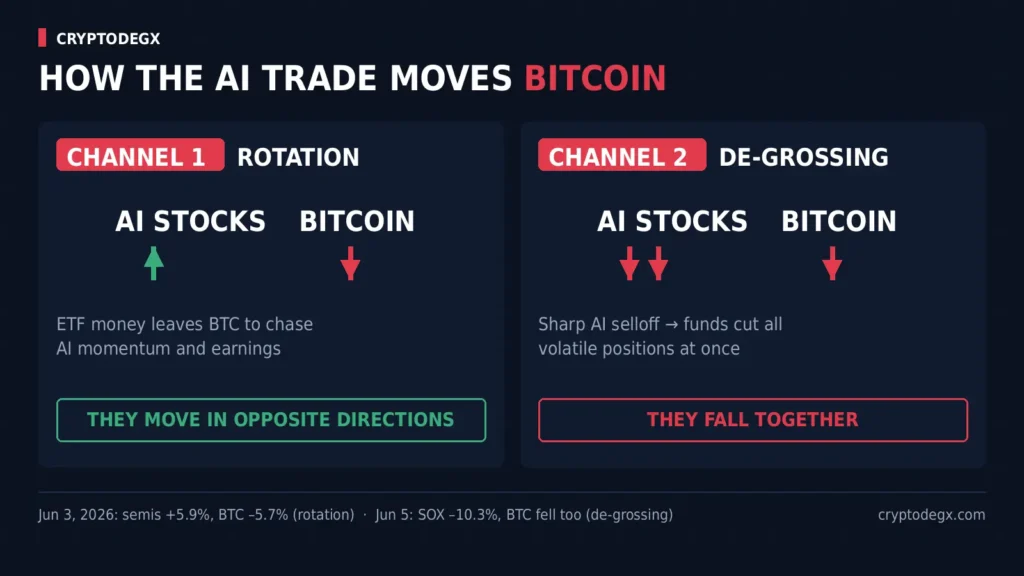
Bitcoin and AI/semiconductor stocks are linked through two channels: capital rotation (money leaving Bitcoin ETFs to chase AI momentum, which moves them in opposite directions) and risk de-grossing (when the AI trade cracks hard, funds cut everything volatile at once, which moves them together). Both channels hurt BTC in the first half of 2026 — but the July bounce shows the rotation can run in reverse.
Five episodes that map the linkage

January 1 — the tone-setter. On Asia’s first trading day of 2026, semiconductor and AI stocks surged (a Chinese GPU startup’s Hong Kong debut jumped as much as 119%) while Bitcoin flatlined in an otherwise risk-on tape. Money had a preferred destination, and it wasn’t crypto.

June 3 — the split screen. The semiconductor index advanced roughly 5.9% on the back of NVIDIA’s blowout quarter (~$81.6B revenue, guiding toward ~$91B) while Bitcoin fell about 5.7% the same day. That’s the rotation channel in its purest form: same liquidity pool, opposite directions.

June 5 — the stress test. When the SOX collapsed 10.3% and the Nasdaq dropped 4.18%, Bitcoin didn’t benefit as a haven — it fell alongside, to ~$62,715, amid 13 consecutive US spot ETF outflow sessions totaling ~$4.4 billion. That’s the de-grossing channel: in acute stress, funds don’t rotate, they cut.

July 1–3 — the reversal. The memory-chip trade — the year’s hottest, with Sandisk up ~530% and Micron ~230% — cracked. The Roundhill Memory ETF fell 25% from its June 22 peak, semis dropped, and Bitcoin, after dipping below $58,000 on July 1, rebounded above $61,000 as capital rotated back out of cooling AI infrastructure names. The linkage, running in Bitcoin’s favor for once.

July 17 — the reminder. A Chinese AI model topping coding benchmarks knocked semiconductor stocks, and crypto fell with them — de-grossing again, triggered by a model release. When benchmark results move Bitcoin, the correlation is not subtle anymore.

Why this happened: follow the $725 billion

The gravitational force is straightforward: the five largest US hyperscalers are on track to spend roughly $725 billion on AI infrastructure in 2026, with an estimated ~$450 billion flowing directly into chips, servers, and data centers. That’s verifiable revenue arriving at identifiable companies every quarter — the kind of story institutional capital sizes up easily.

Bitcoin can’t offer a revenue beat. Its bull case runs on liquidity, flows, and narrative — and in H1 2026 the flows told one story: the week of May 26 alone saw $1.47 billion leave digital asset products, with Bitcoin funds accounting for $1.3 billion of it, the year’s largest weekly outflow per CoinShares. The marginal buyer who powered the 2024–25 ETF era didn’t disappear; they went to chase earnings momentum in semis. When an asset’s main bid is “number go up,” it loses that bid to whatever number is going up faster.

There’s a psychological layer too: the “digital gold” narrative now competes for attention with AI’s promise of immediate productivity transformation — and in attention-driven markets, the more vivid story wins the capital. Bitcoin didn’t get worse in 2026. Its story got out-marketed.

The honest counterargument

Before treating this as a permanent law: correlation between Bitcoin and tech equities is regime-dependent, and regimes end. BTC traded tightly with the Nasdaq through 2021–22, then partially decoupled. Even now, the “digital gold” behavior isn’t dead — it shows up most in stress specific to the fiat system (banking wobbles, policy shocks), which simply isn’t the kind of stress 2026 has produced. The current linkage says less about Bitcoin’s nature than about where this particular cycle’s marginal dollar lives. Anyone extrapolating today’s correlation ten years forward is doing narrative, not analysis — and that includes us if we’re not careful.

It’s also worth separating signal strength: measured day-to-day correlation can look modest because Bitcoin’s volatility profile differs from equity indices. The economically meaningful link is in the flows — ETF creations and redemptions against semiconductor momentum — more than in any correlation coefficient screenshot.

What to actually do with this

Check your hidden overlap. The portfolio holding NVDA, a semiconductor ETF, and Bitcoin “for diversification” is, in the current regime, one concentrated bet on risk appetite expressed three ways. That’s a choice you’re allowed to make — but make it knowingly.

Watch semis as a leading indicator. In this regime, the SOX and SMH tell you about Bitcoin’s next session more reliably than most crypto-native signals. Sharp AI-stock stress → expect crypto weakness first (de-grossing), possible recovery after (rotation back). The July 1–3 sequence is the template.

Use ETF flows as confirmation. Sustained spot-ETF inflows returning alongside cooling AI momentum would be the cleanest signal that leadership is rotating back — that combination, not a price level, is what a durable Bitcoin recovery looks like from here. We covered the levels themselves in our bear market breakdown.

And a durability note: regime shifts are exactly when leveraged platforms and weak exchanges get stress-tested. Volatile rotations produce liquidation cascades; liquidation cascades find the platforms that were swimming naked. The red-flag checklist applies double in months like these.

FAQ

Why does Bitcoin follow semiconductor stocks now?

Two mechanisms: capital rotation — Bitcoin ETF money chasing AI-stock momentum, moving them inversely — and risk de-grossing, where sharp AI-sector stress makes funds cut all volatile positions at once, moving them together. Both were visible repeatedly in the first half of 2026.

Is Bitcoin still “digital gold”?

Situationally. The safe-haven behavior appears mainly during stress specific to the fiat system, like banking or policy shocks. When stress originates in equity valuations — as in 2026’s AI wobbles — Bitcoin has traded like high-beta risk, not like gold. Both behaviors are real; which one you get depends on the type of stress.

What would decouple Bitcoin from AI stocks?

The most plausible paths: sustained spot-ETF inflows returning (restoring a crypto-native bid), a fiat-system stress event that reactivates the haven narrative, or the AI trade cooling enough that rotation runs durably in Bitcoin’s favor — an early version of which appeared in the first days of July 2026.


Sources are linked throughout; flow data via CoinShares weekly reports and exchange/ETF public data. Think we got something wrong? Challenge it — corrections policy here.

One Response

Leave a Reply

Your email address will not be published. Required fields are marked *