Hyperliquid Explained: How the On-Chain Perp Exchange Actually Works
 October 5, 2026
7 min read
October 5, 2026
7 min read
Disclosure: This article is information and opinion, not financial or investment advice. Perpetual futures are high-risk instruments; most retail traders lose money on them. Figures are 2026 and change. See our full disclaimer.
Hyperliquid is the crypto project that did something most people thought was impossible: it built a fully on-chain exchange that feels like a centralized one. No slow confirmations, no clunky approvals for every click, no thin order books. It settles more perpetuals volume than any other decentralized exchange, and on busy days it out-trades some mid-size centralized ones. If you keep seeing the name and the HYPE token everywhere, here’s what it actually is, in plain terms, risks included.
The one thing that makes it different
Most “decentralized exchanges” are smart contracts bolted onto someone else’s blockchain (Uniswap on Ethereum, for example), and they swap tokens through liquidity pools. Hyperliquid threw that model out. It built its own blockchain (an L1) whose entire job is running a real order book, the kind matching buyers and sellers that centralized exchanges use, except every order, fill, and liquidation lives on-chain and is publicly visible.
That’s the whole trick. You get the speed and feel of Binance with the self-custody and transparency of DeFi: you trade from your own wallet, nobody holds your funds, and the entire order book is auditable by anyone. For perpetual futures traders frustrated by slow, thin, expensive on-chain options, that combination is why Hyperliquid took over.
Perpetuals, quickly, since that’s what it’s for
Hyperliquid is primarily a perpetual futures exchange, so it’s worth knowing what that means before going further. Perps are leveraged bets on price with no expiry date, letting you go long or short with up to 50x leverage, with a “funding rate” paid between longs and shorts every hour to keep the perp price tethered to the real spot price. They’re powerful and genuinely dangerous: leverage cuts both ways, and the large majority of retail perp traders lose money. This article explains the venue, not a recommendation to trade perps, which deserve their own hard look first.
HLP: the part where you can be the house
Here’s Hyperliquid’s most interesting and most misunderstood feature. Every exchange needs someone on the other side of trades, providing liquidity and absorbing the positions of people who get liquidated. On Hyperliquid, that role is partly run by HLP (the Hyperliquidity Provider), a public vault anyone can deposit USDC into.
Deposit, and you become a fractional owner of the protocol’s market-making and liquidation engine, earning a pro-rata share of its profit and loss with no fee or profit share taken (deposits lock for 4 days). In plain terms: you’re being the house instead of the gambler. But read the risk honestly, because the brochures don’t: HLP is effectively short volatility and the counterparty to winning traders, so when traders collectively win big or a market breaks, HLP can take real losses. It’s a yield strategy with a genuine way to lose money, not a savings account.
HYPE and the buyback flywheel
HYPE is the native token (1 billion max supply), and its design is the most interesting tokenomics in the current crowd, which is why the HYPE price page exists. It pays gas on Hyperliquid’s EVM layer, earns fee discounts when staked (up to 40%), and secures the network. But the headline mechanic is the buyback.
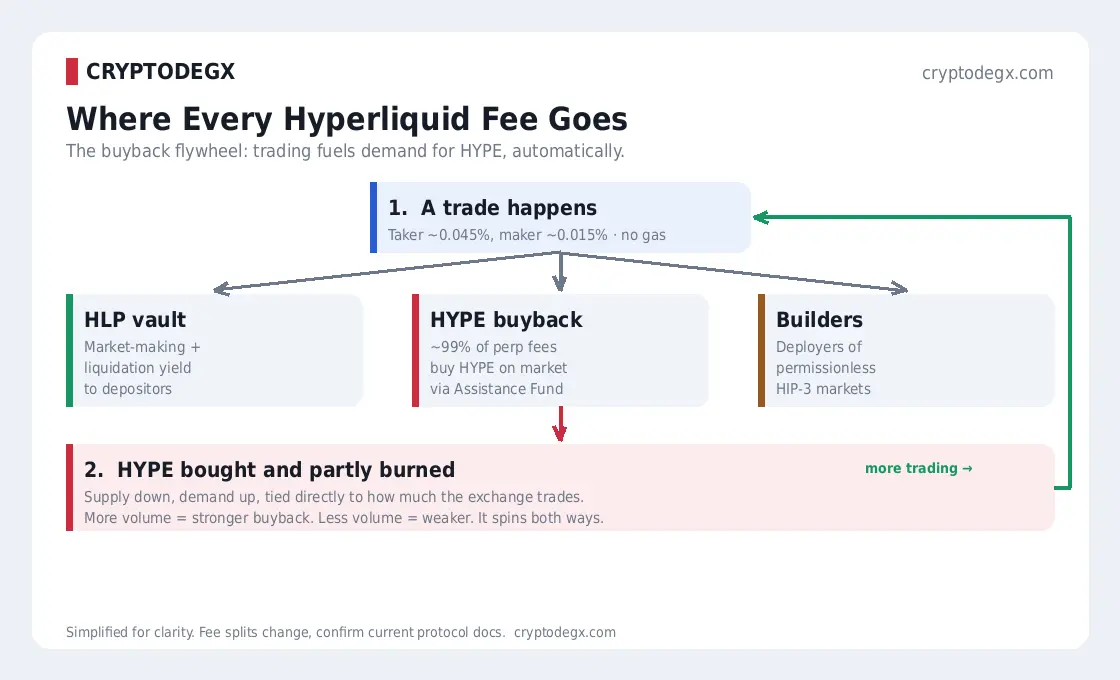
Nearly all protocol trading fees route automatically to an Assistance Fund that uses them to buy HYPE on the open market, with a large share effectively removed from supply. Every trade on the platform feeds a buy pressure on the token, encoded at the protocol level rather than promised in a blog post. When volume is high, that’s real, mechanical demand, which is rare in a space full of tokens that capture no value. The honest counterweight: the buyback’s strength is only as strong as the trading volume funding it, and volume is cyclical. The flywheel spins both ways.
What it costs and how it makes money
Trading fees are low: base 0.045% taker and 0.015% maker, falling with volume and HYPE staking, with no gas fees on trades. The exchange’s revenue is those fees, and where they go is the unusual part already covered: split between the HLP vault, the HYPE buyback fund, and the deployers of permissionless markets. It’s a business model that routes most of its income back to the token and its liquidity providers rather than to a company, which is the structural case the exchange business-model analysis gets into.
The risks the reviews soft-pedal
An honest explainer names these. Perps themselves are the biggest risk by far; most people trading leverage lose, and the venue being excellent doesn’t change the odds of the instrument. HLP can lose money, as covered, since it’s the counterparty to traders. The JELLY incident in early 2026 is required reading: a low-liquidity token’s price was manipulated into a position that threatened HLP, and the team intervened to delist it, which worked but raised real questions about how decentralized the venue is when something breaks. Centralization generally: a relatively small validator set and an active core team mean Hyperliquid sits closer to the efficient-but-centralized end than its DeFi branding suggests, the same honest tension on the HYPE page. And token unlocks: large allocations vesting over time are supply pressure to watch against the buyback.
Who it’s for, and who it isn’t
Hyperliquid is built for active perpetuals traders who want centralized-exchange performance without surrendering custody, and for USDC holders willing to understand HLP’s real risk in exchange for its yield. It is not built for beginners looking to buy and hold, who have no business near 50x leverage, and it’s not the place to learn what perps are. If the words in this article were mostly new, the right next step is understanding perpetuals and position sizing, not opening a trade. The exchange is genuinely impressive engineering; impressive engineering has still liquidated plenty of people who skipped the basics.
FAQ
What is Hyperliquid?
A decentralized exchange built on its own purpose-made blockchain, running a fully on-chain order book for perpetual futures and spot trading. It delivers the speed and feel of a centralized exchange while letting you trade from your own wallet with full self-custody, and it settles more perpetuals volume than any other DEX.
How does Hyperliquid work?
Instead of using liquidity pools like most DEXs, Hyperliquid runs a real order book on a custom Layer 1 blockchain where every order, fill, and liquidation is recorded on-chain and publicly visible. You connect a wallet, deposit USDC, and trade perps or spot directly, with matching handled by the chain itself rather than a company’s servers.
What is the HYPE token?
Hyperliquid’s native token, capped at 1 billion supply, used to pay gas on its EVM layer, earn fee discounts of up to 40% when staked, and secure the network. Its defining feature is an automated buyback: most protocol fees fund on-market HYPE purchases, creating mechanical demand tied directly to trading volume.
What is HLP on Hyperliquid?
The Hyperliquidity Provider, a public vault anyone can deposit USDC into to become a fractional owner of the protocol’s market-making and liquidation engine, earning a pro-rata share of its profit and loss with no fees and a 4-day deposit lock. It lets you effectively be the house, but it carries real risk, since it’s short volatility and the counterparty to winning traders.
Is HLP a safe way to earn yield?
It’s a strategy with genuine downside, not a savings account. HLP profits from providing liquidity and absorbing liquidations, but it can lose money when traders collectively win or a market breaks, as the JELLY incident demonstrated. Treat any advertised HLP yield as compensation for taking the other side of leveraged traders, and size accordingly.
How much are Hyperliquid’s fees?
Base trading fees are about 0.045% for takers and 0.015% for makers, with no gas fees on trades, and both fall with 14-day volume and HYPE staking discounts. Spot fees are somewhat higher, and permissionless builder-run markets can add their own fee on top, so separate core markets from builder markets when assessing cost.
What was the JELLY incident?
In early 2026 a thinly traded token (JELLY) had its price manipulated into a position that threatened the HLP vault, and Hyperliquid’s team intervened to delist it and contain the damage. The response protected depositors but sparked debate about how decentralized the platform really is, since a core team stepping in is not something a fully trustless system should need.
Is Hyperliquid safe to use?
Its self-custody model and on-chain transparency are genuine strengths, and it has run without a protocol-draining exploit, but “safe” depends on what you do there: trading perpetuals with leverage is high-risk regardless of venue, HLP can lose money, and the platform is more centralized than its branding implies. The engineering is strong; the instruments and the leverage are where people get hurt.