Hyperliquid HLP Vault Guide (2026): How Market-Making Yields ~20% APR
 November 22, 2026
6 min read
Disclosure: This is information and opinion, not financial advice. HLP yields, profit figures, and drawdown risk change constantly. Depositing in HLP means taking on real market risk, including loss of capital. See our full disclaimer.
On a normal exchange, the people earning from your trades are the market makers and the house. Hyperliquid flips that: its HLP vault lets ordinary users take the market-maker side and collect the fees, spreads, and liquidation flow that usually go to firms. That’s the appeal, and it’s real.
But “be the house” cuts both ways. The house wins most of the time and loses badly some of the time. HLP has done exactly that. Before you park a single dollar of USDC in it, you need to understand both halves of that trade.
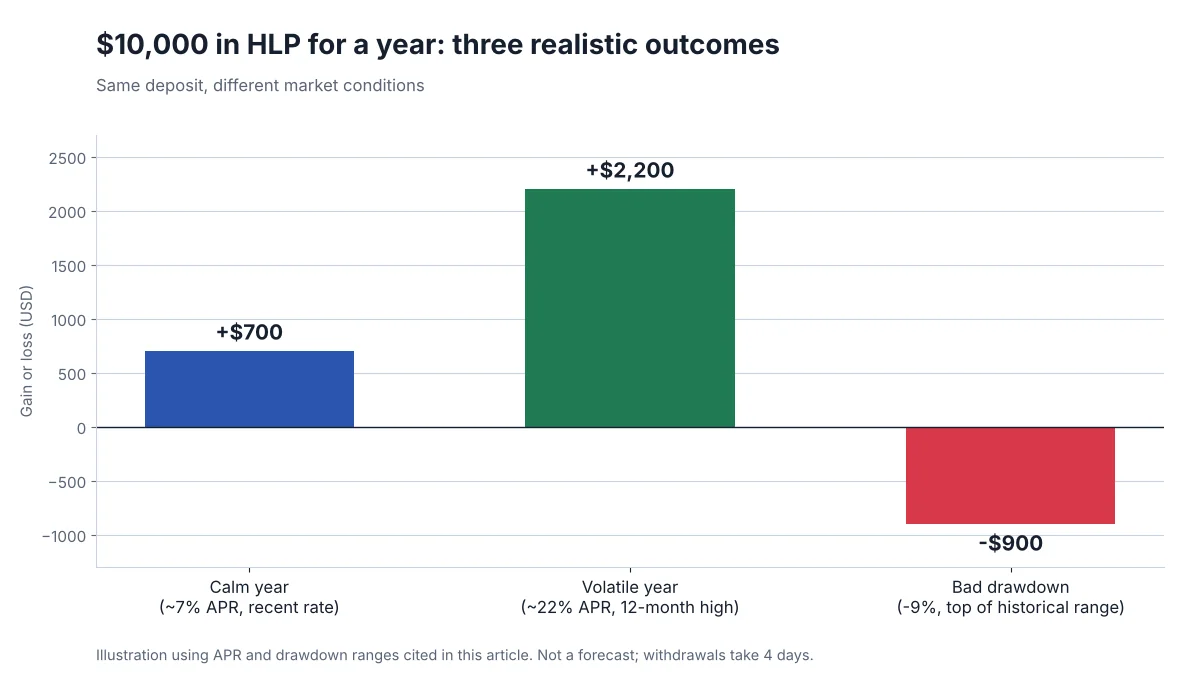
What you earn: USDC yield from spreads, a share of trading fees, liquidations, and funding. Historically ~15-30% APR in strong quarters, but recent months have been closer to ~7%. It swings with volatility.
Fees: HLP itself charges no performance fee (unlike community vaults, which take a 10% cut for their leader).
The lock: Withdrawals take 4 days.
Where the yield actually comes from
HLP’s return isn’t a token emission or a marketing subsidy. It’s earned from real trading activity, through four channels:
- Bid-ask spreads: HLP quotes buy and sell orders on the book and captures the spread when trades fill against it.
- Trading-fee share: a portion of the exchange’s perp fees flows into the vault.
- Liquidations: HLP is the backstop that absorbs liquidated positions, often at a profit when markets are orderly.
- Funding payments: it collects funding from leveraged traders on the other side of its positions.
The catch is hidden in point three. Being the backstop is where the yield comes from, and it’s also where the losses come from. Same mechanism, both directions.
How to deposit into HLP
You need a Web3 wallet with USDC. The flow:
- Open the Hyperliquid app and connect an EVM wallet (Rabby or MetaMask both work).
- Bridge USDC into your Hyperliquid balance.
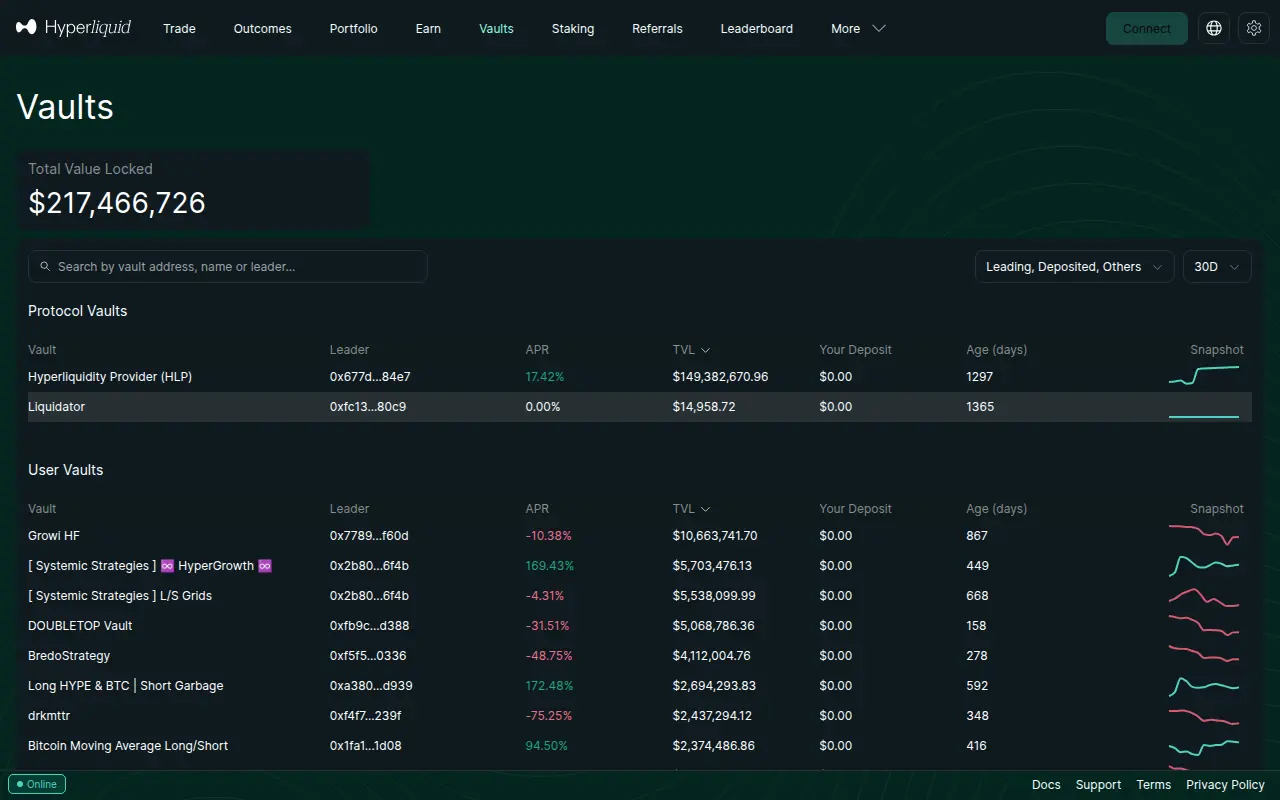
- Go to the Vaults tab and select HLP (Hyperliquidity Provider).
- Enter your USDC amount and confirm the deposit.
- Your deposit starts earning immediately, compounding into the vault’s share value. Remember it’s now subject to the 4-day withdrawal lock.
The risks, stated plainly
Most HLP write-ups bury this. It’s the most important part.
HLP is not a stablecoin savings account
Because HLP is the counterparty and backstop, it can lose money, and it has. In the March 2025 JELLY incident, a trader manipulated a thin memecoin to force a liquidation onto HLP, leaving it with a short worth about $15 million and a mark-to-market loss near $12 million. At the worst point, the vault was at risk of losing a large share of its balance. Hyperliquid only avoided that by delisting the token and force-settling positions, a move that drew heavy criticism and triggered over $80 million in HLP withdrawals afterward. A separate whale event cost the vault around $4 million.
The team has since tightened risk controls, and a $700M liquidation in February 2026 cleared without significant vault losses. But the structural risk is permanent:
- Counterparty exposure: in a strong one-way market where most traders are on the winning side, HLP sits on the losing side and its equity drops. Independent risk analyses put HLP’s historical max drawdown around 5-9%.
- The 4-day lock works against you: you can’t exit fast. If confidence cracks during a crisis, you’re stuck in the queue while others rush the exits.
- Smart-contract and governance risk: the JELLY resolution showed the team can and will intervene in ways that help the vault but raise questions about how decentralized the backstop really is.
HLP vs other USDC yield options
| Option | Typical yield | Where it comes from | Exit |
|---|---|---|---|
| Hyperliquid HLP | ~7% recently; 15-30% in strong quarters | Market making, fees, liquidations | 4-day lock |
| Jupiter JLP | Variable, has run high | Perp fees plus price exposure to SOL/BTC/ETH | Tradeable, near-instant ✓ |
| Aave v3 USDC | Low-to-mid single digits | Lending interest | Instant withdrawal ✓ |
One honest distinction the yield numbers hide: JLP is not a stablecoin product. Its holders carry price exposure to the assets in the pool, so a “higher APR” there can be wiped out by the underlying coins falling. HLP and Aave keep you in USDC terms; JLP does not.
Pros and cons
In its favour
- Real, USDC-denominated yield from genuine trading activity
- Gives retail the market-maker side normally reserved for firms
- No performance fee on HLP itself; yield auto-compounds
- Risk controls improved after 2025’s incidents
Against it
- Can lose money; it is not cash and has taken real hits
- Yield has compressed to single digits in recent, calmer months
- 4-day lock prevents a fast exit in a crisis
- Returns are unpredictable and depend on the volatility regime
Who it’s for, and who should skip it
Honest verdict
HLP suits someone who understands they’re taking a market-making position, not making a deposit, and who can leave the capital locked and ride out a drawdown. If you need the money accessible, or you’re treating it as a safe stablecoin yield, it’s the wrong tool. Size it as risk capital, not savings, and check the live APR before you assume anything, because the headline numbers people quote are usually from the vault’s best periods.
If you’re weighing this up, read our honest take on the platform in is Hyperliquid safe, and if you’re new to on-chain leverage and DEX mechanics, start with how to use a DEX safely. For live vault figures, check HLP’s page on DefiLlama.
FAQ
What is the HLP vault on Hyperliquid?
HLP (Hyperliquidity Provider) is Hyperliquid’s protocol-owned vault. It market-makes on the order book and acts as the backstop that absorbs liquidated positions, sharing the resulting profits, and losses, with USDC depositors.
What is the real APR on HLP?
It varies with market volatility. Historically HLP has returned roughly 15-30% APR in strong quarters, with a 12-month figure around 22%, but recent calmer months have been closer to 7%. There’s no fixed rate, and past returns don’t predict future ones. Always check the live figure on DefiLlama.
Can HLP lose money?
Yes, and it has. As the counterparty and backstop, HLP takes losses when markets move hard against its positions. In the March 2025 JELLY incident it faced a mark-to-market loss near $12 million and risked losing much of its balance before the team intervened. Treat it as risk capital, not a savings account.
What currency do I earn in?
USDC. Deposits and yield are denominated in USDC stablecoins, so your returns are measured in dollar terms rather than a volatile token, though the dollar value of the vault can still fall during drawdowns.
How long does it take to withdraw from HLP?
There’s a 4-day unbonding period. When you request a withdrawal, your funds sit in a queue for about four days before they’re released, a design meant to stop people draining liquidity during volatile swings. It also means you can’t exit quickly in a crisis.
Does HLP charge fees?
HLP itself charges no performance or management fee, so the yield you see accrues to depositors. Note that Hyperliquid’s separate community (user) vaults do take a 10% profit share for the vault leader, so don’t confuse the two.
How much could I earn on a $10,000 deposit?
At a recent rate near 7%, roughly $700 a year; in a strong-volatility quarter annualizing 20%+, more. But it’s not guaranteed and a bad stretch can produce a loss instead. Treat any projection as a wide range, not a promise.